

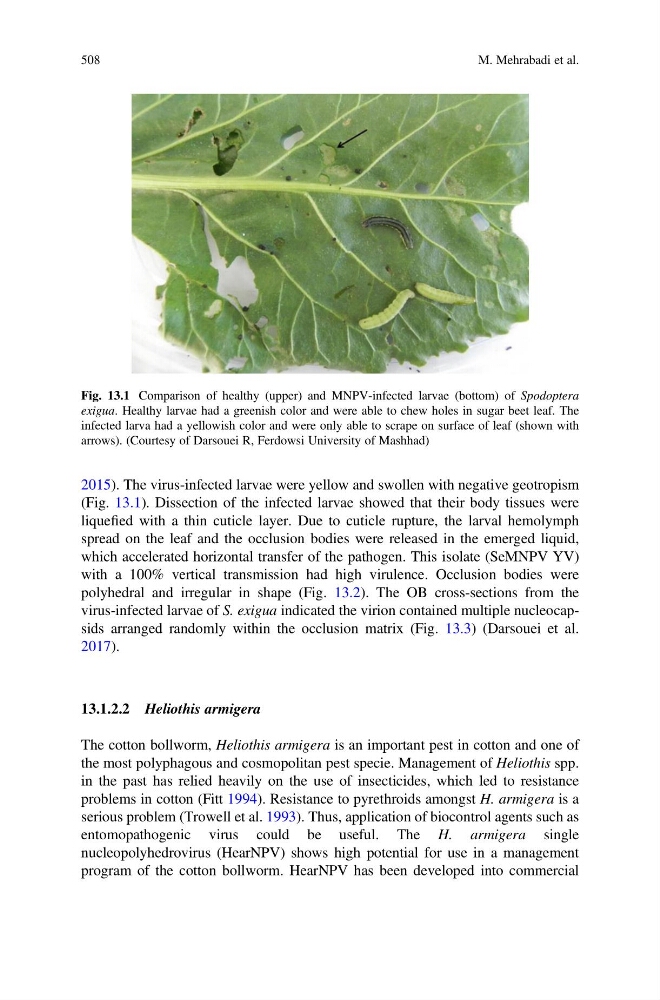
2015). The virus-infected larvae were yellow and swollen with negative geotropism
(Fig. 13.1). Dissection of the infected larvae showed that their body tissues were
liquefied with a thin cuticle layer. Due to cuticle rupture, the larval hemolymph
spread on the leaf and the occlusion bodies were released in the emerged liquid,
which accelerated horizontal transfer of the pathogen. This isolate (SeMNPV YV)
with a 100% vertical transmission had high virulence. Occlusion bodies were
polyhedral and irregular in shape (Fig. 13.2). The OB cross-sections from the
virus-infected larvae of S. exigua indicated the virion contained multiple nucleocapsids arranged randomly within the occlusion matrix (Fig. 13.3) (Darsouei et al.
2017).
13.1.2.2 Heliothis armigera
The cotton bollworm, Heliothis armigera is an important pest in cotton and one of
the most polyphagous and cosmopolitan pest specie. Management of Heliothis spp.
in the past has relied heavily on the use of insecticides, which led to resistance
problems in cotton (Fitt 1994). Resistance to pyrethroids amongst H. armigera is a
serious problem (Trowell et al. 1993). Thus, application of biocontrol agents such as
entomopathogenic virus could be useful. The H. armigera single
nucleopolyhedrovirus (HearNPV) shows high potential for use in a management
program of the cotton bollworm. HearNPV has been developed into commercial
Fig. 13.1 Comparison of healthy (upper) and MNPV-infected larvae (bottom) of Spodoptera
exigua. Healthy larvae had a greenish color and were able to chew holes in sugar beet leaf. The
infected larva had a yellowish color and were only able to scrape on surface of leaf (shown with
arrows). (Courtesy of Darsouei R, Ferdowsi University of Mashhad)
508
M. Mehrabadi et al.
(Fig. 13.1). Dissection of the infected larvae showed that their body tissues were
liquefied with a thin cuticle layer. Due to cuticle rupture, the larval hemolymph
spread on the leaf and the occlusion bodies were released in the emerged liquid,
which accelerated horizontal transfer of the pathogen. This isolate (SeMNPV YV)
with a 100% vertical transmission had high virulence. Occlusion bodies were
polyhedral and irregular in shape (Fig. 13.2). The OB cross-sections from the
virus-infected larvae of S. exigua indicated the virion contained multiple nucleocapsids arranged randomly within the occlusion matrix (Fig. 13.3) (Darsouei et al.
2017).
13.1.2.2 Heliothis armigera
The cotton bollworm, Heliothis armigera is an important pest in cotton and one of
the most polyphagous and cosmopolitan pest specie. Management of Heliothis spp.
in the past has relied heavily on the use of insecticides, which led to resistance
problems in cotton (Fitt 1994). Resistance to pyrethroids amongst H. armigera is a
serious problem (Trowell et al. 1993). Thus, application of biocontrol agents such as
entomopathogenic virus could be useful. The H. armigera single
nucleopolyhedrovirus (HearNPV) shows high potential for use in a management
program of the cotton bollworm. HearNPV has been developed into commercial
Fig. 13.1 Comparison of healthy (upper) and MNPV-infected larvae (bottom) of Spodoptera
exigua. Healthy larvae had a greenish color and were able to chew holes in sugar beet leaf. The
infected larva had a yellowish color and were only able to scrape on surface of leaf (shown with
arrows). (Courtesy of Darsouei R, Ferdowsi University of Mashhad)
508
M. Mehrabadi et al.