

undamaged) did not have any influence on the interaction between the beetle and the
fungus. The fungus was transmitted properly through the beetle colony. The authors
declared the efficiency of the sporulating-cadavers can be a remarkable reservoir in
grain stores.
The major concern about these research is an issue about target niche of stored
product pests. EPF can kill the pests in these niches, but there are limitations to their
use in storage facilities. In all cases, the insects were treated directly, not within the
infested grains. So there is a gap among this aspect for usage of EPF in storage
facilities and more work needs to be done elaborating practical applications.
11.9 Household Pests
High level of insecticide resistance in hygienic pests and public demand for reducing
broad pesticide usage has developed an interest in biocontrol strategies of these
pests.
Initially, Sharififard et al. (2011) found an interaction between M. anisopliae and
sublethal doses of Spinosad and indicated a synergistic effect on mortality of house
fly, Musca domestica (Diptera: Muscidae) as well as reduction in the speed of
mortality. Afterward, effect of temperature (15, 20, 25, 30, 35
C) and humidity
(45 and 75%) on the pathogenicity of B. bassiana (isolate Iran 187C) and
M. anisopliae (isolate Iran 437C) in controlling the house fly under laboratory
condition was examined by Sharififard et al. (2012). The result indicated Bb 187C
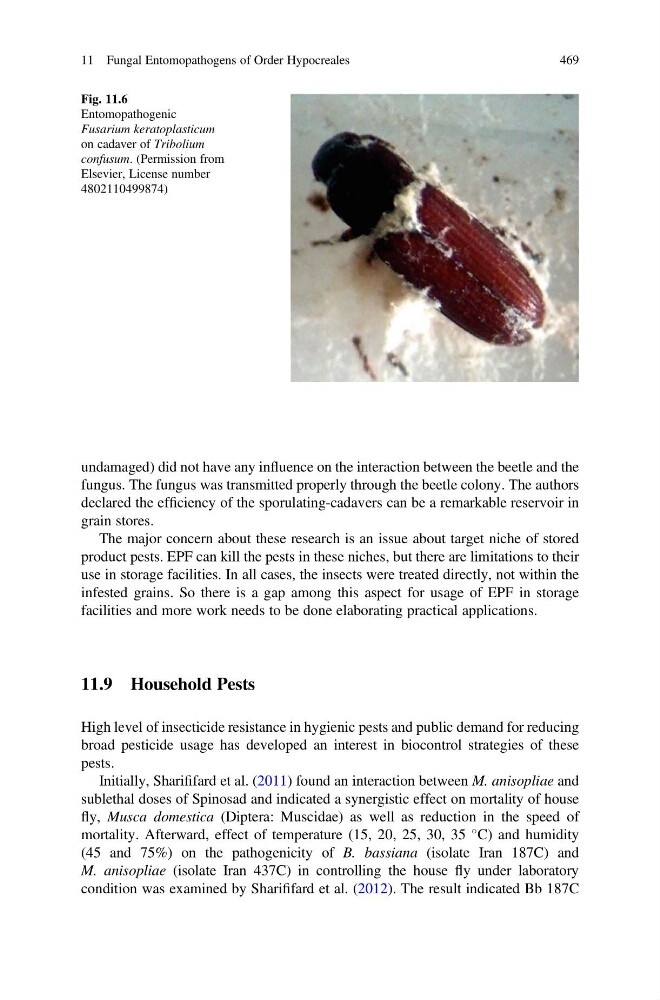
Fig. 11.6
Entomopathogenic
Fusarium keratoplasticum
on cadaver of Tribolium
confusum. (Permission from
Elsevier, License number
4802110499874)
11 Fungal Entomopathogens of Order Hypocreales
469
fungus. The fungus was transmitted properly through the beetle colony. The authors
declared the efficiency of the sporulating-cadavers can be a remarkable reservoir in
grain stores.
The major concern about these research is an issue about target niche of stored
product pests. EPF can kill the pests in these niches, but there are limitations to their
use in storage facilities. In all cases, the insects were treated directly, not within the
infested grains. So there is a gap among this aspect for usage of EPF in storage
facilities and more work needs to be done elaborating practical applications.
11.9 Household Pests
High level of insecticide resistance in hygienic pests and public demand for reducing
broad pesticide usage has developed an interest in biocontrol strategies of these
pests.
Initially, Sharififard et al. (2011) found an interaction between M. anisopliae and
sublethal doses of Spinosad and indicated a synergistic effect on mortality of house
fly, Musca domestica (Diptera: Muscidae) as well as reduction in the speed of
mortality. Afterward, effect of temperature (15, 20, 25, 30, 35
C) and humidity
(45 and 75%) on the pathogenicity of B. bassiana (isolate Iran 187C) and
M. anisopliae (isolate Iran 437C) in controlling the house fly under laboratory
condition was examined by Sharififard et al. (2012). The result indicated Bb 187C
Fig. 11.6
Entomopathogenic
Fusarium keratoplasticum
on cadaver of Tribolium
confusum. (Permission from
Elsevier, License number
4802110499874)
11 Fungal Entomopathogens of Order Hypocreales
469