

Jokar et al. (2013) reported only a moderate association between pathogenicity and
spore count for T. castaneum treated with different isolates of M. anisopliae.
In 2017, Chehri reported incidence of Fusarium keratoplasticum and Fusarium
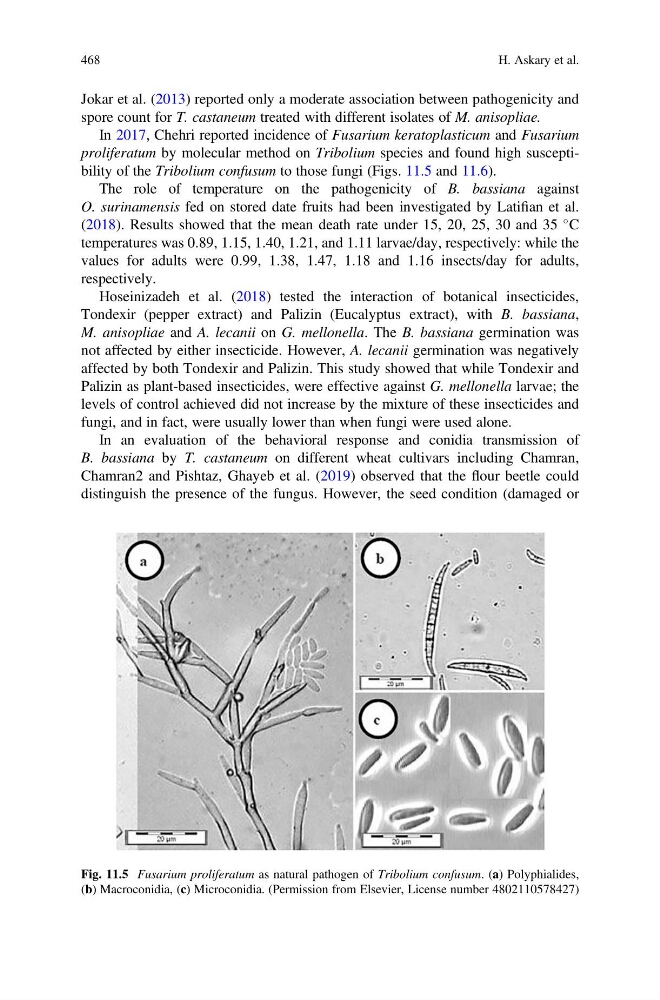
proliferatum by molecular method on Tribolium species and found high susceptibility of the Tribolium confusum to those fungi (Figs. 11.5 and 11.6).
The role of temperature on the pathogenicity of B. bassiana against
O. surinamensis fed on stored date fruits had been investigated by Latifian et al.
(2018). Results showed that the mean death rate under 15, 20, 25, 30 and 35
C
temperatures was 0.89, 1.15, 1.40, 1.21, and 1.11 larvae/day, respectively: while the
values for adults were 0.99, 1.38, 1.47, 1.18 and 1.16 insects/day for adults,
respectively.
Hoseinizadeh et al. (2018) tested the interaction of botanical insecticides,
Tondexir (pepper extract) and Palizin (Eucalyptus extract), with B. bassiana,
M. anisopliae and A. lecanii on G. mellonella. The B. bassiana germination was
not affected by either insecticide. However, A. lecanii germination was negatively
affected by both Tondexir and Palizin. This study showed that while Tondexir and
Palizin as plant-based insecticides, were effective against G. mellonella larvae; the
levels of control achieved did not increase by the mixture of these insecticides and
fungi, and in fact, were usually lower than when fungi were used alone.
In an evaluation of the behavioral response and conidia transmission of
B. bassiana by T. castaneum on different wheat cultivars including Chamran,
Chamran2 and Pishtaz, Ghayeb et al. (2019) observed that the flour beetle could
distinguish the presence of the fungus. However, the seed condition (damaged or
Fig. 11.5 Fusarium proliferatum as natural pathogen of Tribolium confusum. (a) Polyphialides,
(b) Macroconidia, (c) Microconidia. (Permission from Elsevier, License number 4802110578427)
468
H. Askary et al.
spore count for T. castaneum treated with different isolates of M. anisopliae.
In 2017, Chehri reported incidence of Fusarium keratoplasticum and Fusarium
proliferatum by molecular method on Tribolium species and found high susceptibility of the Tribolium confusum to those fungi (Figs. 11.5 and 11.6).
The role of temperature on the pathogenicity of B. bassiana against
O. surinamensis fed on stored date fruits had been investigated by Latifian et al.
(2018). Results showed that the mean death rate under 15, 20, 25, 30 and 35
C
temperatures was 0.89, 1.15, 1.40, 1.21, and 1.11 larvae/day, respectively: while the
values for adults were 0.99, 1.38, 1.47, 1.18 and 1.16 insects/day for adults,
respectively.
Hoseinizadeh et al. (2018) tested the interaction of botanical insecticides,
Tondexir (pepper extract) and Palizin (Eucalyptus extract), with B. bassiana,
M. anisopliae and A. lecanii on G. mellonella. The B. bassiana germination was
not affected by either insecticide. However, A. lecanii germination was negatively
affected by both Tondexir and Palizin. This study showed that while Tondexir and
Palizin as plant-based insecticides, were effective against G. mellonella larvae; the
levels of control achieved did not increase by the mixture of these insecticides and
fungi, and in fact, were usually lower than when fungi were used alone.
In an evaluation of the behavioral response and conidia transmission of
B. bassiana by T. castaneum on different wheat cultivars including Chamran,
Chamran2 and Pishtaz, Ghayeb et al. (2019) observed that the flour beetle could
distinguish the presence of the fungus. However, the seed condition (damaged or
Fig. 11.5 Fusarium proliferatum as natural pathogen of Tribolium confusum. (a) Polyphialides,
(b) Macroconidia, (c) Microconidia. (Permission from Elsevier, License number 4802110578427)
468
H. Askary et al.