

LT50 recorded 4.68 days on the rice bran extract for second instar nymph and the top
LT50 (13.13 days) was recorded on rice grain versus fourth instar nymphs. Susceptibility of overwintered adults to conidia and blastospores of M. anisopliae was
greater than the aestivated Sunn pest adult.
Bioassays clearly indicate that E. integriceps is susceptible to infection by
M. anisopliae s.l. and the nymphal stages more susceptible than the adults (Sedighi
et al. 2014). Variable susceptibility of different nymphal stages could be attributed to
cuticle structure and molting, but this relationship needs elucidation. Ghamari Zare
et al. (2014) showed significant differences between diapause and summer adult
susceptibility to fungi. Diapausing populations were more susceptible than summer
populations, presumably because of reduced food storage and reduced fat body.
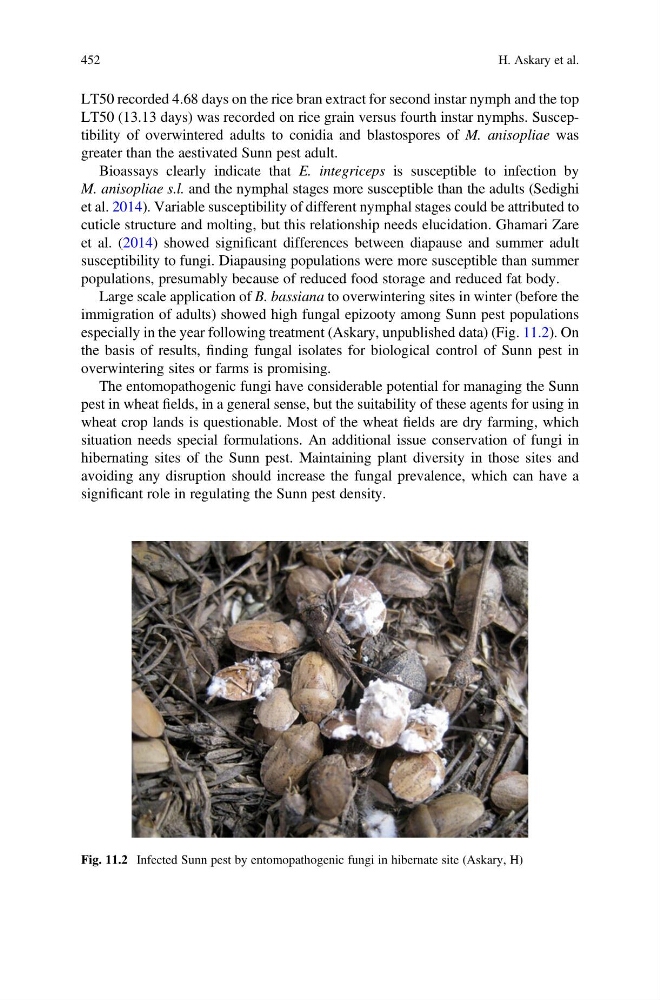
Large scale application of B. bassiana to overwintering sites in winter (before the
immigration of adults) showed high fungal epizooty among Sunn pest populations
especially in the year following treatment (Askary, unpublished data) (Fig. 11.2). On
the basis of results, finding fungal isolates for biological control of Sunn pest in
overwintering sites or farms is promising.
The entomopathogenic fungi have considerable potential for managing the Sunn
pest in wheat fields, in a general sense, but the suitability of these agents for using in
wheat crop lands is questionable. Most of the wheat fields are dry farming, which
situation needs special formulations. An additional issue conservation of fungi in
hibernating sites of the Sunn pest. Maintaining plant diversity in those sites and
avoiding any disruption should increase the fungal prevalence, which can have a
significant role in regulating the Sunn pest density.
Fig. 11.2 Infected Sunn pest by entomopathogenic fungi in hibernate site (Askary, H)
452
H. Askary et al.
LT50 (13.13 days) was recorded on rice grain versus fourth instar nymphs. Susceptibility of overwintered adults to conidia and blastospores of M. anisopliae was
greater than the aestivated Sunn pest adult.
Bioassays clearly indicate that E. integriceps is susceptible to infection by
M. anisopliae s.l. and the nymphal stages more susceptible than the adults (Sedighi
et al. 2014). Variable susceptibility of different nymphal stages could be attributed to
cuticle structure and molting, but this relationship needs elucidation. Ghamari Zare
et al. (2014) showed significant differences between diapause and summer adult
susceptibility to fungi. Diapausing populations were more susceptible than summer
populations, presumably because of reduced food storage and reduced fat body.
Large scale application of B. bassiana to overwintering sites in winter (before the
immigration of adults) showed high fungal epizooty among Sunn pest populations
especially in the year following treatment (Askary, unpublished data) (Fig. 11.2). On
the basis of results, finding fungal isolates for biological control of Sunn pest in
overwintering sites or farms is promising.
The entomopathogenic fungi have considerable potential for managing the Sunn
pest in wheat fields, in a general sense, but the suitability of these agents for using in
wheat crop lands is questionable. Most of the wheat fields are dry farming, which
situation needs special formulations. An additional issue conservation of fungi in
hibernating sites of the Sunn pest. Maintaining plant diversity in those sites and
avoiding any disruption should increase the fungal prevalence, which can have a
significant role in regulating the Sunn pest density.
Fig. 11.2 Infected Sunn pest by entomopathogenic fungi in hibernate site (Askary, H)
452
H. Askary et al.