

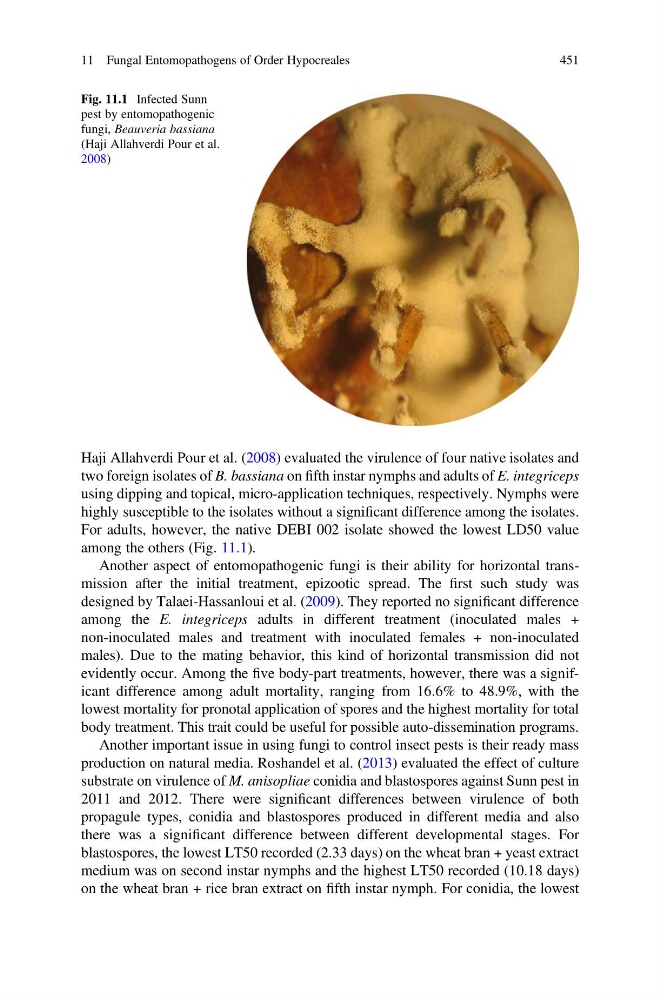
Haji Allahverdi Pour et al. (2008) evaluated the virulence of four native isolates and
two foreign isolates of B. bassiana on fifth instar nymphs and adults of E. integriceps
using dipping and topical, micro-application techniques, respectively. Nymphs were
highly susceptible to the isolates without a significant difference among the isolates.
For adults, however, the native DEBI 002 isolate showed the lowest LD50 value
among the others (Fig. 11.1).
Another aspect of entomopathogenic fungi is their ability for horizontal transmission after the initial treatment, epizootic spread. The first such study was
designed by Talaei-Hassanloui et al. (2009). They reported no significant difference
among the E. integriceps adults in different treatment (inoculated males +
non-inoculated males and treatment with inoculated females + non-inoculated
males). Due to the mating behavior, this kind of horizontal transmission did not
evidently occur. Among the five body-part treatments, however, there was a significant difference among adult mortality, ranging from 16.6% to 48.9%, with the
lowest mortality for pronotal application of spores and the highest mortality for total
body treatment. This trait could be useful for possible auto-dissemination programs.
Another important issue in using fungi to control insect pests is their ready mass
production on natural media. Roshandel et al. (2013) evaluated the effect of culture
substrate on virulence of M. anisopliae conidia and blastospores against Sunn pest in
2011 and 2012. There were significant differences between virulence of both
propagule types, conidia and blastospores produced in different media and also
there was a significant difference between different developmental stages. For
blastospores, the lowest LT50 recorded (2.33 days) on the wheat bran + yeast extract
medium was on second instar nymphs and the highest LT50 recorded (10.18 days)
on the wheat bran + rice bran extract on fifth instar nymph. For conidia, the lowest
Fig. 11.1 Infected Sunn
pest by entomopathogenic
fungi, Beauveria bassiana
(Haji Allahverdi Pour et al.
2008)
11 Fungal Entomopathogens of Order Hypocreales
451
two foreign isolates of B. bassiana on fifth instar nymphs and adults of E. integriceps
using dipping and topical, micro-application techniques, respectively. Nymphs were
highly susceptible to the isolates without a significant difference among the isolates.
For adults, however, the native DEBI 002 isolate showed the lowest LD50 value
among the others (Fig. 11.1).
Another aspect of entomopathogenic fungi is their ability for horizontal transmission after the initial treatment, epizootic spread. The first such study was
designed by Talaei-Hassanloui et al. (2009). They reported no significant difference
among the E. integriceps adults in different treatment (inoculated males +
non-inoculated males and treatment with inoculated females + non-inoculated
males). Due to the mating behavior, this kind of horizontal transmission did not
evidently occur. Among the five body-part treatments, however, there was a significant difference among adult mortality, ranging from 16.6% to 48.9%, with the
lowest mortality for pronotal application of spores and the highest mortality for total
body treatment. This trait could be useful for possible auto-dissemination programs.
Another important issue in using fungi to control insect pests is their ready mass
production on natural media. Roshandel et al. (2013) evaluated the effect of culture
substrate on virulence of M. anisopliae conidia and blastospores against Sunn pest in
2011 and 2012. There were significant differences between virulence of both
propagule types, conidia and blastospores produced in different media and also
there was a significant difference between different developmental stages. For
blastospores, the lowest LT50 recorded (2.33 days) on the wheat bran + yeast extract
medium was on second instar nymphs and the highest LT50 recorded (10.18 days)
on the wheat bran + rice bran extract on fifth instar nymph. For conidia, the lowest
Fig. 11.1 Infected Sunn
pest by entomopathogenic
fungi, Beauveria bassiana
(Haji Allahverdi Pour et al.
2008)
11 Fungal Entomopathogens of Order Hypocreales
451