

10.6 Research Studies in Iran
Due to the importance of Bt in biological control of agricultural and medical pests,
many countries have attempted to investigate novel Bt strains. The purpose of this
research is to discover new toxins with a different mode of action, increased potency
against pests, and a wider spectrum of activity. In Iran, researchers over the past
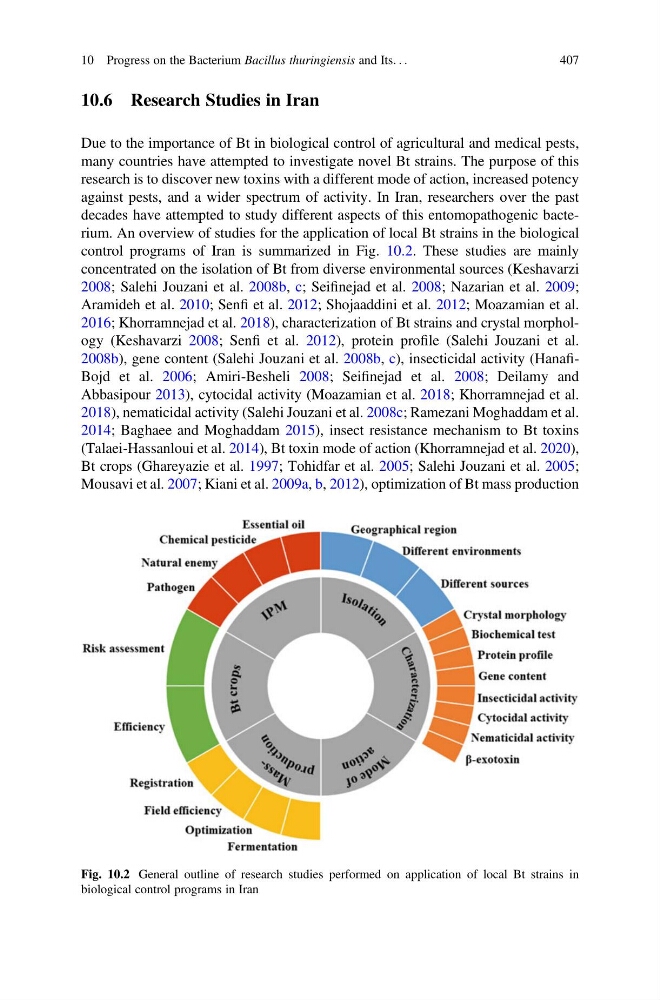
decades have attempted to study different aspects of this entomopathogenic bacterium. An overview of studies for the application of local Bt strains in the biological
control programs of Iran is summarized in Fig. 10.2. These studies are mainly
concentrated on the isolation of Bt from diverse environmental sources (Keshavarzi
2008; Salehi Jouzani et al. 2008b, c; Seifinejad et al. 2008; Nazarian et al. 2009;
Aramideh et al. 2010; Senfi et al. 2012; Shojaaddini et al. 2012; Moazamian et al.
2016; Khorramnejad et al. 2018), characterization of Bt strains and crystal morphology (Keshavarzi 2008; Senfi et al. 2012), protein profile (Salehi Jouzani et al.
2008b), gene content (Salehi Jouzani et al. 2008b, c), insecticidal activity (HanafiBojd et al. 2006; Amiri-Besheli 2008; Seifinejad et al. 2008; Deilamy and
Abbasipour 2013), cytocidal activity (Moazamian et al. 2018; Khorramnejad et al.
2018), nematicidal activity (Salehi Jouzani et al. 2008c; Ramezani Moghaddam et al.
2014; Baghaee and Moghaddam 2015), insect resistance mechanism to Bt toxins
(Talaei-Hassanloui et al. 2014), Bt toxin mode of action (Khorramnejad et al. 2020),
Bt crops (Ghareyazie et al. 1997; Tohidfar et al. 2005; Salehi Jouzani et al. 2005;
Mousavi et al. 2007; Kiani et al. 2009a, b, 2012), optimization of Bt mass production
Fig. 10.2 General outline of research studies performed on application of local Bt strains in
biological control programs in Iran
10 Progress on the Bacterium Bacillus thuringiensis and Its. . .
407
Due to the importance of Bt in biological control of agricultural and medical pests,
many countries have attempted to investigate novel Bt strains. The purpose of this
research is to discover new toxins with a different mode of action, increased potency
against pests, and a wider spectrum of activity. In Iran, researchers over the past
decades have attempted to study different aspects of this entomopathogenic bacterium. An overview of studies for the application of local Bt strains in the biological
control programs of Iran is summarized in Fig. 10.2. These studies are mainly
concentrated on the isolation of Bt from diverse environmental sources (Keshavarzi
2008; Salehi Jouzani et al. 2008b, c; Seifinejad et al. 2008; Nazarian et al. 2009;
Aramideh et al. 2010; Senfi et al. 2012; Shojaaddini et al. 2012; Moazamian et al.
2016; Khorramnejad et al. 2018), characterization of Bt strains and crystal morphology (Keshavarzi 2008; Senfi et al. 2012), protein profile (Salehi Jouzani et al.
2008b), gene content (Salehi Jouzani et al. 2008b, c), insecticidal activity (HanafiBojd et al. 2006; Amiri-Besheli 2008; Seifinejad et al. 2008; Deilamy and
Abbasipour 2013), cytocidal activity (Moazamian et al. 2018; Khorramnejad et al.
2018), nematicidal activity (Salehi Jouzani et al. 2008c; Ramezani Moghaddam et al.
2014; Baghaee and Moghaddam 2015), insect resistance mechanism to Bt toxins
(Talaei-Hassanloui et al. 2014), Bt toxin mode of action (Khorramnejad et al. 2020),
Bt crops (Ghareyazie et al. 1997; Tohidfar et al. 2005; Salehi Jouzani et al. 2005;
Mousavi et al. 2007; Kiani et al. 2009a, b, 2012), optimization of Bt mass production
Fig. 10.2 General outline of research studies performed on application of local Bt strains in
biological control programs in Iran
10 Progress on the Bacterium Bacillus thuringiensis and Its. . .
407