

representative of the Western Palaearctic region. Aphidius absinthii Marshall
(including Aphidius asteris Haliday) can be considered as a the most adapted
parasitoid species attacking about 30 species of Macrosiphoniella del Guercio,
followed by Ephedrus niger Gautier, Bonnamour & Gaumont (10 species) in the
Palaearctic region (Fig. 9.6). Aphidius phalangomyzi Starý and Praon absinthii
Bignell are also the strictly specific parasitoids of Macrosiphoniella aphids on
Artemisia, but Trioxys pannonicus Starý is a parasitoid of Titanosiphon Nevsky
aphids on the same host plant and its association with Macrosiphoniella seems
erroneous and needs further investigations. The same problem is also existing for
Aphidius arvensis (Starý) – a parasitoid of Coloradoa Wilson as well. Since their
Asteraceae host plants represent an important part of environmental structure, both
Macrosiphoniella and Uroleucon Mordvilko aphids are very common around agroecosystems and can play important role in association with broadly oligophagous
parasitoids, as well as the predatory insects.
9.5 Negative Agents on the Efficieny of Aphid Parasitoids
9.5.1 Hyperparasitoids
Hyperparasitoids, which are commonly known as “secondary parasitoids” are group
of insects which their progeny develops on a primary parasitoid (Sullivan 1987).
Many studies have been conducted on the various aspect of the biology (Höller et al.
1993; Brodeur and McNeil 1994), ecology (Mackauer and Völkl 1993; Völkl et al.
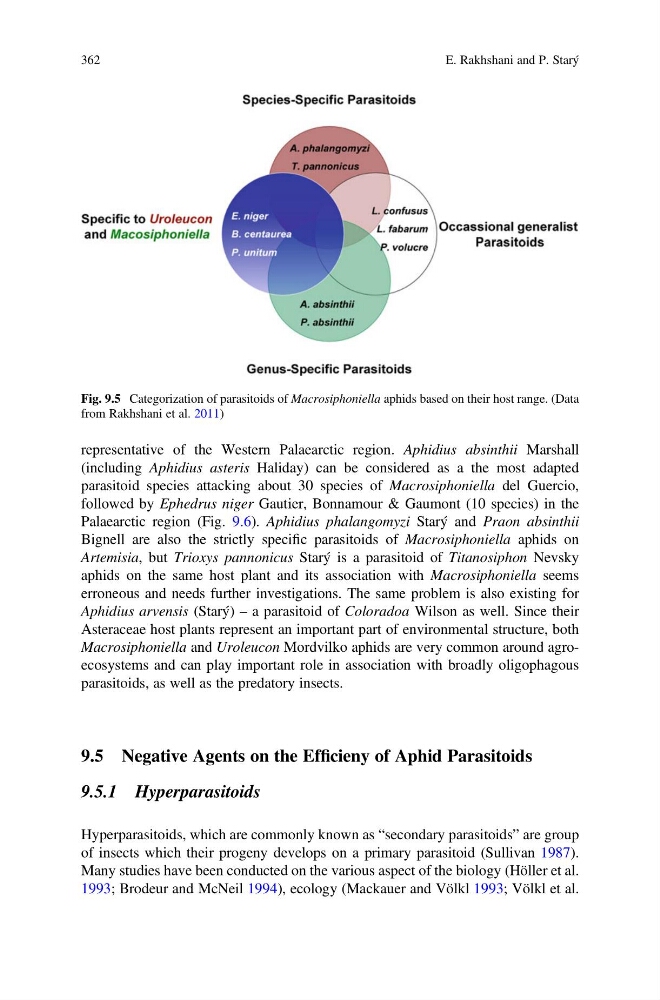
Fig. 9.5 Categorization of parasitoids of Macrosiphoniella aphids based on their host range. (Data
from Rakhshani et al. 2011)
362
E. Rakhshani and P. Starý
(including Aphidius asteris Haliday) can be considered as a the most adapted
parasitoid species attacking about 30 species of Macrosiphoniella del Guercio,
followed by Ephedrus niger Gautier, Bonnamour & Gaumont (10 species) in the
Palaearctic region (Fig. 9.6). Aphidius phalangomyzi Starý and Praon absinthii
Bignell are also the strictly specific parasitoids of Macrosiphoniella aphids on
Artemisia, but Trioxys pannonicus Starý is a parasitoid of Titanosiphon Nevsky
aphids on the same host plant and its association with Macrosiphoniella seems
erroneous and needs further investigations. The same problem is also existing for
Aphidius arvensis (Starý) – a parasitoid of Coloradoa Wilson as well. Since their
Asteraceae host plants represent an important part of environmental structure, both
Macrosiphoniella and Uroleucon Mordvilko aphids are very common around agroecosystems and can play important role in association with broadly oligophagous
parasitoids, as well as the predatory insects.
9.5 Negative Agents on the Efficieny of Aphid Parasitoids
9.5.1 Hyperparasitoids
Hyperparasitoids, which are commonly known as “secondary parasitoids” are group
of insects which their progeny develops on a primary parasitoid (Sullivan 1987).
Many studies have been conducted on the various aspect of the biology (Höller et al.
1993; Brodeur and McNeil 1994), ecology (Mackauer and Völkl 1993; Völkl et al.
Fig. 9.5 Categorization of parasitoids of Macrosiphoniella aphids based on their host range. (Data
from Rakhshani et al. 2011)
362
E. Rakhshani and P. Starý