

2005). The large populations of Cinara cedri Mimeur make a considerable amount
of honeydew around the tree and greatly disrupt its ornamental values.
The situation is worse, in the case of Eulachnus species on pines, where the aphid
honeydew makes a sticky surface on glass of the cars stopped under the trees. All of
these aphids have their own specific parasitoids at their area of origin. Species of the
genus Pauesia Quilis are the most common and well known parasitoids of Cinara
aphids on conifers in (Europe, Far East, Oriental region, North America). A single
species Pauesia hazratbalensis Bhagat is detected on Thuja orientalis in association
with its common aphid, Cinara thujafilina (Del Guercio) in north central (Starý et al.
2005) and north eastern (Rakhshani et al. 2012b) parts of Iran. It is necessary to
make program for introduction of some efficient parasitoid species for the rest of
coniferous aphids, especially Eulachnus species. Diaeretus leucopterus (Haliday) is
a taxonomically closely related species to Pauesia and known as the specific
parasitoid of Eulachnus aphids. It is widely distributed in Europe (Kavallieratos
et al. 2004) and even in North Africa (Ben Halima et al. 2020). Rose (Rosa spp.),
including a number of famous and popular flowering shrubs, which categorized as
the most common ornamental plants in gardens and outdoors. Many aphids are
known attacking various commercial rose (Rezwani 2001) causing defoliation,
reducing the ornamental value of the flowers and transmitting the viral diseases.
Among them, some species including Macrosiphum rosae (L.), Amphorophora
catharinae (Nevsky), Aphis craccivora Koch, Aphis gossypii Glover, Wahlgreniella
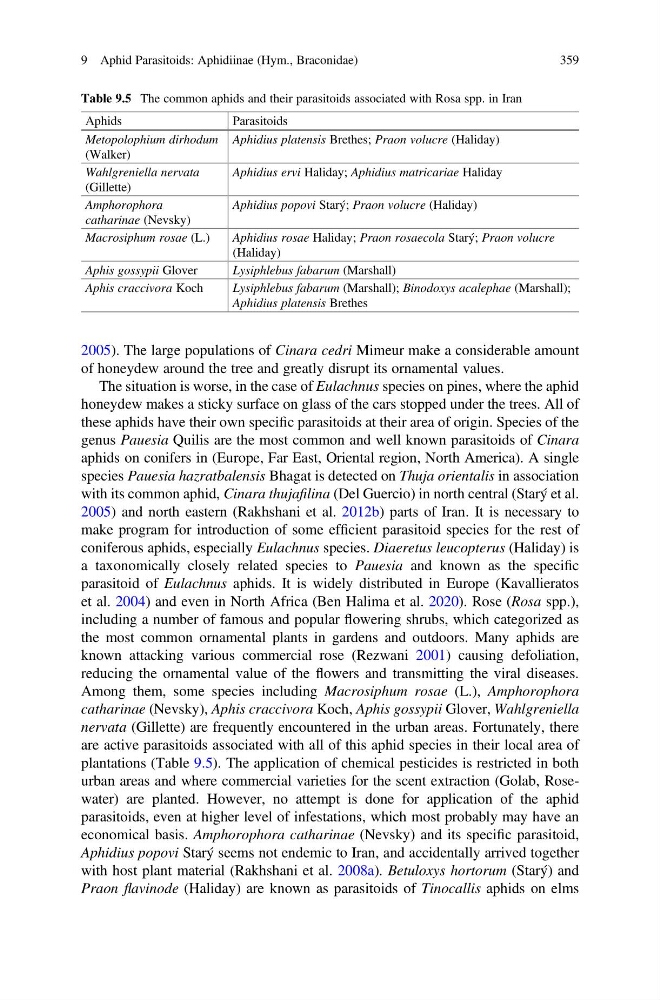
nervata (Gillette) are frequently encountered in the urban areas. Fortunately, there
are active parasitoids associated with all of this aphid species in their local area of
plantations (Table 9.5). The application of chemical pesticides is restricted in both
urban areas and where commercial varieties for the scent extraction (Golab, Rosewater) are planted. However, no attempt is done for application of the aphid
parasitoids, even at higher level of infestations, which most probably may have an
economical basis. Amphorophora catharinae (Nevsky) and its specific parasitoid,
Aphidius popovi Starý seems not endemic to Iran, and accidentally arrived together
with host plant material (Rakhshani et al. 2008a). Betuloxys hortorum (Starý) and
Praon flavinode (Haliday) are known as parasitoids of Tinocallis aphids on elms
Table 9.5 The common aphids and their parasitoids associated with Rosa spp. in Iran
Aphids
Parasitoids
Metopolophium dirhodum
(Walker)
Aphidius platensis Brethes; Praon volucre (Haliday)
Wahlgreniella nervata
(Gillette)
Aphidius ervi Haliday; Aphidius matricariae Haliday
Amphorophora
catharinae (Nevsky)
Aphidius popovi Starý; Praon volucre (Haliday)
Macrosiphum rosae (L.)
Aphidius rosae Haliday; Praon rosaecola Starý; Praon volucre
(Haliday)
Aphis gossypii Glover
Lysiphlebus fabarum (Marshall)
Aphis craccivora Koch
Lysiphlebus fabarum (Marshall); Binodoxys acalephae (Marshall);
Aphidius platensis Brethes
9 Aphid Parasitoids: Aphidiinae (Hym., Braconidae)
359
of honeydew around the tree and greatly disrupt its ornamental values.
The situation is worse, in the case of Eulachnus species on pines, where the aphid
honeydew makes a sticky surface on glass of the cars stopped under the trees. All of
these aphids have their own specific parasitoids at their area of origin. Species of the
genus Pauesia Quilis are the most common and well known parasitoids of Cinara
aphids on conifers in (Europe, Far East, Oriental region, North America). A single
species Pauesia hazratbalensis Bhagat is detected on Thuja orientalis in association
with its common aphid, Cinara thujafilina (Del Guercio) in north central (Starý et al.
2005) and north eastern (Rakhshani et al. 2012b) parts of Iran. It is necessary to
make program for introduction of some efficient parasitoid species for the rest of
coniferous aphids, especially Eulachnus species. Diaeretus leucopterus (Haliday) is
a taxonomically closely related species to Pauesia and known as the specific
parasitoid of Eulachnus aphids. It is widely distributed in Europe (Kavallieratos
et al. 2004) and even in North Africa (Ben Halima et al. 2020). Rose (Rosa spp.),
including a number of famous and popular flowering shrubs, which categorized as
the most common ornamental plants in gardens and outdoors. Many aphids are
known attacking various commercial rose (Rezwani 2001) causing defoliation,
reducing the ornamental value of the flowers and transmitting the viral diseases.
Among them, some species including Macrosiphum rosae (L.), Amphorophora
catharinae (Nevsky), Aphis craccivora Koch, Aphis gossypii Glover, Wahlgreniella
nervata (Gillette) are frequently encountered in the urban areas. Fortunately, there
are active parasitoids associated with all of this aphid species in their local area of
plantations (Table 9.5). The application of chemical pesticides is restricted in both
urban areas and where commercial varieties for the scent extraction (Golab, Rosewater) are planted. However, no attempt is done for application of the aphid
parasitoids, even at higher level of infestations, which most probably may have an
economical basis. Amphorophora catharinae (Nevsky) and its specific parasitoid,
Aphidius popovi Starý seems not endemic to Iran, and accidentally arrived together
with host plant material (Rakhshani et al. 2008a). Betuloxys hortorum (Starý) and
Praon flavinode (Haliday) are known as parasitoids of Tinocallis aphids on elms
Table 9.5 The common aphids and their parasitoids associated with Rosa spp. in Iran
Aphids
Parasitoids
Metopolophium dirhodum
(Walker)
Aphidius platensis Brethes; Praon volucre (Haliday)
Wahlgreniella nervata
(Gillette)
Aphidius ervi Haliday; Aphidius matricariae Haliday
Amphorophora
catharinae (Nevsky)
Aphidius popovi Starý; Praon volucre (Haliday)
Macrosiphum rosae (L.)
Aphidius rosae Haliday; Praon rosaecola Starý; Praon volucre
(Haliday)
Aphis gossypii Glover
Lysiphlebus fabarum (Marshall)
Aphis craccivora Koch
Lysiphlebus fabarum (Marshall); Binodoxys acalephae (Marshall);
Aphidius platensis Brethes
9 Aphid Parasitoids: Aphidiinae (Hym., Braconidae)
359