

Chalcidids are mostly parasitoids, although a few are hyperparasitoids on a wide
range of holometabolous insect hosts (Bouček 1952; Narendran 1986; Delvare and
Bouček 1992; Noyes 2018). In Iran, this group has not been studied systematically,
and only limited research on the taxon has been conducted (Delvare et al. 2011;
Rajabi et al. 2011; Lotfalizadeh et al. 2012; Tavakoli Roodi et al. 2016;
Falahatpisheh et al. 2018). The first information on Chalcididae from Iran was
published by Masi (1924), who described two new species. In the following years,
only a few species of this family were reported from the country (Bouček 1952;
Nikol’skaya 1952, 1978). Recently, Delvare et al. (2011) described three new
species from Iran. Later, Rajabi et al. (2011) and Lotfalizadeh et al. (2012) provided
novel information on the Iranian chalcidid fauna together with new data on the hosts
of the Chalcididae. Within five subfamilies, 68 species and 18 reported genera from
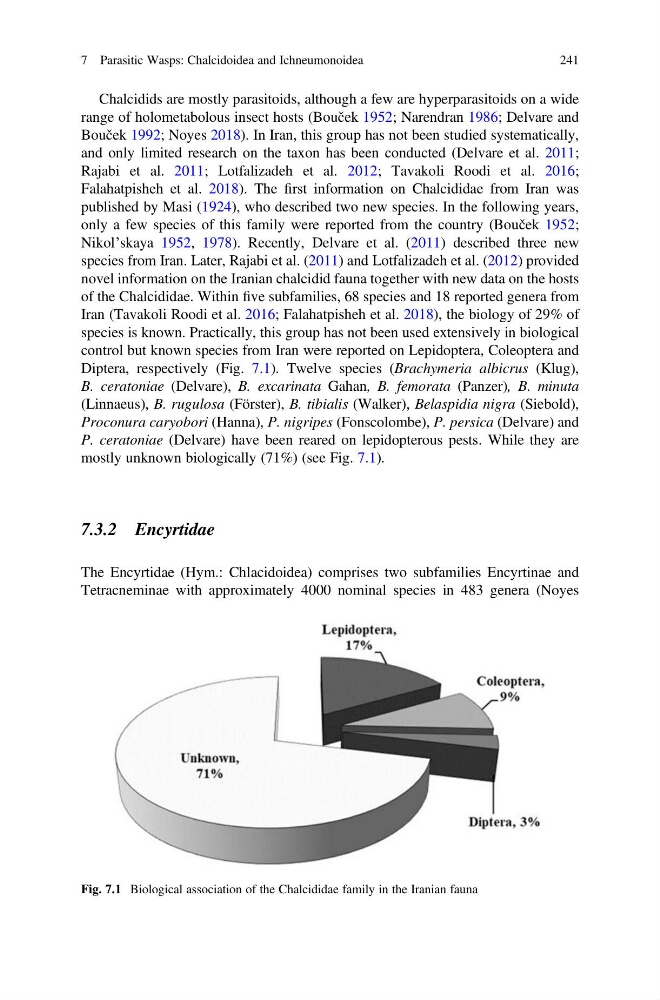
Iran (Tavakoli Roodi et al. 2016; Falahatpisheh et al. 2018), the biology of 29% of
species is known. Practically, this group has not been used extensively in biological
control but known species from Iran were reported on Lepidoptera, Coleoptera and
Diptera, respectively (Fig. 7.1). Twelve species (Brachymeria albicrus (Klug),
B. ceratoniae (Delvare), B. excarinata Gahan, B. femorata (Panzer), B. minuta
(Linnaeus), B. rugulosa (Förster), B. tibialis (Walker), Belaspidia nigra (Siebold),
Proconura caryobori (Hanna), P. nigripes (Fonscolombe), P. persica (Delvare) and
P. ceratoniae (Delvare) have been reared on lepidopterous pests. While they are
mostly unknown biologically (71%) (see Fig. 7.1).
7.3.2 Encyrtidae
The Encyrtidae (Hym.: Chlacidoidea) comprises two subfamilies Encyrtinae and
Tetracneminae with approximately 4000 nominal species in 483 genera (Noyes
Fig. 7.1 Biological association of the Chalcididae family in the Iranian fauna
7 Parasitic Wasps: Chalcidoidea and Ichneumonoidea
241
range of holometabolous insect hosts (Bouček 1952; Narendran 1986; Delvare and
Bouček 1992; Noyes 2018). In Iran, this group has not been studied systematically,
and only limited research on the taxon has been conducted (Delvare et al. 2011;
Rajabi et al. 2011; Lotfalizadeh et al. 2012; Tavakoli Roodi et al. 2016;
Falahatpisheh et al. 2018). The first information on Chalcididae from Iran was
published by Masi (1924), who described two new species. In the following years,
only a few species of this family were reported from the country (Bouček 1952;
Nikol’skaya 1952, 1978). Recently, Delvare et al. (2011) described three new
species from Iran. Later, Rajabi et al. (2011) and Lotfalizadeh et al. (2012) provided
novel information on the Iranian chalcidid fauna together with new data on the hosts
of the Chalcididae. Within five subfamilies, 68 species and 18 reported genera from
Iran (Tavakoli Roodi et al. 2016; Falahatpisheh et al. 2018), the biology of 29% of
species is known. Practically, this group has not been used extensively in biological
control but known species from Iran were reported on Lepidoptera, Coleoptera and
Diptera, respectively (Fig. 7.1). Twelve species (Brachymeria albicrus (Klug),
B. ceratoniae (Delvare), B. excarinata Gahan, B. femorata (Panzer), B. minuta
(Linnaeus), B. rugulosa (Förster), B. tibialis (Walker), Belaspidia nigra (Siebold),
Proconura caryobori (Hanna), P. nigripes (Fonscolombe), P. persica (Delvare) and
P. ceratoniae (Delvare) have been reared on lepidopterous pests. While they are
mostly unknown biologically (71%) (see Fig. 7.1).
7.3.2 Encyrtidae
The Encyrtidae (Hym.: Chlacidoidea) comprises two subfamilies Encyrtinae and
Tetracneminae with approximately 4000 nominal species in 483 genera (Noyes
Fig. 7.1 Biological association of the Chalcididae family in the Iranian fauna
7 Parasitic Wasps: Chalcidoidea and Ichneumonoidea
241