

7.2.2 Parasitoids of Stored-Product Pests
Four species of fruit flies (Dip.: Tephritidae), including Acanthiophilus helianthi
(Rossi), Chaetorellia carthami Stackelberg, Terellia luteola (Wiedemann),
Urophora mauritanica Macquart, and the safflower gall wasp, Isocolus tinctorius
Melika & Gharali (Hym.: Cynipidae) are serious pests of safflower fields in Iran.
Twelve species of hymenopterous parasitoids of these pests were reared and some of
their morphological and biological data were presented. These parasitoids belong to
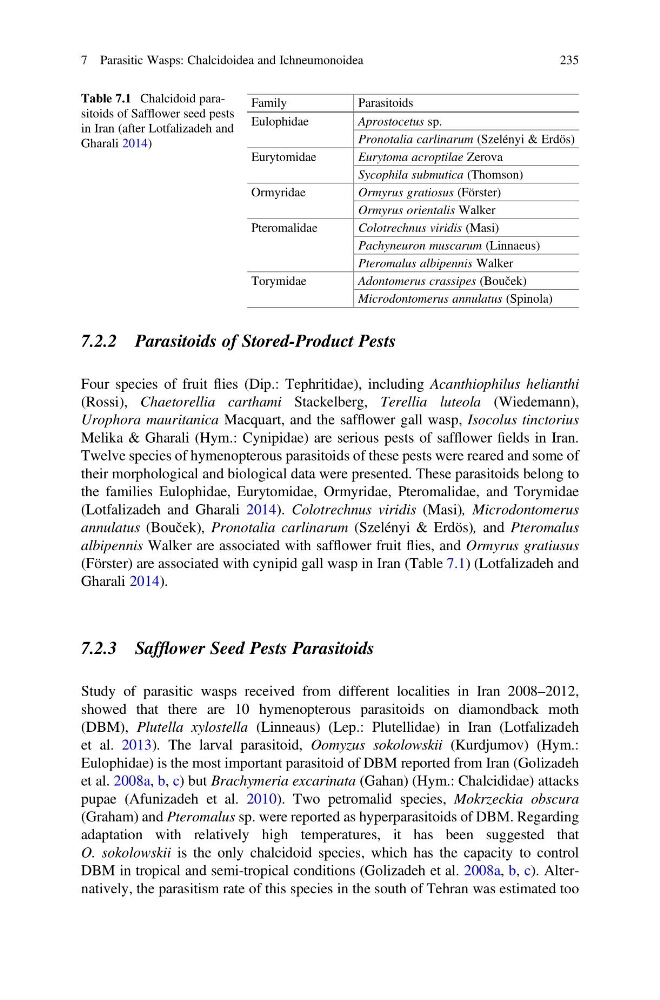
the families Eulophidae, Eurytomidae, Ormyridae, Pteromalidae, and Torymidae
(Lotfalizadeh and Gharali 2014). Colotrechnus viridis (Masi), Microdontomerus
annulatus (Bouček), Pronotalia carlinarum (Szelényi & Erdös), and Pteromalus
albipennis Walker are associated with safflower fruit flies, and Ormyrus gratiusus
(Förster) are associated with cynipid gall wasp in Iran (Table 7.1) (Lotfalizadeh and
Gharali 2014).
7.2.3 Safflower Seed Pests Parasitoids
Study of parasitic wasps received from different localities in Iran 2008–2012,
showed that there are 10 hymenopterous parasitoids on diamondback moth
(DBM), Plutella xylostella (Linneaus) (Lep.: Plutellidae) in Iran (Lotfalizadeh
et al. 2013). The larval parasitoid, Oomyzus sokolowskii (Kurdjumov) (Hym.:
Eulophidae) is the most important parasitoid of DBM reported from Iran (Golizadeh
et al. 2008a, b, c) but Brachymeria excarinata (Gahan) (Hym.: Chalcididae) attacks
pupae (Afunizadeh et al. 2010). Two petromalid species, Mokrzeckia obscura
(Graham) and Pteromalus sp. were reported as hyperparasitoids of DBM. Regarding
adaptation with relatively high temperatures, it has been suggested that
O. sokolowskii is the only chalcidoid species, which has the capacity to control
DBM in tropical and semi-tropical conditions (Golizadeh et al. 2008a, b, c). Alternatively, the parasitism rate of this species in the south of Tehran was estimated too
Table 7.1 Chalcidoid parasitoids of Safflower seed pests
in Iran (after Lotfalizadeh and
Gharali 2014)
Family
Parasitoids
Eulophidae
Aprostocetus sp.
Pronotalia carlinarum (Szelényi & Erdös)
Eurytomidae
Eurytoma acroptilae Zerova
Sycophila submutica (Thomson)
Ormyridae
Ormyrus gratiosus (Förster)
Ormyrus orientalis Walker
Pteromalidae
Colotrechnus viridis (Masi)
Pachyneuron muscarum (Linnaeus)
Pteromalus albipennis Walker
Torymidae
Adontomerus crassipes (Bouček)
Microdontomerus annulatus (Spinola)
7 Parasitic Wasps: Chalcidoidea and Ichneumonoidea
235
Four species of fruit flies (Dip.: Tephritidae), including Acanthiophilus helianthi
(Rossi), Chaetorellia carthami Stackelberg, Terellia luteola (Wiedemann),
Urophora mauritanica Macquart, and the safflower gall wasp, Isocolus tinctorius
Melika & Gharali (Hym.: Cynipidae) are serious pests of safflower fields in Iran.
Twelve species of hymenopterous parasitoids of these pests were reared and some of
their morphological and biological data were presented. These parasitoids belong to
the families Eulophidae, Eurytomidae, Ormyridae, Pteromalidae, and Torymidae
(Lotfalizadeh and Gharali 2014). Colotrechnus viridis (Masi), Microdontomerus
annulatus (Bouček), Pronotalia carlinarum (Szelényi & Erdös), and Pteromalus
albipennis Walker are associated with safflower fruit flies, and Ormyrus gratiusus
(Förster) are associated with cynipid gall wasp in Iran (Table 7.1) (Lotfalizadeh and
Gharali 2014).
7.2.3 Safflower Seed Pests Parasitoids
Study of parasitic wasps received from different localities in Iran 2008–2012,
showed that there are 10 hymenopterous parasitoids on diamondback moth
(DBM), Plutella xylostella (Linneaus) (Lep.: Plutellidae) in Iran (Lotfalizadeh
et al. 2013). The larval parasitoid, Oomyzus sokolowskii (Kurdjumov) (Hym.:
Eulophidae) is the most important parasitoid of DBM reported from Iran (Golizadeh
et al. 2008a, b, c) but Brachymeria excarinata (Gahan) (Hym.: Chalcididae) attacks
pupae (Afunizadeh et al. 2010). Two petromalid species, Mokrzeckia obscura
(Graham) and Pteromalus sp. were reported as hyperparasitoids of DBM. Regarding
adaptation with relatively high temperatures, it has been suggested that
O. sokolowskii is the only chalcidoid species, which has the capacity to control
DBM in tropical and semi-tropical conditions (Golizadeh et al. 2008a, b, c). Alternatively, the parasitism rate of this species in the south of Tehran was estimated too
Table 7.1 Chalcidoid parasitoids of Safflower seed pests
in Iran (after Lotfalizadeh and
Gharali 2014)
Family
Parasitoids
Eulophidae
Aprostocetus sp.
Pronotalia carlinarum (Szelényi & Erdös)
Eurytomidae
Eurytoma acroptilae Zerova
Sycophila submutica (Thomson)
Ormyridae
Ormyrus gratiosus (Förster)
Ormyrus orientalis Walker
Pteromalidae
Colotrechnus viridis (Masi)
Pachyneuron muscarum (Linnaeus)
Pteromalus albipennis Walker
Torymidae
Adontomerus crassipes (Bouček)
Microdontomerus annulatus (Spinola)
7 Parasitic Wasps: Chalcidoidea and Ichneumonoidea
235