

are Pasteur Institute of Iran, Razi Vaccine and Serum Research Institute, Animal
Science Research Institute of Iran (ASRI), Silkworm Breeding Company and the
Silkworm Research Center, the Sugar Beet Seed Institute, Seed and Plant Improvement Institute, Horticultural Science Research Institute, Rice Research Institute of
Iran, Cotton Research Institute, Research Institute of Forests and Rangelands, and
Agricultural Biotechnology Research Institute of Iran (ABRII).
1.8.1 Pasteur Institute of Iran
After destructive World War I, due to famine, diseases and the need for scientific
progress, the Iranian government requested assistance from the President of the
Pasteur Institute of France to founding a similar facility in Iran. After an initial
attempt, once World War II ended, a new round of collaborations started between the
Iranian and French Pasteur Institutes. In 1968, on the occasion of the 25th
. anniversary of Pasteur Institute of Iran, a scientific-technical cooperation agreement was
signed between the two institutes and a French microbiologist, Marcel Baltazard was
appointed as President of the Pasteur Institute of Iran with the mandate to launch new
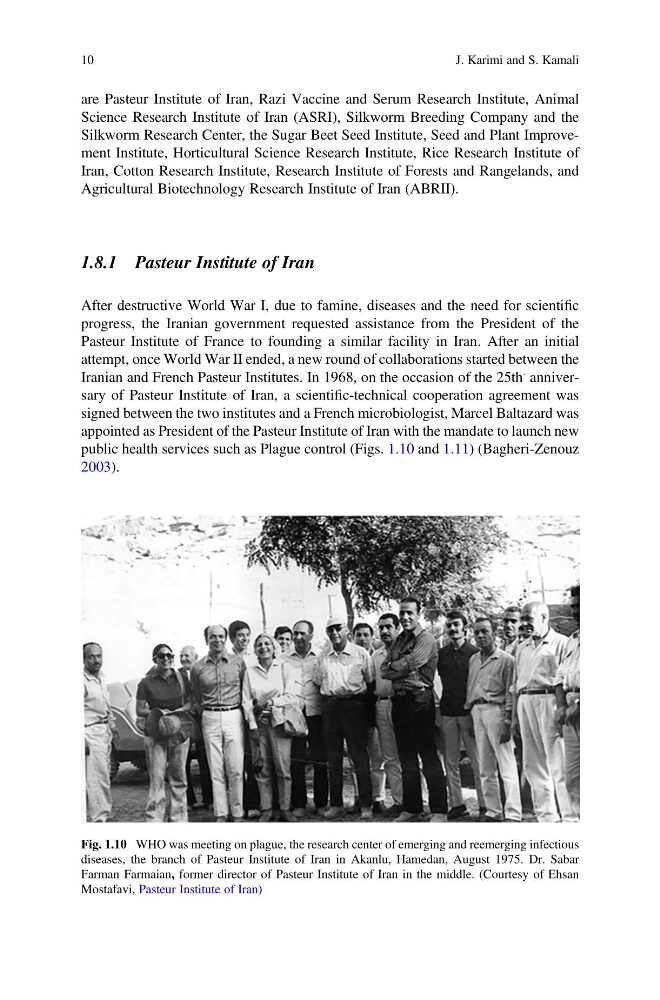
public health services such as Plague control (Figs. 1.10 and 1.11) (Bagheri-Zenouz
2003).
Fig. 1.10 WHO was meeting on plague, the research center of emerging and reemerging infectious
diseases, the branch of Pasteur Institute of Iran in Akanlu, Hamedan, August 1975. Dr. Sabar
Farman Farmaian, former director of Pasteur Institute of Iran in the middle. (Courtesy of Ehsan
Mostafavi, Pasteur Institute of Iran)
10
J. Karimi and S. Kamali
Science Research Institute of Iran (ASRI), Silkworm Breeding Company and the
Silkworm Research Center, the Sugar Beet Seed Institute, Seed and Plant Improvement Institute, Horticultural Science Research Institute, Rice Research Institute of
Iran, Cotton Research Institute, Research Institute of Forests and Rangelands, and
Agricultural Biotechnology Research Institute of Iran (ABRII).
1.8.1 Pasteur Institute of Iran
After destructive World War I, due to famine, diseases and the need for scientific
progress, the Iranian government requested assistance from the President of the
Pasteur Institute of France to founding a similar facility in Iran. After an initial
attempt, once World War II ended, a new round of collaborations started between the
Iranian and French Pasteur Institutes. In 1968, on the occasion of the 25th
. anniversary of Pasteur Institute of Iran, a scientific-technical cooperation agreement was
signed between the two institutes and a French microbiologist, Marcel Baltazard was
appointed as President of the Pasteur Institute of Iran with the mandate to launch new
public health services such as Plague control (Figs. 1.10 and 1.11) (Bagheri-Zenouz
2003).
Fig. 1.10 WHO was meeting on plague, the research center of emerging and reemerging infectious
diseases, the branch of Pasteur Institute of Iran in Akanlu, Hamedan, August 1975. Dr. Sabar
Farman Farmaian, former director of Pasteur Institute of Iran in the middle. (Courtesy of Ehsan
Mostafavi, Pasteur Institute of Iran)
10
J. Karimi and S. Kamali