

On the other hand, superiority of S.cereallella does not so impressive in two other
species of Trichogramma. Similar order in host suitability is not present among
various Trichogramma species. All these species are of applied value for integrated
pest management of different pests.
6.6.4 Functional Response
Functional response is a key concept to understand how parasitoids/ predators
influence population dynamics of their hosts/preys and how they affect the structure
and hence stability of the communities in which they are living (Jervis and Kidd
1996; Reay-Jones et al. 2006; Wajnberg et al. 2008). Functional response experiments may be conducted to evaluate parasitoid/ predator potential in suppressing the
different prey/host densities and can be helpful in preliminary screening of natural
enemies as well as predicting the results of their release in field (Moezipour et al.
2008; Carneiro et al. 2010). Functional response of a natural enemy is indicated by
two parameters: the handling time (T h ), the time taken for a parasitoid to chase,
overcome and handle a single host; and the attack rate or searching efficiency (a or
b), the rate of encounter to new hosts (Holling 1966; Hassell 1978). The parameter
“a” is rather a constant value while the “b” shows density dependence. Estimation of
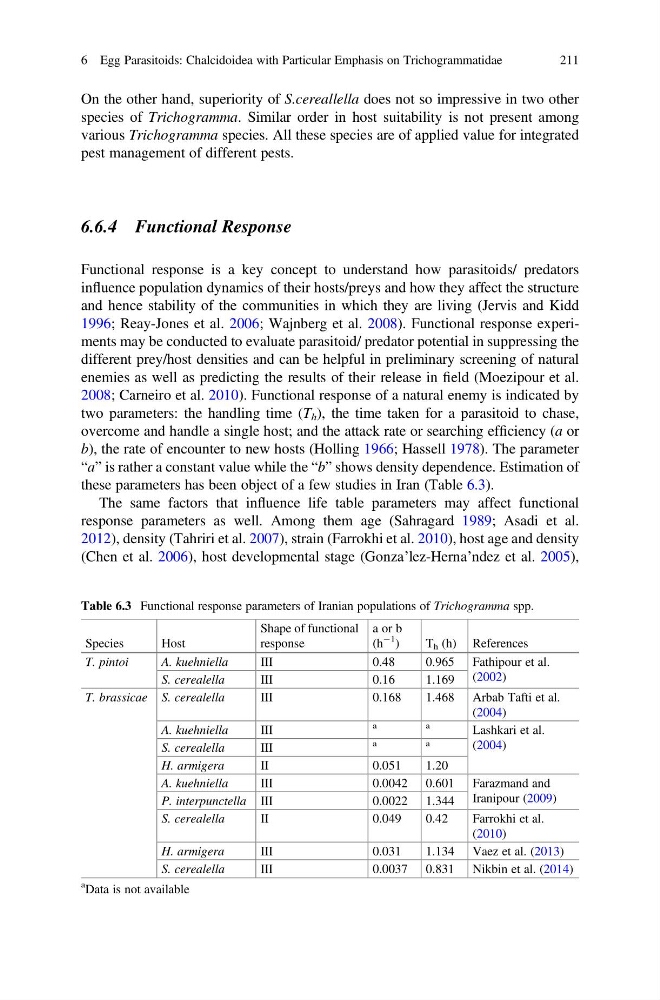
these parameters has been object of a few studies in Iran (Table 6.3).
The same factors that influence life table parameters may affect functional
response parameters as well. Among them age (Sahragard 1989; Asadi et al.
2012), density (Tahriri et al. 2007), strain (Farrokhi et al. 2010), host age and density
(Chen et al. 2006), host developmental stage (Gonza’lez-Herna’ndez et al. 2005),
Table 6.3 Functional response parameters of Iranian populations of Trichogramma spp.
Species
Host
Shape of functional
response
a or b
(h
À1 )
T h (h) References
T. pintoi
A. kuehniella
III
0.48
0.965 Fathipour et al.
(2002)
S. cerealella
III
0.16
1.169
T. brassicae S. cerealella
III
0.168
1.468 Arbab Tafti et al.
(2004)
A. kuehniella
III
a
a
Lashkari et al.
(2004)
S. cerealella
III
a
a
H. armigera
II
0.051
1.20
A. kuehniella
III
0.0042 0.601 Farazmand and
Iranipour (2009)
P. interpunctella III
0.0022 1.344
S. cerealella
II
0.049
0.42
Farrokhi et al.
(2010)
H. armigera
III
0.031
1.134 Vaez et al. (2013)
S. cerealella
III
0.0037 0.831 Nikbin et al. (2014)
a Data is not available
6 Egg Parasitoids: Chalcidoidea with Particular Emphasis on Trichogrammatidae
211
species of Trichogramma. Similar order in host suitability is not present among
various Trichogramma species. All these species are of applied value for integrated
pest management of different pests.
6.6.4 Functional Response
Functional response is a key concept to understand how parasitoids/ predators
influence population dynamics of their hosts/preys and how they affect the structure
and hence stability of the communities in which they are living (Jervis and Kidd
1996; Reay-Jones et al. 2006; Wajnberg et al. 2008). Functional response experiments may be conducted to evaluate parasitoid/ predator potential in suppressing the
different prey/host densities and can be helpful in preliminary screening of natural
enemies as well as predicting the results of their release in field (Moezipour et al.
2008; Carneiro et al. 2010). Functional response of a natural enemy is indicated by
two parameters: the handling time (T h ), the time taken for a parasitoid to chase,
overcome and handle a single host; and the attack rate or searching efficiency (a or
b), the rate of encounter to new hosts (Holling 1966; Hassell 1978). The parameter
“a” is rather a constant value while the “b” shows density dependence. Estimation of
these parameters has been object of a few studies in Iran (Table 6.3).
The same factors that influence life table parameters may affect functional
response parameters as well. Among them age (Sahragard 1989; Asadi et al.
2012), density (Tahriri et al. 2007), strain (Farrokhi et al. 2010), host age and density
(Chen et al. 2006), host developmental stage (Gonza’lez-Herna’ndez et al. 2005),
Table 6.3 Functional response parameters of Iranian populations of Trichogramma spp.
Species
Host
Shape of functional
response
a or b
(h
À1 )
T h (h) References
T. pintoi
A. kuehniella
III
0.48
0.965 Fathipour et al.
(2002)
S. cerealella
III
0.16
1.169
T. brassicae S. cerealella
III
0.168
1.468 Arbab Tafti et al.
(2004)
A. kuehniella
III
a
a
Lashkari et al.
(2004)
S. cerealella
III
a
a
H. armigera
II
0.051
1.20
A. kuehniella
III
0.0042 0.601 Farazmand and
Iranipour (2009)
P. interpunctella III
0.0022 1.344
S. cerealella
II
0.049
0.42
Farrokhi et al.
(2010)
H. armigera
III
0.031
1.134 Vaez et al. (2013)
S. cerealella
III
0.0037 0.831 Nikbin et al. (2014)
a Data is not available
6 Egg Parasitoids: Chalcidoidea with Particular Emphasis on Trichogrammatidae
211