

H. armigera, Mamestra brassicae L. (Noctuidae), Scrobipalpa ocellatella Boyd
(Gelechiidae), Papilio demoleus L. (Papilionidae), O. nubilalis and C. suppressalis
(Crambidae) eggs.
Trichogramma evanescens Westwood is the second most common species that
has been collected on O. nubilalis, C. suppressalis, H. armigera, C. pomonella,
Ectomyelois ceratoniae Zeller and Naranga aenescens Moore eggs from Isfahan,
Alborz, Markazi, East Azarbaijan, Khorasan-e-Razavi and Northern provinces
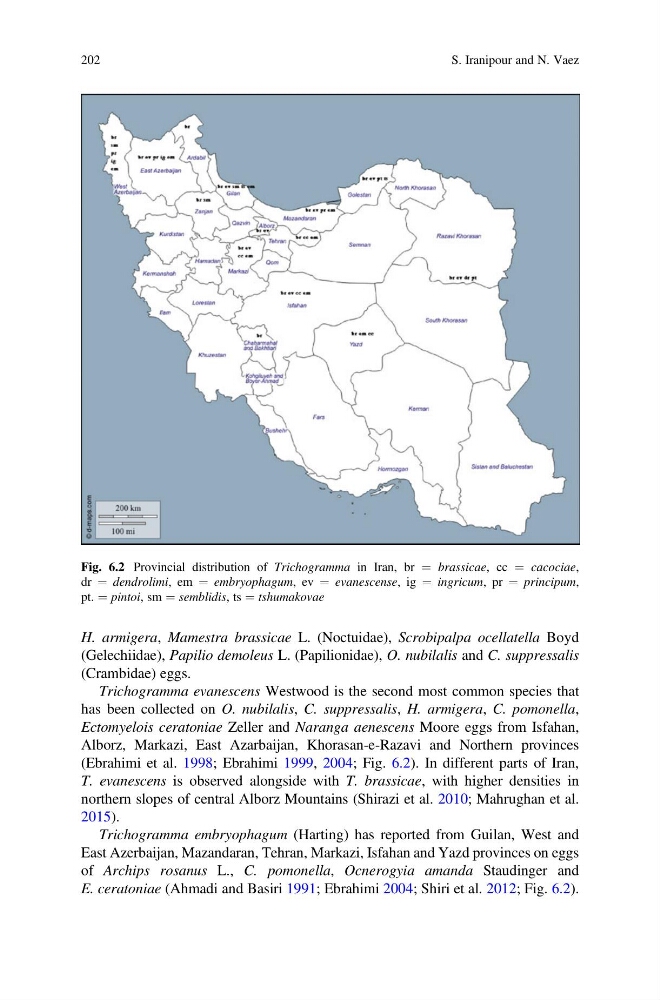
(Ebrahimi et al. 1998; Ebrahimi 1999, 2004; Fig. 6.2). In different parts of Iran,
T. evanescens is observed alongside with T. brassicae, with higher densities in
northern slopes of central Alborz Mountains (Shirazi et al. 2010; Mahrughan et al.
2015).
Trichogramma embryophagum (Harting) has reported from Guilan, West and
East Azerbaijan, Mazandaran, Tehran, Markazi, Isfahan and Yazd provinces on eggs
of Archips rosanus L., C. pomonella, Ocnerogyia amanda Staudinger and
E. ceratoniae (Ahmadi and Basiri 1991; Ebrahimi 2004; Shiri et al. 2012; Fig. 6.2).
Fig. 6.2 Provincial distribution of Trichogramma in Iran, br ¼ brassicae, cc ¼ cacociae,
dr ¼ dendrolimi, em ¼ embryophagum, ev ¼ evanescense, ig ¼ ingricum, pr ¼ principum,
pt. ¼ pintoi, sm ¼ semblidis, ts ¼ tshumakovae
202
S. Iranipour and N. Vaez
(Gelechiidae), Papilio demoleus L. (Papilionidae), O. nubilalis and C. suppressalis
(Crambidae) eggs.
Trichogramma evanescens Westwood is the second most common species that
has been collected on O. nubilalis, C. suppressalis, H. armigera, C. pomonella,
Ectomyelois ceratoniae Zeller and Naranga aenescens Moore eggs from Isfahan,
Alborz, Markazi, East Azarbaijan, Khorasan-e-Razavi and Northern provinces
(Ebrahimi et al. 1998; Ebrahimi 1999, 2004; Fig. 6.2). In different parts of Iran,
T. evanescens is observed alongside with T. brassicae, with higher densities in
northern slopes of central Alborz Mountains (Shirazi et al. 2010; Mahrughan et al.
2015).
Trichogramma embryophagum (Harting) has reported from Guilan, West and
East Azerbaijan, Mazandaran, Tehran, Markazi, Isfahan and Yazd provinces on eggs
of Archips rosanus L., C. pomonella, Ocnerogyia amanda Staudinger and
E. ceratoniae (Ahmadi and Basiri 1991; Ebrahimi 2004; Shiri et al. 2012; Fig. 6.2).
Fig. 6.2 Provincial distribution of Trichogramma in Iran, br ¼ brassicae, cc ¼ cacociae,
dr ¼ dendrolimi, em ¼ embryophagum, ev ¼ evanescense, ig ¼ ingricum, pr ¼ principum,
pt. ¼ pintoi, sm ¼ semblidis, ts ¼ tshumakovae
202
S. Iranipour and N. Vaez