

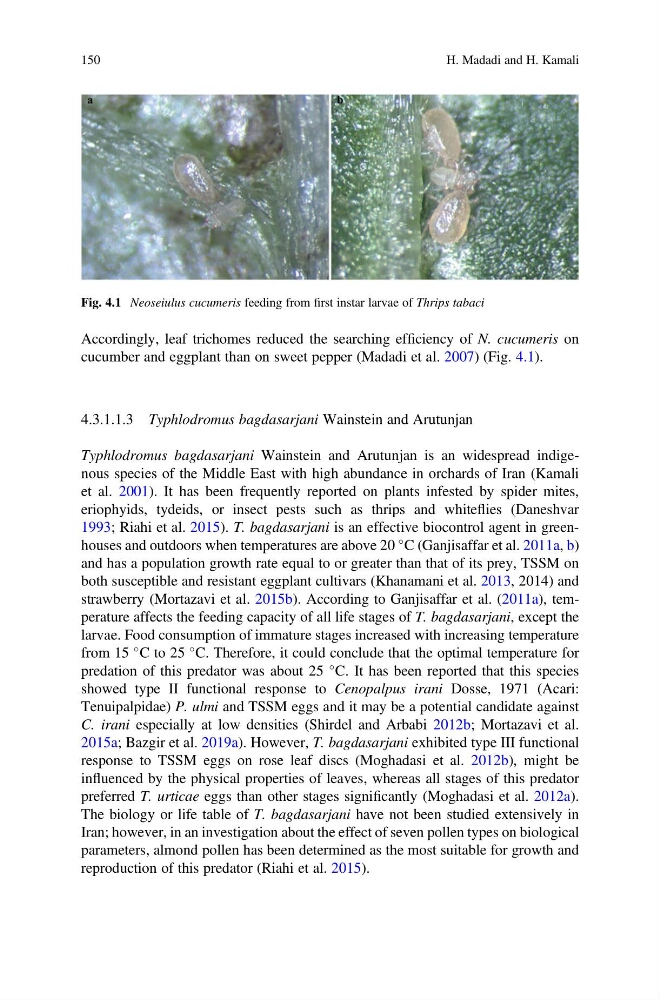
Accordingly, leaf trichomes reduced the searching efficiency of N. cucumeris on
cucumber and eggplant than on sweet pepper (Madadi et al. 2007) (Fig. 4.1).
4.3.1.1.3 Typhlodromus bagdasarjani Wainstein and Arutunjan
Typhlodromus bagdasarjani Wainstein and Arutunjan is an widespread indigenous species of the Middle East with high abundance in orchards of Iran (Kamali
et al. 2001). It has been frequently reported on plants infested by spider mites,
eriophyids, tydeids, or insect pests such as thrips and whiteflies (Daneshvar
1993; Riahi et al. 2015). T. bagdasarjani is an effective biocontrol agent in greenhouses and outdoors when temperatures are above 20
C (Ganjisaffar et al. 2011a, b)
and has a population growth rate equal to or greater than that of its prey, TSSM on
both susceptible and resistant eggplant cultivars (Khanamani et al. 2013, 2014) and
strawberry (Mortazavi et al. 2015b). According to Ganjisaffar et al. (2011a), temperature affects the feeding capacity of all life stages of T. bagdasarjani, except the
larvae. Food consumption of immature stages increased with increasing temperature
from 15
C to 25
C. Therefore, it could conclude that the optimal temperature for
predation of this predator was about 25
C. It has been reported that this species
showed type II functional response to Cenopalpus irani Dosse, 1971 (Acari:
Tenuipalpidae) P. ulmi and TSSM eggs and it may be a potential candidate against
C. irani especially at low densities (Shirdel and Arbabi 2012b; Mortazavi et al.
2015a; Bazgir et al. 2019a). However, T. bagdasarjani exhibited type III functional
response to TSSM eggs on rose leaf discs (Moghadasi et al. 2012b), might be
influenced by the physical properties of leaves, whereas all stages of this predator
preferred T. urticae eggs than other stages significantly (Moghadasi et al. 2012a).
The biology or life table of T. bagdasarjani have not been studied extensively in
Iran; however, in an investigation about the effect of seven pollen types on biological
parameters, almond pollen has been determined as the most suitable for growth and
reproduction of this predator (Riahi et al. 2015).
Fig. 4.1 Neoseiulus cucumeris feeding from first instar larvae of Thrips tabaci
150
H. Madadi and H. Kamali
cucumber and eggplant than on sweet pepper (Madadi et al. 2007) (Fig. 4.1).
4.3.1.1.3 Typhlodromus bagdasarjani Wainstein and Arutunjan
Typhlodromus bagdasarjani Wainstein and Arutunjan is an widespread indigenous species of the Middle East with high abundance in orchards of Iran (Kamali
et al. 2001). It has been frequently reported on plants infested by spider mites,
eriophyids, tydeids, or insect pests such as thrips and whiteflies (Daneshvar
1993; Riahi et al. 2015). T. bagdasarjani is an effective biocontrol agent in greenhouses and outdoors when temperatures are above 20
C (Ganjisaffar et al. 2011a, b)
and has a population growth rate equal to or greater than that of its prey, TSSM on
both susceptible and resistant eggplant cultivars (Khanamani et al. 2013, 2014) and
strawberry (Mortazavi et al. 2015b). According to Ganjisaffar et al. (2011a), temperature affects the feeding capacity of all life stages of T. bagdasarjani, except the
larvae. Food consumption of immature stages increased with increasing temperature
from 15
C to 25
C. Therefore, it could conclude that the optimal temperature for
predation of this predator was about 25
C. It has been reported that this species
showed type II functional response to Cenopalpus irani Dosse, 1971 (Acari:
Tenuipalpidae) P. ulmi and TSSM eggs and it may be a potential candidate against
C. irani especially at low densities (Shirdel and Arbabi 2012b; Mortazavi et al.
2015a; Bazgir et al. 2019a). However, T. bagdasarjani exhibited type III functional
response to TSSM eggs on rose leaf discs (Moghadasi et al. 2012b), might be
influenced by the physical properties of leaves, whereas all stages of this predator
preferred T. urticae eggs than other stages significantly (Moghadasi et al. 2012a).
The biology or life table of T. bagdasarjani have not been studied extensively in
Iran; however, in an investigation about the effect of seven pollen types on biological
parameters, almond pollen has been determined as the most suitable for growth and
reproduction of this predator (Riahi et al. 2015).
Fig. 4.1 Neoseiulus cucumeris feeding from first instar larvae of Thrips tabaci
150
H. Madadi and H. Kamali