

134
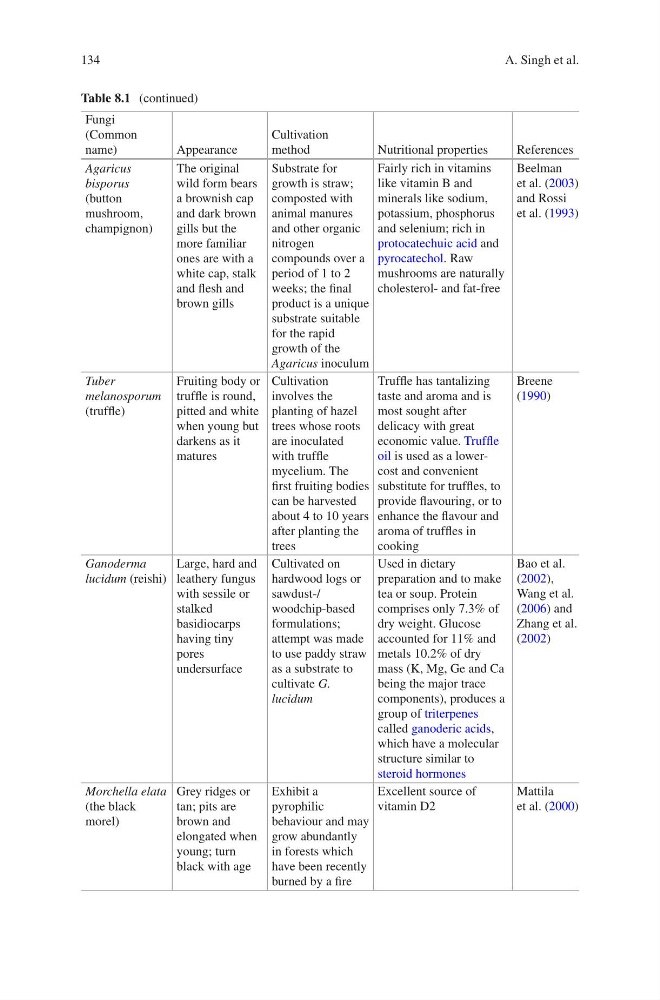
Table 8.1 (continued)
Fungi
(Common
name)
Appearance
Cultivation
method
Nutritional properties
References
Agaricus
bisporus
(button
mushroom,
champignon)
The original
wild form bears
a brownish cap
and dark brown
gills but the
more familiar
ones are with a
white cap, stalk
and flesh and
brown gills
Substrate for
growth is straw;
composted with
animal manures
and other organic
nitrogen
compounds over a
period of 1 to 2
weeks; the final
product is a unique
substrate suitable
for the rapid
growth of the
Agaricus inoculum
Fairly rich in vitamins
like vitamin B and
minerals like sodium,
potassium, phosphorus
and selenium; rich in
protocatechuic acid and
pyrocatechol. Raw
mushrooms are naturally
cholesterol- and fat-free
Beelman
et al. (2003)
and Rossi
et al. (1993)
Tuber
melanosporum
(truffle)
Fruiting body or
truffle is round,
pitted and white
when young but
darkens as it
matures
Cultivation
involves the
planting of hazel
trees whose roots
are inoculated
with truffle
mycelium. The
first fruiting bodies
can be harvested
about 4 to 10 years
after planting the
trees
Truffle has tantalizing
taste and aroma and is
most sought after
delicacy with great
economic value. Truffle
oil is used as a lowercost and convenient
substitute for truffles, to
provide flavouring, or to
enhance the flavour and
aroma of truffles in
cooking
Breene
(1990)
Ganoderma
lucidum (reishi)
Large, hard and
leathery fungus
with sessile or
stalked
basidiocarps
having tiny
pores
undersurface
Cultivated on
hardwood logs or
sawdust-/
woodchip-based
formulations;
attempt was made
to use paddy straw
as a substrate to
cultivate G.
lucidum
Used in dietary
preparation and to make
tea or soup. Protein
comprises only 7.3% of
dry weight. Glucose
accounted for 11% and
metals 10.2% of dry
mass (K, Mg, Ge and Ca
being the major trace
components), produces a
group of triterpenes
called ganoderic acids,
which have a molecular
structure similar to
steroid hormones
Bao et al.
(2002),
Wang et al.
(2006) and
Zhang et al.
(2002)
Morchella elata
(the black
morel)
Grey ridges or
tan; pits are
brown and
elongated when
young; turn
black with age
Exhibit a
pyrophilic
behaviour and may
grow abundantly
in forests which
have been recently
burned by a fire
Excellent source of
vitamin D2
Mattila
et al. (2000)
A. Singh et al.
Table 8.1 (continued)
Fungi
(Common
name)
Appearance
Cultivation
method
Nutritional properties
References
Agaricus
bisporus
(button
mushroom,
champignon)
The original
wild form bears
a brownish cap
and dark brown
gills but the
more familiar
ones are with a
white cap, stalk
and flesh and
brown gills
Substrate for
growth is straw;
composted with
animal manures
and other organic
nitrogen
compounds over a
period of 1 to 2
weeks; the final
product is a unique
substrate suitable
for the rapid
growth of the
Agaricus inoculum
Fairly rich in vitamins
like vitamin B and
minerals like sodium,
potassium, phosphorus
and selenium; rich in
protocatechuic acid and
pyrocatechol. Raw
mushrooms are naturally
cholesterol- and fat-free
Beelman
et al. (2003)
and Rossi
et al. (1993)
Tuber
melanosporum
(truffle)
Fruiting body or
truffle is round,
pitted and white
when young but
darkens as it
matures
Cultivation
involves the
planting of hazel
trees whose roots
are inoculated
with truffle
mycelium. The
first fruiting bodies
can be harvested
about 4 to 10 years
after planting the
trees
Truffle has tantalizing
taste and aroma and is
most sought after
delicacy with great
economic value. Truffle
oil is used as a lowercost and convenient
substitute for truffles, to
provide flavouring, or to
enhance the flavour and
aroma of truffles in
cooking
Breene
(1990)
Ganoderma
lucidum (reishi)
Large, hard and
leathery fungus
with sessile or
stalked
basidiocarps
having tiny
pores
undersurface
Cultivated on
hardwood logs or
sawdust-/
woodchip-based
formulations;
attempt was made
to use paddy straw
as a substrate to
cultivate G.
lucidum
Used in dietary
preparation and to make
tea or soup. Protein
comprises only 7.3% of
dry weight. Glucose
accounted for 11% and
metals 10.2% of dry
mass (K, Mg, Ge and Ca
being the major trace
components), produces a
group of triterpenes
called ganoderic acids,
which have a molecular
structure similar to
steroid hormones
Bao et al.
(2002),
Wang et al.
(2006) and
Zhang et al.
(2002)
Morchella elata
(the black
morel)
Grey ridges or
tan; pits are
brown and
elongated when
young; turn
black with age
Exhibit a
pyrophilic
behaviour and may
grow abundantly
in forests which
have been recently
burned by a fire
Excellent source of
vitamin D2
Mattila
et al. (2000)
A. Singh et al.