

219
12.12 Zearalenone
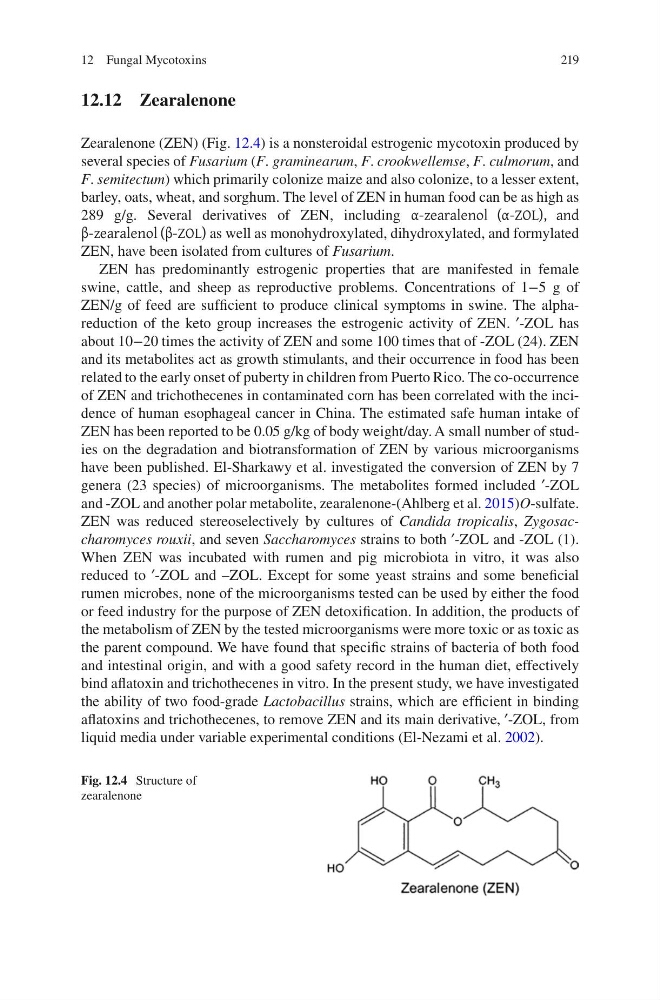
Zearalenone (ZEN) (Fig. 12.4) is a nonsteroidal estrogenic mycotoxin produced by
several species of Fusarium (F. graminearum, F. crookwellemse, F. culmorum, and
F. semitectum) which primarily colonize maize and also colonize, to a lesser extent,
barley, oats, wheat, and sorghum. The level of ZEN in human food can be as high as
289 g/g. Several derivatives of ZEN, including α-zearalenol (α-ZOL), and
β-zearalenol (β-ZOL) as well as monohydroxylated, dihydroxylated, and formylated
ZEN, have been isolated from cultures of Fusarium.
ZEN has predominantly estrogenic properties that are manifested in female
swine, cattle, and sheep as reproductive problems. Concentrations of 1−5 g of
ZEN/g of feed are sufficient to produce clinical symptoms in swine. The alphareduction of the keto group increases the estrogenic activity of ZEN. ′-ZOL has
about 10−20 times the activity of ZEN and some 100 times that of -ZOL (24). ZEN
and its metabolites act as growth stimulants, and their occurrence in food has been
related to the early onset of puberty in children from Puerto Rico. The co- occurrence
of ZEN and trichothecenes in contaminated corn has been correlated with the incidence of human esophageal cancer in China. The estimated safe human intake of
ZEN has been reported to be 0.05 g/kg of body weight/day. A small number of studies on the degradation and biotransformation of ZEN by various microorganisms
have been published. El-Sharkawy et al. investigated the conversion of ZEN by 7
genera (23 species) of microorganisms. The metabolites formed included ′-ZOL
and -ZOL and another polar metabolite, zearalenone-(Ahlberg et al. 2015)O-sulfate.
ZEN was reduced stereoselectively by cultures of Candida tropicalis, Zygosaccharomyces rouxii, and seven Saccharomyces strains to both ′-ZOL and -ZOL (1).
When ZEN was incubated with rumen and pig microbiota in vitro, it was also
reduced to ′-ZOL and –ZOL. Except for some yeast strains and some beneficial
rumen microbes, none of the microorganisms tested can be used by either the food
or feed industry for the purpose of ZEN detoxification. In addition, the products of
the metabolism of ZEN by the tested microorganisms were more toxic or as toxic as
the parent compound. We have found that specific strains of bacteria of both food
and intestinal origin, and with a good safety record in the human diet, effectively
bind aflatoxin and trichothecenes in vitro. In the present study, we have investigated
the ability of two food-grade Lactobacillus strains, which are efficient in binding
aflatoxins and trichothecenes, to remove ZEN and its main derivative, ′-ZOL, from
liquid media under variable experimental conditions (El-Nezami et al. 2002).
Fig. 12.4 Structure of
zearalenone
12 Fungal Mycotoxins
12.12 Zearalenone
Zearalenone (ZEN) (Fig. 12.4) is a nonsteroidal estrogenic mycotoxin produced by
several species of Fusarium (F. graminearum, F. crookwellemse, F. culmorum, and
F. semitectum) which primarily colonize maize and also colonize, to a lesser extent,
barley, oats, wheat, and sorghum. The level of ZEN in human food can be as high as
289 g/g. Several derivatives of ZEN, including α-zearalenol (α-ZOL), and
β-zearalenol (β-ZOL) as well as monohydroxylated, dihydroxylated, and formylated
ZEN, have been isolated from cultures of Fusarium.
ZEN has predominantly estrogenic properties that are manifested in female
swine, cattle, and sheep as reproductive problems. Concentrations of 1−5 g of
ZEN/g of feed are sufficient to produce clinical symptoms in swine. The alphareduction of the keto group increases the estrogenic activity of ZEN. ′-ZOL has
about 10−20 times the activity of ZEN and some 100 times that of -ZOL (24). ZEN
and its metabolites act as growth stimulants, and their occurrence in food has been
related to the early onset of puberty in children from Puerto Rico. The co- occurrence
of ZEN and trichothecenes in contaminated corn has been correlated with the incidence of human esophageal cancer in China. The estimated safe human intake of
ZEN has been reported to be 0.05 g/kg of body weight/day. A small number of studies on the degradation and biotransformation of ZEN by various microorganisms
have been published. El-Sharkawy et al. investigated the conversion of ZEN by 7
genera (23 species) of microorganisms. The metabolites formed included ′-ZOL
and -ZOL and another polar metabolite, zearalenone-(Ahlberg et al. 2015)O-sulfate.
ZEN was reduced stereoselectively by cultures of Candida tropicalis, Zygosaccharomyces rouxii, and seven Saccharomyces strains to both ′-ZOL and -ZOL (1).
When ZEN was incubated with rumen and pig microbiota in vitro, it was also
reduced to ′-ZOL and –ZOL. Except for some yeast strains and some beneficial
rumen microbes, none of the microorganisms tested can be used by either the food
or feed industry for the purpose of ZEN detoxification. In addition, the products of
the metabolism of ZEN by the tested microorganisms were more toxic or as toxic as
the parent compound. We have found that specific strains of bacteria of both food
and intestinal origin, and with a good safety record in the human diet, effectively
bind aflatoxin and trichothecenes in vitro. In the present study, we have investigated
the ability of two food-grade Lactobacillus strains, which are efficient in binding
aflatoxins and trichothecenes, to remove ZEN and its main derivative, ′-ZOL, from
liquid media under variable experimental conditions (El-Nezami et al. 2002).
Fig. 12.4 Structure of
zearalenone
12 Fungal Mycotoxins