

218
Fumonisins have been isolated from corn sold in a supermarket in Charleston
(South Carolina), the city with the highest incidence of the occurrence of esophageal cancer among Afro-Americans in the USA. In contrast to the other mycotoxins,
which are soluble in organic solvents, fumonisins are hydrosoluble, which hinders
their study, and it is probable that many other mycotoxins remain undiscovered due
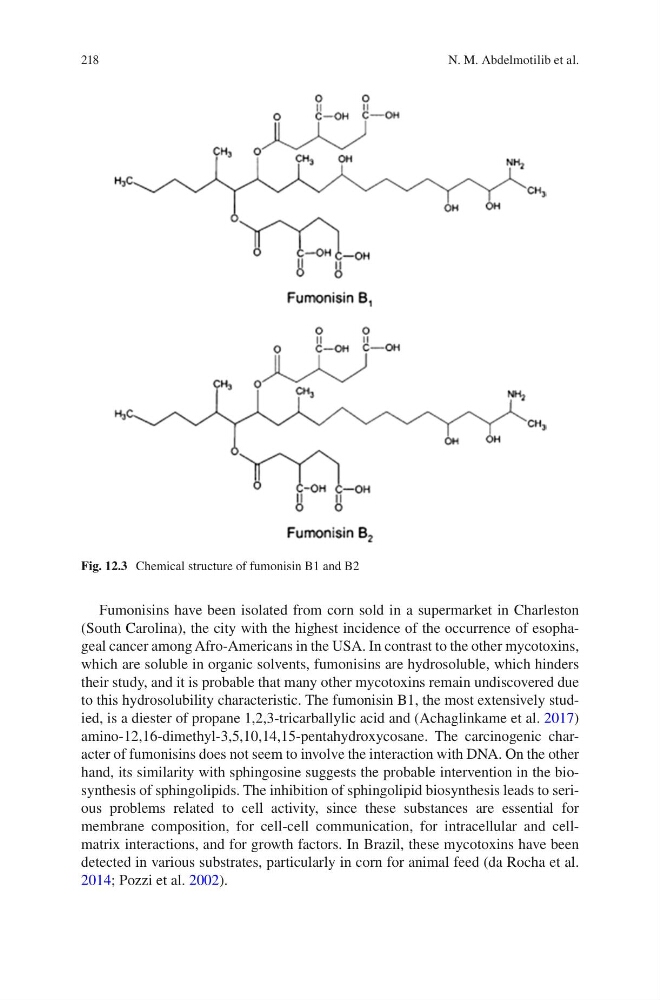
to this hydrosolubility characteristic. The fumonisin B1, the most extensively studied, is a diester of propane 1,2,3-tricarballylic acid and (Achaglinkame et al. 2017)
amino-12,16-dimethyl-3,5,10,14,15-pentahydroxycosane. The carcinogenic character of fumonisins does not seem to involve the interaction with DNA. On the other
hand, its similarity with sphingosine suggests the probable intervention in the biosynthesis of sphingolipids. The inhibition of sphingolipid biosynthesis leads to serious problems related to cell activity, since these substances are essential for
membrane composition, for cell-cell communication, for intracellular and cellmatrix interactions, and for growth factors. In Brazil, these mycotoxins have been
detected in various substrates, particularly in corn for animal feed (da Rocha et al.
2014; Pozzi et al. 2002).
Fig. 12.3 Chemical structure of fumonisin B1 and B2
N. M. Abdelmotilib et al.
Fumonisins have been isolated from corn sold in a supermarket in Charleston
(South Carolina), the city with the highest incidence of the occurrence of esophageal cancer among Afro-Americans in the USA. In contrast to the other mycotoxins,
which are soluble in organic solvents, fumonisins are hydrosoluble, which hinders
their study, and it is probable that many other mycotoxins remain undiscovered due
to this hydrosolubility characteristic. The fumonisin B1, the most extensively studied, is a diester of propane 1,2,3-tricarballylic acid and (Achaglinkame et al. 2017)
amino-12,16-dimethyl-3,5,10,14,15-pentahydroxycosane. The carcinogenic character of fumonisins does not seem to involve the interaction with DNA. On the other
hand, its similarity with sphingosine suggests the probable intervention in the biosynthesis of sphingolipids. The inhibition of sphingolipid biosynthesis leads to serious problems related to cell activity, since these substances are essential for
membrane composition, for cell-cell communication, for intracellular and cellmatrix interactions, and for growth factors. In Brazil, these mycotoxins have been
detected in various substrates, particularly in corn for animal feed (da Rocha et al.
2014; Pozzi et al. 2002).
Fig. 12.3 Chemical structure of fumonisin B1 and B2
N. M. Abdelmotilib et al.