

96
well as applying a semi-industrial scale that has been reported by Farid et al. (2000)
and El-Enshasy et al. (2006, 2018).
Current research on expression systems is focused on two general categories
which are prokaryotic and eukaryotic systems. The advantages of using prokaryotic
system were they are easier to handle and applicable for most purposes, but unfortunately, the prokaryotic system has limitations for the production of eukaryotic
protein especially in post-translational modification like proper folding, glycosylation, phosphorylation, and formation of bridges (Rai and Padh 2001). Hence,
choosing the best expression system in protein expression should be based on some
options like yield to glycosylation, proper folding, and the economics of scaling up.
Study by Porro et al. (2011) showed the comparison of different host cell features in
terms of quantity and quality of the production (Table 6.5). In order to meet the
required production of industrial enzymes, the high yield of production must be
reached.
The filamentous fungi were chosen as a production host instead of yeast or
Escherichia coli for the production of protein due to many factors such as their ability to grow on low-cost medium and their high secretion capacity to the culture
medium. Research by Nevalainen et al. (2005) showed that the natural ability of
filamentous fungi secretes a large amount of protein in the growth medium compared to the other microorganisms.
According to Wang et al. (2005), there are many bioprocessing parameters which
include cultivation medium and effect on condition (pH, agitation, and shear stress)
that should be taken into account in order to improve the yield in terms of growth
and production. In a study conducted by Solis-Pereyra et al. (1993), it is shown that
(4)
D-galacturonic
acid
L-galactonate
2-keto-3-deoxy-L-galactonate
Pyuvate
L-glyceraldehyde
Glycerol
NAD(P)H
NAD(P)
+
L-glyceraldehyde reductase
2-keto-3-deoxy- L-galactonate aldolase
-H20
L-galactonate
dehydratase
gaaB (WG222)
D-galacturonic
acid
reductase
gaaA (WG222)
NAD(P)H
NAD(P)
+
(3)
(2)
(1)
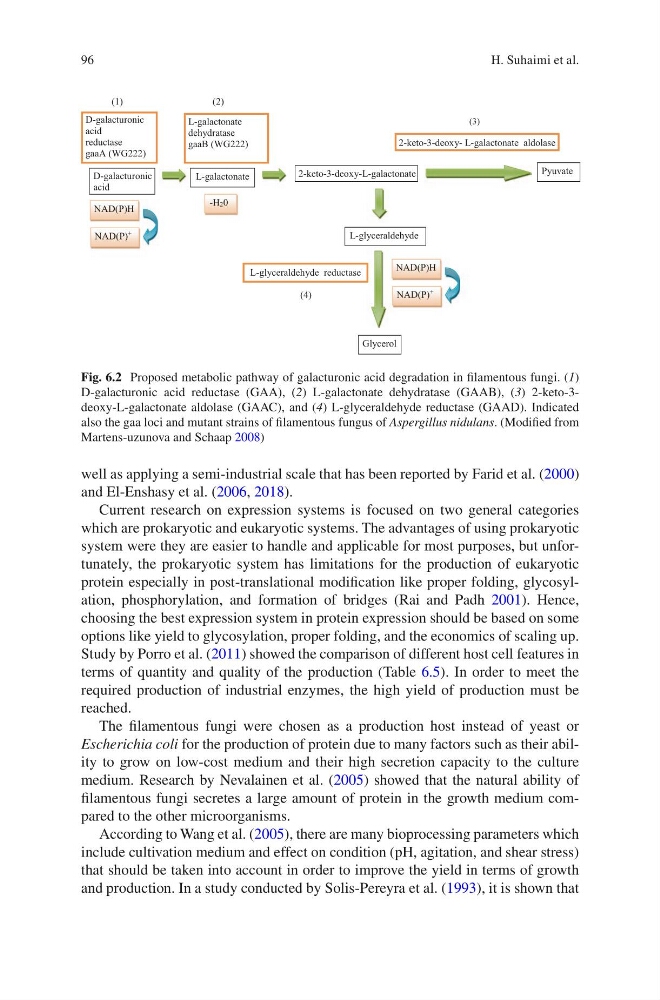
Fig. 6.2 Proposed metabolic pathway of galacturonic acid degradation in filamentous fungi. (1)
D-galacturonic acid reductase (GAA), (2) L-galactonate dehydratase (GAAB), (3) 2-keto-3deoxy-L-galactonate aldolase (GAAC), and (4) L-glyceraldehyde reductase (GAAD). Indicated
also the gaa loci and mutant strains of filamentous fungus of Aspergillus nidulans. (Modified from
Martens-uzunova and Schaap 2008)
H. Suhaimi et al.
well as applying a semi-industrial scale that has been reported by Farid et al. (2000)
and El-Enshasy et al. (2006, 2018).
Current research on expression systems is focused on two general categories
which are prokaryotic and eukaryotic systems. The advantages of using prokaryotic
system were they are easier to handle and applicable for most purposes, but unfortunately, the prokaryotic system has limitations for the production of eukaryotic
protein especially in post-translational modification like proper folding, glycosylation, phosphorylation, and formation of bridges (Rai and Padh 2001). Hence,
choosing the best expression system in protein expression should be based on some
options like yield to glycosylation, proper folding, and the economics of scaling up.
Study by Porro et al. (2011) showed the comparison of different host cell features in
terms of quantity and quality of the production (Table 6.5). In order to meet the
required production of industrial enzymes, the high yield of production must be
reached.
The filamentous fungi were chosen as a production host instead of yeast or
Escherichia coli for the production of protein due to many factors such as their ability to grow on low-cost medium and their high secretion capacity to the culture
medium. Research by Nevalainen et al. (2005) showed that the natural ability of
filamentous fungi secretes a large amount of protein in the growth medium compared to the other microorganisms.
According to Wang et al. (2005), there are many bioprocessing parameters which
include cultivation medium and effect on condition (pH, agitation, and shear stress)
that should be taken into account in order to improve the yield in terms of growth
and production. In a study conducted by Solis-Pereyra et al. (1993), it is shown that
(4)
D-galacturonic
acid
L-galactonate
2-keto-3-deoxy-L-galactonate
Pyuvate
L-glyceraldehyde
Glycerol
NAD(P)H
NAD(P)
+
L-glyceraldehyde reductase
2-keto-3-deoxy- L-galactonate aldolase
-H20
L-galactonate
dehydratase
gaaB (WG222)
D-galacturonic
acid
reductase
gaaA (WG222)
NAD(P)H
NAD(P)
+
(3)
(2)
(1)
Fig. 6.2 Proposed metabolic pathway of galacturonic acid degradation in filamentous fungi. (1)
D-galacturonic acid reductase (GAA), (2) L-galactonate dehydratase (GAAB), (3) 2-keto-3deoxy-L-galactonate aldolase (GAAC), and (4) L-glyceraldehyde reductase (GAAD). Indicated
also the gaa loci and mutant strains of filamentous fungus of Aspergillus nidulans. (Modified from
Martens-uzunova and Schaap 2008)
H. Suhaimi et al.