

unit, which provides the smallest available volume for light detection and as the polymerase incorporates fluorescently labeled deoxyribonucleoside triphosphates (dNTPs) light is
emitted. The order of their enzymatic incorporation into a growing DNA strand is detected
via ZMW nanostructure arrays, which allow the simultaneous detection of thousands of
single-molecule sequencing reactions. The replication processes in all ZMWs of a SMRT
cell are recorded by a “movie” of light pulses, and the pulses corresponding to each ZMW
can be interpreted to be a sequence of bases. With this approach nucleotide incorporation is
measured in real time. With the Sequel II system you can optimize your results with two
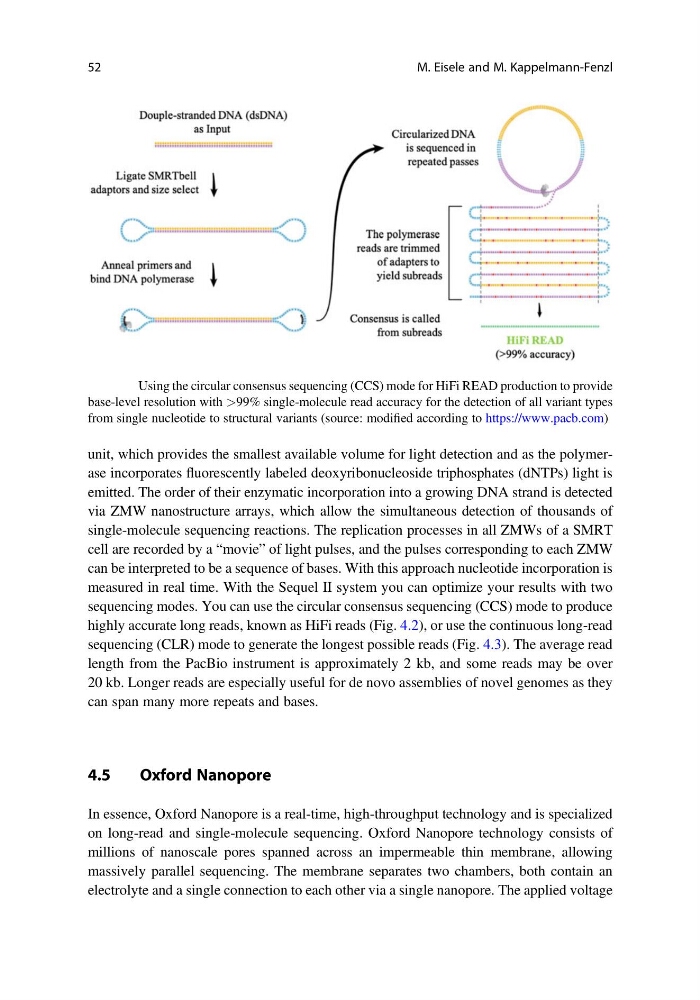
sequencing modes. You can use the circular consensus sequencing (CCS) mode to produce
highly accurate long reads, known as HiFi reads (Fig. 4.2), or use the continuous long-read
sequencing (CLR) mode to generate the longest possible reads (Fig. 4.3). The average read
length from the PacBio instrument is approximately 2 kb, and some reads may be over
20 kb. Longer reads are especially useful for de novo assemblies of novel genomes as they
can span many more repeats and bases.
4.5
Oxford Nanopore
In essence, Oxford Nanopore is a real-time, high-throughput technology and is specialized
on long-read and single-molecule sequencing. Oxford Nanopore technology consists of
millions of nanoscale pores spanned across an impermeable thin membrane, allowing
massively parallel sequencing. The membrane separates two chambers, both contain an
electrolyte and a single connection to each other via a single nanopore. The applied voltage
Fig. 4.2 Using the circular consensus sequencing (CCS) mode for HiFi READ production to provide
base-level resolution with >99% single-molecule read accuracy for the detection of all variant types
from single nucleotide to structural variants (source: modified according to https://www.pacb.com)
52
M. Eisele and M. Kappelmann-Fenzl
emitted. The order of their enzymatic incorporation into a growing DNA strand is detected
via ZMW nanostructure arrays, which allow the simultaneous detection of thousands of
single-molecule sequencing reactions. The replication processes in all ZMWs of a SMRT
cell are recorded by a “movie” of light pulses, and the pulses corresponding to each ZMW
can be interpreted to be a sequence of bases. With this approach nucleotide incorporation is
measured in real time. With the Sequel II system you can optimize your results with two
sequencing modes. You can use the circular consensus sequencing (CCS) mode to produce
highly accurate long reads, known as HiFi reads (Fig. 4.2), or use the continuous long-read
sequencing (CLR) mode to generate the longest possible reads (Fig. 4.3). The average read
length from the PacBio instrument is approximately 2 kb, and some reads may be over
20 kb. Longer reads are especially useful for de novo assemblies of novel genomes as they
can span many more repeats and bases.
4.5
Oxford Nanopore
In essence, Oxford Nanopore is a real-time, high-throughput technology and is specialized
on long-read and single-molecule sequencing. Oxford Nanopore technology consists of
millions of nanoscale pores spanned across an impermeable thin membrane, allowing
massively parallel sequencing. The membrane separates two chambers, both contain an
electrolyte and a single connection to each other via a single nanopore. The applied voltage
Fig. 4.2 Using the circular consensus sequencing (CCS) mode for HiFi READ production to provide
base-level resolution with >99% single-molecule read accuracy for the detection of all variant types
from single nucleotide to structural variants (source: modified according to https://www.pacb.com)
52
M. Eisele and M. Kappelmann-Fenzl