

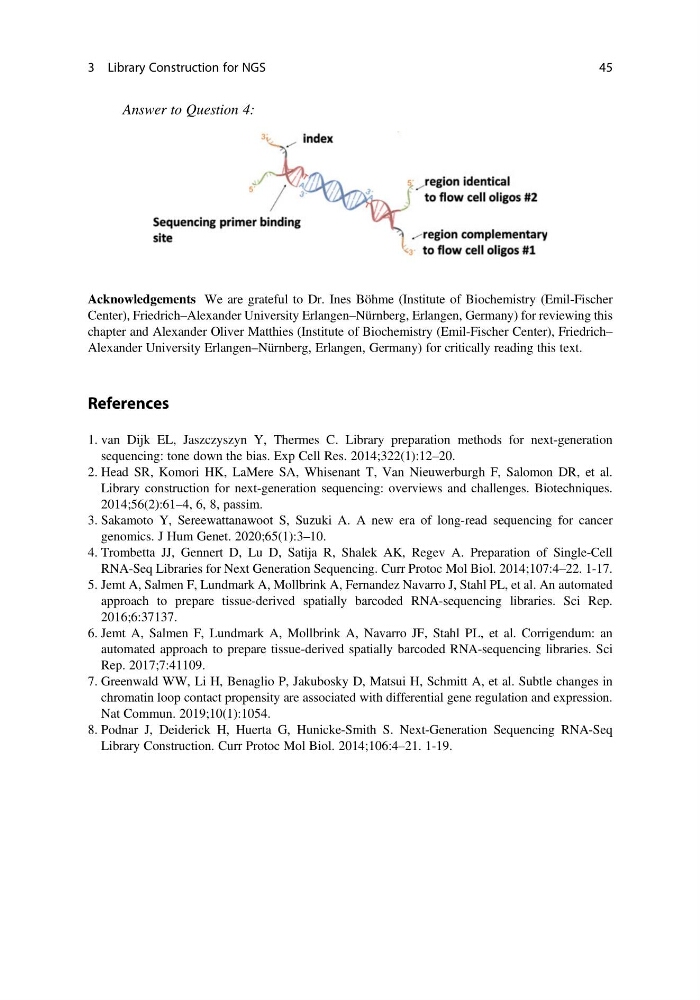
Answer to Question 4:
Acknowledgements We are grateful to Dr. Ines Böhme (Institute of Biochemistry (Emil-Fischer
Center), Friedrich–Alexander University Erlangen–Nürnberg, Erlangen, Germany) for reviewing this
chapter and Alexander Oliver Matthies (Institute of Biochemistry (Emil-Fischer Center), Friedrich–
Alexander University Erlangen–Nürnberg, Erlangen, Germany) for critically reading this text.
References
1. van Dijk EL, Jaszczyszyn Y, Thermes C. Library preparation methods for next-generation
sequencing: tone down the bias. Exp Cell Res. 2014;322(1):12–20.
2. Head SR, Komori HK, LaMere SA, Whisenant T, Van Nieuwerburgh F, Salomon DR, et al.
Library construction for next-generation sequencing: overviews and challenges. Biotechniques.
2014;56(2):61–4, 6, 8, passim.
3. Sakamoto Y, Sereewattanawoot S, Suzuki A. A new era of long-read sequencing for cancer
genomics. J Hum Genet. 2020;65(1):3–10.
4. Trombetta JJ, Gennert D, Lu D, Satija R, Shalek AK, Regev A. Preparation of Single-Cell
RNA-Seq Libraries for Next Generation Sequencing. Curr Protoc Mol Biol. 2014;107:4–22. 1-17.
5. Jemt A, Salmen F, Lundmark A, Mollbrink A, Fernandez Navarro J, Stahl PL, et al. An automated
approach to prepare tissue-derived spatially barcoded RNA-sequencing libraries. Sci Rep.
2016;6:37137.
6. Jemt A, Salmen F, Lundmark A, Mollbrink A, Navarro JF, Stahl PL, et al. Corrigendum: an
automated approach to prepare tissue-derived spatially barcoded RNA-sequencing libraries. Sci
Rep. 2017;7:41109.
7. Greenwald WW, Li H, Benaglio P, Jakubosky D, Matsui H, Schmitt A, et al. Subtle changes in
chromatin loop contact propensity are associated with differential gene regulation and expression.
Nat Commun. 2019;10(1):1054.
8. Podnar J, Deiderick H, Huerta G, Hunicke-Smith S. Next-Generation Sequencing RNA-Seq
Library Construction. Curr Protoc Mol Biol. 2014;106:4–21. 1-19.
3 Library Construction for NGS
45
Acknowledgements We are grateful to Dr. Ines Böhme (Institute of Biochemistry (Emil-Fischer
Center), Friedrich–Alexander University Erlangen–Nürnberg, Erlangen, Germany) for reviewing this
chapter and Alexander Oliver Matthies (Institute of Biochemistry (Emil-Fischer Center), Friedrich–
Alexander University Erlangen–Nürnberg, Erlangen, Germany) for critically reading this text.
References
1. van Dijk EL, Jaszczyszyn Y, Thermes C. Library preparation methods for next-generation
sequencing: tone down the bias. Exp Cell Res. 2014;322(1):12–20.
2. Head SR, Komori HK, LaMere SA, Whisenant T, Van Nieuwerburgh F, Salomon DR, et al.
Library construction for next-generation sequencing: overviews and challenges. Biotechniques.
2014;56(2):61–4, 6, 8, passim.
3. Sakamoto Y, Sereewattanawoot S, Suzuki A. A new era of long-read sequencing for cancer
genomics. J Hum Genet. 2020;65(1):3–10.
4. Trombetta JJ, Gennert D, Lu D, Satija R, Shalek AK, Regev A. Preparation of Single-Cell
RNA-Seq Libraries for Next Generation Sequencing. Curr Protoc Mol Biol. 2014;107:4–22. 1-17.
5. Jemt A, Salmen F, Lundmark A, Mollbrink A, Fernandez Navarro J, Stahl PL, et al. An automated
approach to prepare tissue-derived spatially barcoded RNA-sequencing libraries. Sci Rep.
2016;6:37137.
6. Jemt A, Salmen F, Lundmark A, Mollbrink A, Navarro JF, Stahl PL, et al. Corrigendum: an
automated approach to prepare tissue-derived spatially barcoded RNA-sequencing libraries. Sci
Rep. 2017;7:41109.
7. Greenwald WW, Li H, Benaglio P, Jakubosky D, Matsui H, Schmitt A, et al. Subtle changes in
chromatin loop contact propensity are associated with differential gene regulation and expression.
Nat Commun. 2019;10(1):1054.
8. Podnar J, Deiderick H, Huerta G, Hunicke-Smith S. Next-Generation Sequencing RNA-Seq
Library Construction. Curr Protoc Mol Biol. 2014;106:4–21. 1-19.
3 Library Construction for NGS
45