

ACA
ACC
ACG
ACT
CCA
CCC
CCG
CCT
GCA
GCC
ACA
ACC
ACG
ACT
CCA
CCC
CCG
CCT
GCA
GCC
ACA
ACC
ACG
ACT
CCA
CCC
CCG
CCT
GCA
GCC
ACA
ACC
ACG
ACT
CCA
CCC
CCG
CCT
GCA
GCC
ACA
ACC
ACG
ACT
CCA
CCC
CCG
CCT
GCA
GCC
ACA
ACC
ACG
ACT
CCA
CCC
CCG
CCT
GCA
GCC
0
5
number of mutations
10
15
20
C>A
C>G
C>T
T>A
T>C
T>G
UV exposure causes
DNA damage
Pyrimidine dimer formation
Specific patterns of mutational processes
Fig. 2.2
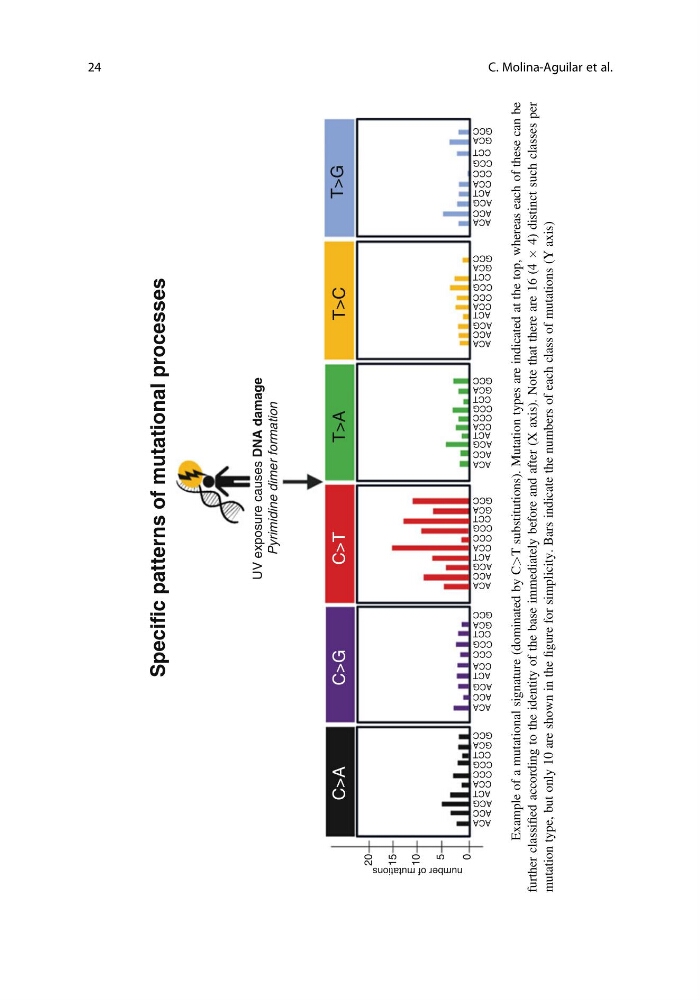
Example of a mutational signature (dominated by C>T substitutions). Mutation types are indicated at the top, whereas each of these can be
further classified according to the identity of the base immediately before and after (X axis). Note that there are 16 (4
 4) distinct such classes per
mutation type, but only 10 are shown in the
figure for simplicity. Bars indicate the numbers of each class of mutations (Y axis)
24
C. Molina-Aguilar et al.
ACC
ACG
ACT
CCA
CCC
CCG
CCT
GCA
GCC
ACA
ACC
ACG
ACT
CCA
CCC
CCG
CCT
GCA
GCC
ACA
ACC
ACG
ACT
CCA
CCC
CCG
CCT
GCA
GCC
ACA
ACC
ACG
ACT
CCA
CCC
CCG
CCT
GCA
GCC
ACA
ACC
ACG
ACT
CCA
CCC
CCG
CCT
GCA
GCC
ACA
ACC
ACG
ACT
CCA
CCC
CCG
CCT
GCA
GCC
0
5
number of mutations
10
15
20
C>A
C>G
C>T
T>A
T>C
T>G
UV exposure causes
DNA damage
Pyrimidine dimer formation
Specific patterns of mutational processes
Fig. 2.2
Example of a mutational signature (dominated by C>T substitutions). Mutation types are indicated at the top, whereas each of these can be
further classified according to the identity of the base immediately before and after (X axis). Note that there are 16 (4
 4) distinct such classes per
mutation type, but only 10 are shown in the
figure for simplicity. Bars indicate the numbers of each class of mutations (Y axis)
24
C. Molina-Aguilar et al.