

or methylated DNA of “regions.” Defining peaks/regions means to identify locations in the
genome where we find more sequencing reads than we would expect to find by chance.
There are number of different methods for identifying peaks/regions from ChIP-Seq
experiments. You can use any peak calling algorithm (http://seabass.mpipz.mpg.de/
encode/encodeTools.html) and it is not required that you use HOMER for peak finding to
use the rest of the tools included in HOMER.
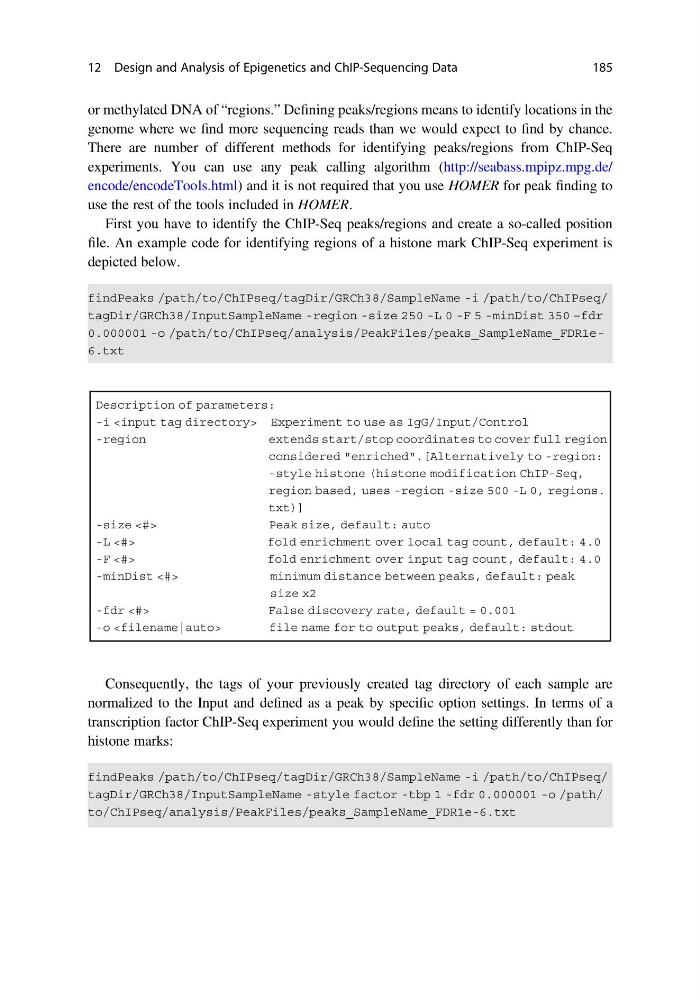
First you have to identify the ChIP-Seq peaks/regions and create a so-called position
file. An example code for identifying regions of a histone mark ChIP-Seq experiment is
depicted below.
Consequently, the tags of your previously created tag directory of each sample are
normalized to the Input and defined as a peak by specific option settings. In terms of a
transcription factor ChIP-Seq experiment you would define the setting differently than for
histone marks:
12 Design and Analysis of Epigenetics and ChIP-Sequencing Data
185
genome where we find more sequencing reads than we would expect to find by chance.
There are number of different methods for identifying peaks/regions from ChIP-Seq
experiments. You can use any peak calling algorithm (http://seabass.mpipz.mpg.de/
encode/encodeTools.html) and it is not required that you use HOMER for peak finding to
use the rest of the tools included in HOMER.
First you have to identify the ChIP-Seq peaks/regions and create a so-called position
file. An example code for identifying regions of a histone mark ChIP-Seq experiment is
depicted below.
Consequently, the tags of your previously created tag directory of each sample are
normalized to the Input and defined as a peak by specific option settings. In terms of a
transcription factor ChIP-Seq experiment you would define the setting differently than for
histone marks:
12 Design and Analysis of Epigenetics and ChIP-Sequencing Data
185