

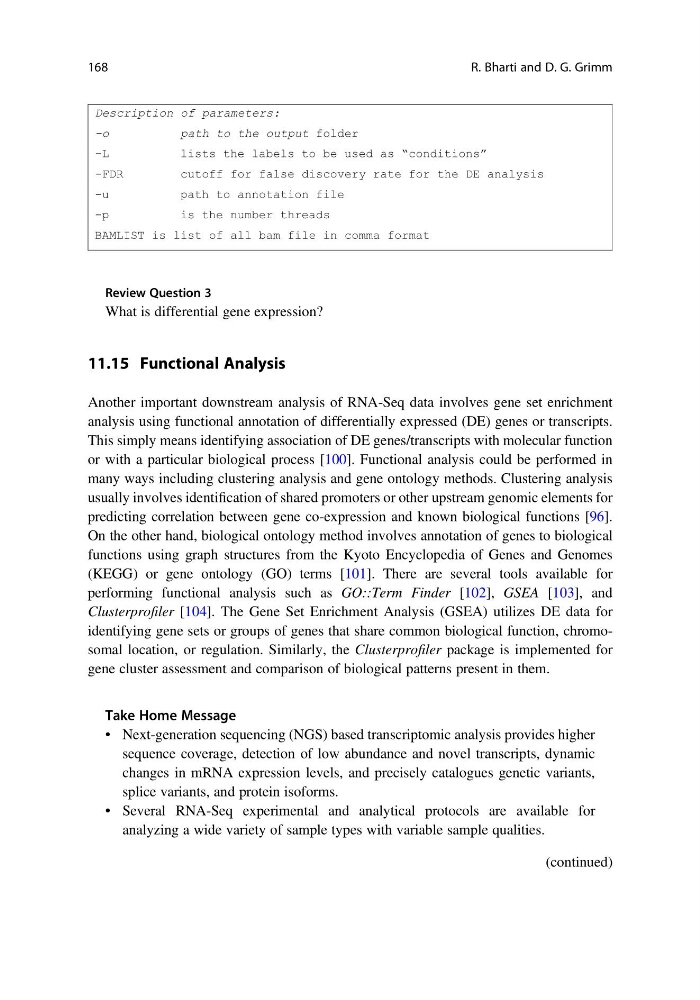
Description of parameters:
-o
path to the output folder
-L
lists the labels to be used as “conditions”
-FDR
cutoff for false discovery rate for the DE analysis
-u
path to annotation file
-p
is the number threads
BAMLIST is list of all bam file in comma format
Review Question 3
What is differential gene expression?
11.15 Functional Analysis
Another important downstream analysis of RNA-Seq data involves gene set enrichment
analysis using functional annotation of differentially expressed (DE) genes or transcripts.
This simply means identifying association of DE genes/transcripts with molecular function
or with a particular biological process [100]. Functional analysis could be performed in
many ways including clustering analysis and gene ontology methods. Clustering analysis
usually involves identification of shared promoters or other upstream genomic elements for
predicting correlation between gene co-expression and known biological functions [96].
On the other hand, biological ontology method involves annotation of genes to biological
functions using graph structures from the Kyoto Encyclopedia of Genes and Genomes
(KEGG) or gene ontology (GO) terms [101]. There are several tools available for
performing functional analysis such as GO::Term Finder [102], GSEA [103], and
Clusterprofiler [104]. The Gene Set Enrichment Analysis (GSEA) utilizes DE data for
identifying gene sets or groups of genes that share common biological function, chromosomal location, or regulation. Similarly, the Clusterprofiler package is implemented for
gene cluster assessment and comparison of biological patterns present in them.
Take Home Message
• Next-generation sequencing (NGS) based transcriptomic analysis provides higher
sequence coverage, detection of low abundance and novel transcripts, dynamic
changes in mRNA expression levels, and precisely catalogues genetic variants,
splice variants, and protein isoforms.
• Several RNA-Seq experimental and analytical protocols are available for
analyzing a wide variety of sample types with variable sample qualities.
(continued)
168
R. Bharti and D. G. Grimm
-o
path to the output folder
-L
lists the labels to be used as “conditions”
-FDR
cutoff for false discovery rate for the DE analysis
-u
path to annotation file
-p
is the number threads
BAMLIST is list of all bam file in comma format
Review Question 3
What is differential gene expression?
11.15 Functional Analysis
Another important downstream analysis of RNA-Seq data involves gene set enrichment
analysis using functional annotation of differentially expressed (DE) genes or transcripts.
This simply means identifying association of DE genes/transcripts with molecular function
or with a particular biological process [100]. Functional analysis could be performed in
many ways including clustering analysis and gene ontology methods. Clustering analysis
usually involves identification of shared promoters or other upstream genomic elements for
predicting correlation between gene co-expression and known biological functions [96].
On the other hand, biological ontology method involves annotation of genes to biological
functions using graph structures from the Kyoto Encyclopedia of Genes and Genomes
(KEGG) or gene ontology (GO) terms [101]. There are several tools available for
performing functional analysis such as GO::Term Finder [102], GSEA [103], and
Clusterprofiler [104]. The Gene Set Enrichment Analysis (GSEA) utilizes DE data for
identifying gene sets or groups of genes that share common biological function, chromosomal location, or regulation. Similarly, the Clusterprofiler package is implemented for
gene cluster assessment and comparison of biological patterns present in them.
Take Home Message
• Next-generation sequencing (NGS) based transcriptomic analysis provides higher
sequence coverage, detection of low abundance and novel transcripts, dynamic
changes in mRNA expression levels, and precisely catalogues genetic variants,
splice variants, and protein isoforms.
• Several RNA-Seq experimental and analytical protocols are available for
analyzing a wide variety of sample types with variable sample qualities.
(continued)
168
R. Bharti and D. G. Grimm