

Existing Count Table If a pre-existing count table is available, then it can be processed
directly by either package.
Subsequently, the lowly expressed transcripts are removed by independent filtering
before the count-based DE analysis is performed using either of the packages (DESeq2,
edgeR, or Limma).
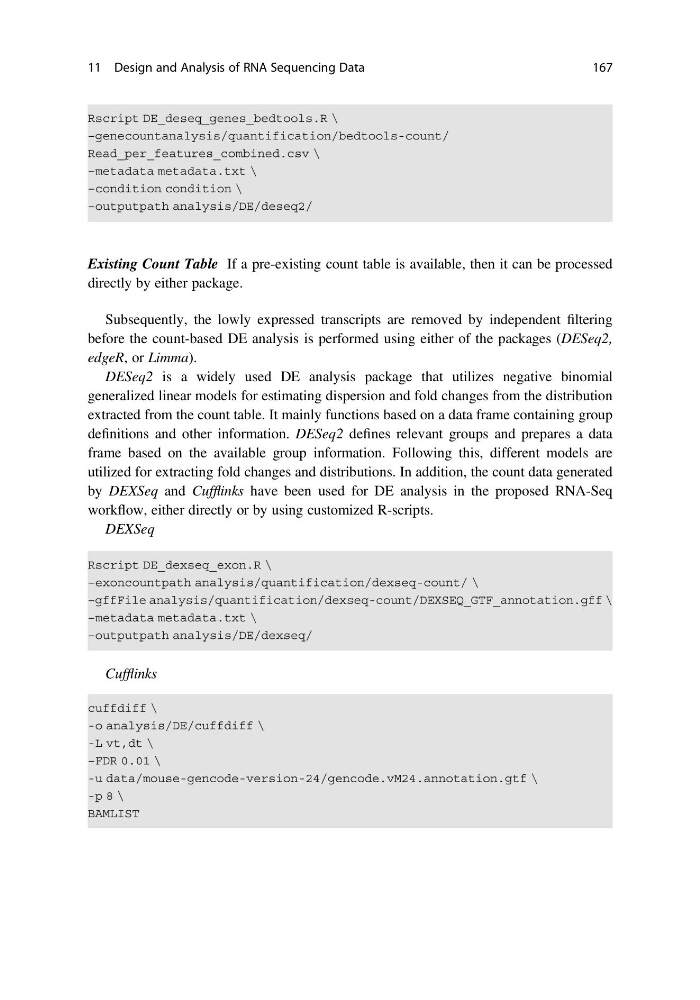
DESeq2 is a widely used DE analysis package that utilizes negative binomial
generalized linear models for estimating dispersion and fold changes from the distribution
extracted from the count table. It mainly functions based on a data frame containing group
definitions and other information. DESeq2 defines relevant groups and prepares a data
frame based on the available group information. Following this, different models are
utilized for extracting fold changes and distributions. In addition, the count data generated
by DEXSeq and Cufflinks have been used for DE analysis in the proposed RNA-Seq
workflow, either directly or by using customized R-scripts.
DEXSeq
Cufflinks
11 Design and Analysis of RNA Sequencing Data
167
directly by either package.
Subsequently, the lowly expressed transcripts are removed by independent filtering
before the count-based DE analysis is performed using either of the packages (DESeq2,
edgeR, or Limma).
DESeq2 is a widely used DE analysis package that utilizes negative binomial
generalized linear models for estimating dispersion and fold changes from the distribution
extracted from the count table. It mainly functions based on a data frame containing group
definitions and other information. DESeq2 defines relevant groups and prepares a data
frame based on the available group information. Following this, different models are
utilized for extracting fold changes and distributions. In addition, the count data generated
by DEXSeq and Cufflinks have been used for DE analysis in the proposed RNA-Seq
workflow, either directly or by using customized R-scripts.
DEXSeq
Cufflinks
11 Design and Analysis of RNA Sequencing Data
167