

consists of 120 million base pairs (120 Mb). Due to the huge amount of data, it is common
to refer to genome sizes in terms of kilo-bases (thousands), mega-bases (millions), and
giga-bases (billions). But there is absolutely no relation between genome size and complexity or intelligence of an organism.
1.2.1.1 RNA
As already mentioned above, the DNA is written in a four-letter code (T/A/C/G) partially
containing genes. In eukaryotic cell systems, the DNA never leaves the nucleus, thus a
structure called RNA is created, a transcript of the DNA, carrying the genetic information
out of the nucleus, e.g., to guarantee translation into functional proteins. The RNA code is
similar to the genetic one; however, RNA is single stranded, the nucleotide T is replaced by
a U (Uracil) and after transcription from DNA to RNA, we do not longer talk about
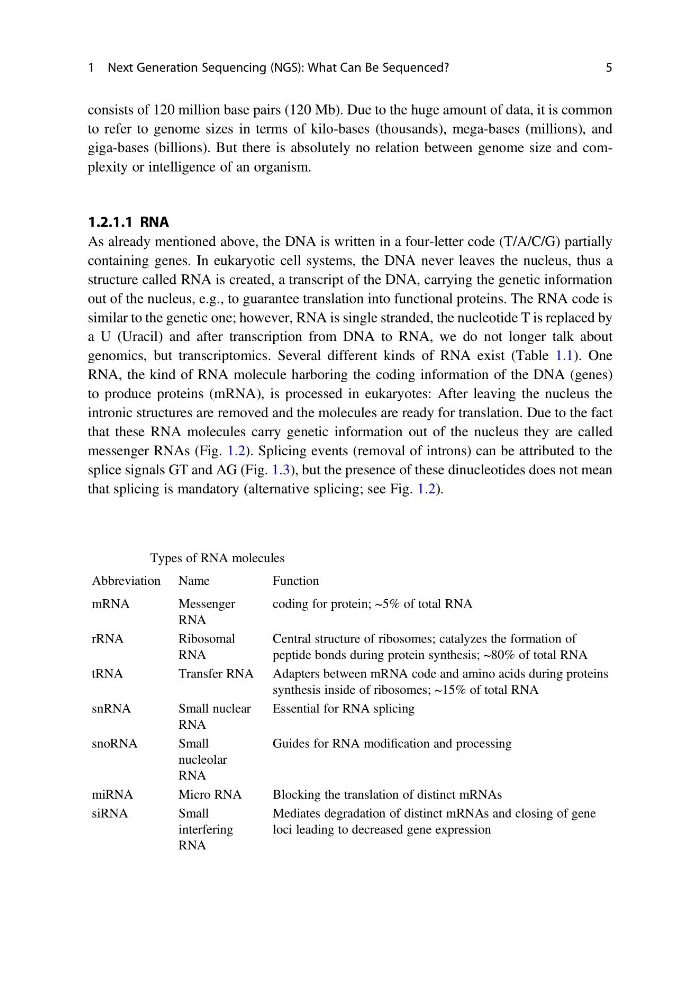
genomics, but transcriptomics. Several different kinds of RNA exist (Table 1.1). One
RNA, the kind of RNA molecule harboring the coding information of the DNA (genes)
to produce proteins (mRNA), is processed in eukaryotes: After leaving the nucleus the
intronic structures are removed and the molecules are ready for translation. Due to the fact
that these RNA molecules carry genetic information out of the nucleus they are called
messenger RNAs (Fig. 1.2). Splicing events (removal of introns) can be attributed to the
splice signals GT and AG (Fig. 1.3), but the presence of these dinucleotides does not mean
that splicing is mandatory (alternative splicing; see Fig. 1.2).
Table 1.1 Types of RNA molecules
Abbreviation Name
Function
mRNA
Messenger
RNA
coding for protein; ~5% of total RNA
rRNA
Ribosomal
RNA
Central structure of ribosomes; catalyzes the formation of
peptide bonds during protein synthesis; ~80% of total RNA
tRNA
Transfer RNA Adapters between mRNA code and amino acids during proteins
synthesis inside of ribosomes; ~15% of total RNA
snRNA
Small nuclear
RNA
Essential for RNA splicing
snoRNA
Small
nucleolar
RNA
Guides for RNA modification and processing
miRNA
Micro RNA
Blocking the translation of distinct mRNAs
siRNA
Small
interfering
RNA
Mediates degradation of distinct mRNAs and closing of gene
loci leading to decreased gene expression
1 Next Generation Sequencing (NGS): What Can Be Sequenced?
5
to refer to genome sizes in terms of kilo-bases (thousands), mega-bases (millions), and
giga-bases (billions). But there is absolutely no relation between genome size and complexity or intelligence of an organism.
1.2.1.1 RNA
As already mentioned above, the DNA is written in a four-letter code (T/A/C/G) partially
containing genes. In eukaryotic cell systems, the DNA never leaves the nucleus, thus a
structure called RNA is created, a transcript of the DNA, carrying the genetic information
out of the nucleus, e.g., to guarantee translation into functional proteins. The RNA code is
similar to the genetic one; however, RNA is single stranded, the nucleotide T is replaced by
a U (Uracil) and after transcription from DNA to RNA, we do not longer talk about
genomics, but transcriptomics. Several different kinds of RNA exist (Table 1.1). One
RNA, the kind of RNA molecule harboring the coding information of the DNA (genes)
to produce proteins (mRNA), is processed in eukaryotes: After leaving the nucleus the
intronic structures are removed and the molecules are ready for translation. Due to the fact
that these RNA molecules carry genetic information out of the nucleus they are called
messenger RNAs (Fig. 1.2). Splicing events (removal of introns) can be attributed to the
splice signals GT and AG (Fig. 1.3), but the presence of these dinucleotides does not mean
that splicing is mandatory (alternative splicing; see Fig. 1.2).
Table 1.1 Types of RNA molecules
Abbreviation Name
Function
mRNA
Messenger
RNA
coding for protein; ~5% of total RNA
rRNA
Ribosomal
RNA
Central structure of ribosomes; catalyzes the formation of
peptide bonds during protein synthesis; ~80% of total RNA
tRNA
Transfer RNA Adapters between mRNA code and amino acids during proteins
synthesis inside of ribosomes; ~15% of total RNA
snRNA
Small nuclear
RNA
Essential for RNA splicing
snoRNA
Small
nucleolar
RNA
Guides for RNA modification and processing
miRNA
Micro RNA
Blocking the translation of distinct mRNAs
siRNA
Small
interfering
RNA
Mediates degradation of distinct mRNAs and closing of gene
loci leading to decreased gene expression
1 Next Generation Sequencing (NGS): What Can Be Sequenced?
5