

• forward/reverse
• top/bottom
• Watson/Crick
• leading/lagging, etc.
It should be noted that the different possible labels of the DNA strands should not be
confused with the directionality sense and antisense. The antisense strand is transcribed
into RNA not the sense strand, resulting in an RNA having the sequence of the sense strand
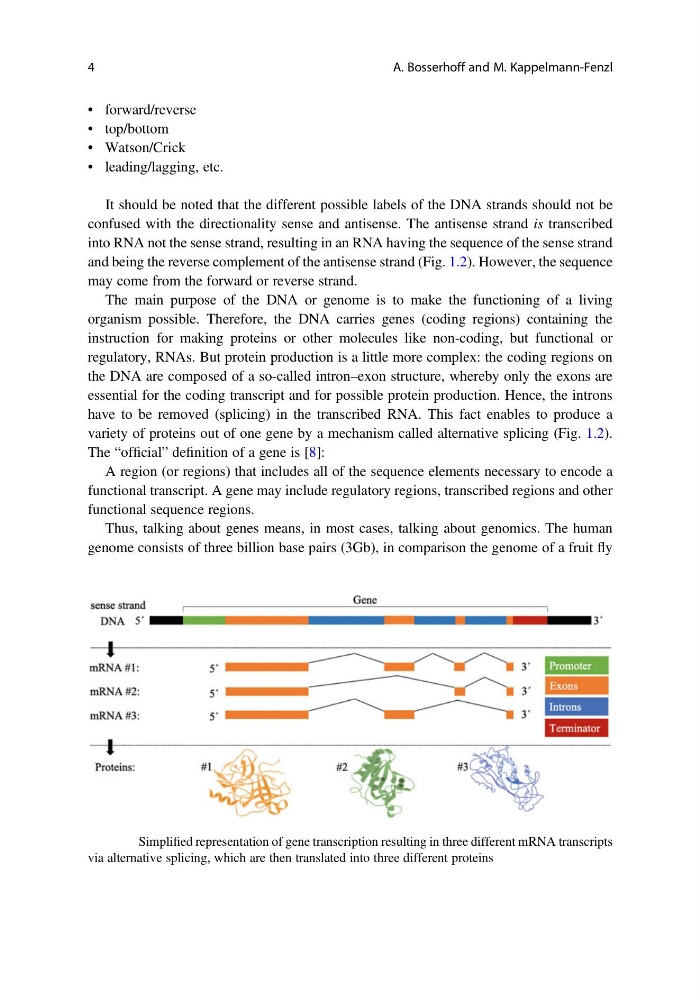
and being the reverse complement of the antisense strand (Fig. 1.2). However, the sequence
may come from the forward or reverse strand.
The main purpose of the DNA or genome is to make the functioning of a living
organism possible. Therefore, the DNA carries genes (coding regions) containing the
instruction for making proteins or other molecules like non-coding, but functional or
regulatory, RNAs. But protein production is a little more complex: the coding regions on
the DNA are composed of a so-called intron–exon structure, whereby only the exons are
essential for the coding transcript and for possible protein production. Hence, the introns
have to be removed (splicing) in the transcribed RNA. This fact enables to produce a
variety of proteins out of one gene by a mechanism called alternative splicing (Fig. 1.2).
The “official” definition of a gene is [8]:
A region (or regions) that includes all of the sequence elements necessary to encode a
functional transcript. A gene may include regulatory regions, transcribed regions and other
functional sequence regions.
Thus, talking about genes means, in most cases, talking about genomics. The human
genome consists of three billion base pairs (3Gb), in comparison the genome of a fruit fly
Fig. 1.2 Simplified representation of gene transcription resulting in three different mRNA transcripts
via alternative splicing, which are then translated into three different proteins
4
A. Bosserhoff and M. Kappelmann-Fenzl
• top/bottom
• Watson/Crick
• leading/lagging, etc.
It should be noted that the different possible labels of the DNA strands should not be
confused with the directionality sense and antisense. The antisense strand is transcribed
into RNA not the sense strand, resulting in an RNA having the sequence of the sense strand
and being the reverse complement of the antisense strand (Fig. 1.2). However, the sequence
may come from the forward or reverse strand.
The main purpose of the DNA or genome is to make the functioning of a living
organism possible. Therefore, the DNA carries genes (coding regions) containing the
instruction for making proteins or other molecules like non-coding, but functional or
regulatory, RNAs. But protein production is a little more complex: the coding regions on
the DNA are composed of a so-called intron–exon structure, whereby only the exons are
essential for the coding transcript and for possible protein production. Hence, the introns
have to be removed (splicing) in the transcribed RNA. This fact enables to produce a
variety of proteins out of one gene by a mechanism called alternative splicing (Fig. 1.2).
The “official” definition of a gene is [8]:
A region (or regions) that includes all of the sequence elements necessary to encode a
functional transcript. A gene may include regulatory regions, transcribed regions and other
functional sequence regions.
Thus, talking about genes means, in most cases, talking about genomics. The human
genome consists of three billion base pairs (3Gb), in comparison the genome of a fruit fly
Fig. 1.2 Simplified representation of gene transcription resulting in three different mRNA transcripts
via alternative splicing, which are then translated into three different proteins
4
A. Bosserhoff and M. Kappelmann-Fenzl