

of raw sequencing reads. FastQC is a commonly used tool providing various analyses and
quality assessments about the overall quality of the raw sequencing to identify low-quality
reads (see Sect. 7.3.1). QC is followed by a pre-processing step that involves removal of lowquality bases, adapter sequences, and other contaminating sequences. Cutadapt [28] and
Trimmomatic [29] are two popular tools utilized for filtering (removing adapter and/or other
contaminating sequences) based on parameters that could be easily customized by the user.
Figure 11.2 summarizes all necessary steps schematically. In addition, we provide a
detailed practical example for a reference-based RNA-Seq analysis on GitHub: https://
github.com/grimmlab/BookChapter-RNA-Seq-Analyses. For this example, data from the
Sequence Read Archive (SRA) [30] are used. Fastq files are downloaded and an initial
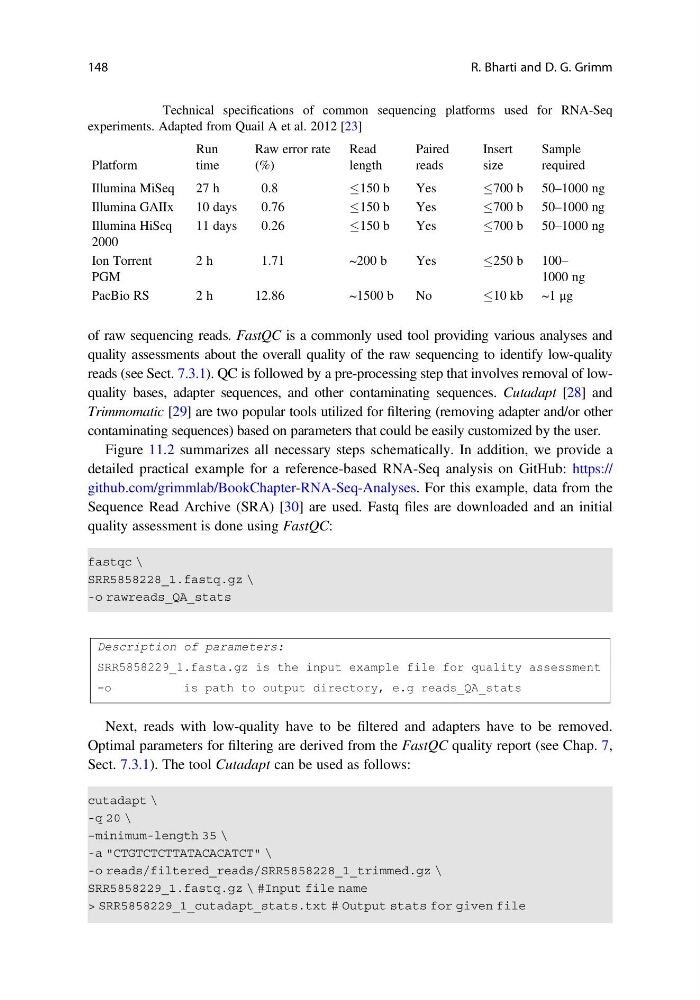
quality assessment is done using FastQC:
Description of parameters:
SRR5858229_1.fasta.gz is the input example file for quality assessment
-o
is path to output directory, e.g reads_QA_stats
Next, reads with low-quality have to be filtered and adapters have to be removed.
Optimal parameters for filtering are derived from the FastQC quality report (see Chap. 7,
Sect. 7.3.1). The tool Cutadapt can be used as follows:
Table 11.1 Technical specifications of common sequencing platforms used for RNA-Seq
experiments. Adapted from Quail A et al. 2012 [23]
Platform
Run
time
Raw error rate
(%)
Read
length
Paired
reads
Insert
size
Sample
required
Illumina MiSeq
27 h
0.8
150 b
Yes
700 b 50–1000 ng
Illumina GAIIx
10 days
0.76
150 b
Yes
700 b 50–1000 ng
Illumina HiSeq
2000
11 days
0.26
150 b
Yes
700 b 50–1000 ng
Ion Torrent
PGM
2 h
1.71
~200 b
Yes
250 b 100–
1000 ng
PacBio RS
2 h
12.86
~1500 b
No
10 kb ~1 μg
148
R. Bharti and D. G. Grimm
quality assessments about the overall quality of the raw sequencing to identify low-quality
reads (see Sect. 7.3.1). QC is followed by a pre-processing step that involves removal of lowquality bases, adapter sequences, and other contaminating sequences. Cutadapt [28] and
Trimmomatic [29] are two popular tools utilized for filtering (removing adapter and/or other
contaminating sequences) based on parameters that could be easily customized by the user.
Figure 11.2 summarizes all necessary steps schematically. In addition, we provide a
detailed practical example for a reference-based RNA-Seq analysis on GitHub: https://
github.com/grimmlab/BookChapter-RNA-Seq-Analyses. For this example, data from the
Sequence Read Archive (SRA) [30] are used. Fastq files are downloaded and an initial
quality assessment is done using FastQC:
Description of parameters:
SRR5858229_1.fasta.gz is the input example file for quality assessment
-o
is path to output directory, e.g reads_QA_stats
Next, reads with low-quality have to be filtered and adapters have to be removed.
Optimal parameters for filtering are derived from the FastQC quality report (see Chap. 7,
Sect. 7.3.1). The tool Cutadapt can be used as follows:
Table 11.1 Technical specifications of common sequencing platforms used for RNA-Seq
experiments. Adapted from Quail A et al. 2012 [23]
Platform
Run
time
Raw error rate
(%)
Read
length
Paired
reads
Insert
size
Sample
required
Illumina MiSeq
27 h
0.8
150 b
Yes
700 b 50–1000 ng
Illumina GAIIx
10 days
0.76
150 b
Yes
700 b 50–1000 ng
Illumina HiSeq
2000
11 days
0.26
150 b
Yes
700 b 50–1000 ng
Ion Torrent
PGM
2 h
1.71
~200 b
Yes
250 b 100–
1000 ng
PacBio RS
2 h
12.86
~1500 b
No
10 kb ~1 μg
148
R. Bharti and D. G. Grimm