

Genome Analysis Toolkit: A MapReduce Framework for Analyzing next-Generation DNA
Sequencing Data.” Genome Research. 2010;20(9):1297–1303.
Varscan2. (Heuristic). Koboldt, Daniel C., Qunyuan Zhang, David E. Larson, Dong
Shen, Michael D. McLellan, Ling Lin, Christopher A. Miller, Elaine R. Mardis, Li Ding,
and Richard K. Wilson. “VarScan 2: Somatic Mutation and Copy Number Alteration
Discovery in Cancer by Exome Sequencing.” Genome Research. 2012;22(3):568–76.
10.7 A Practical Example Workflow
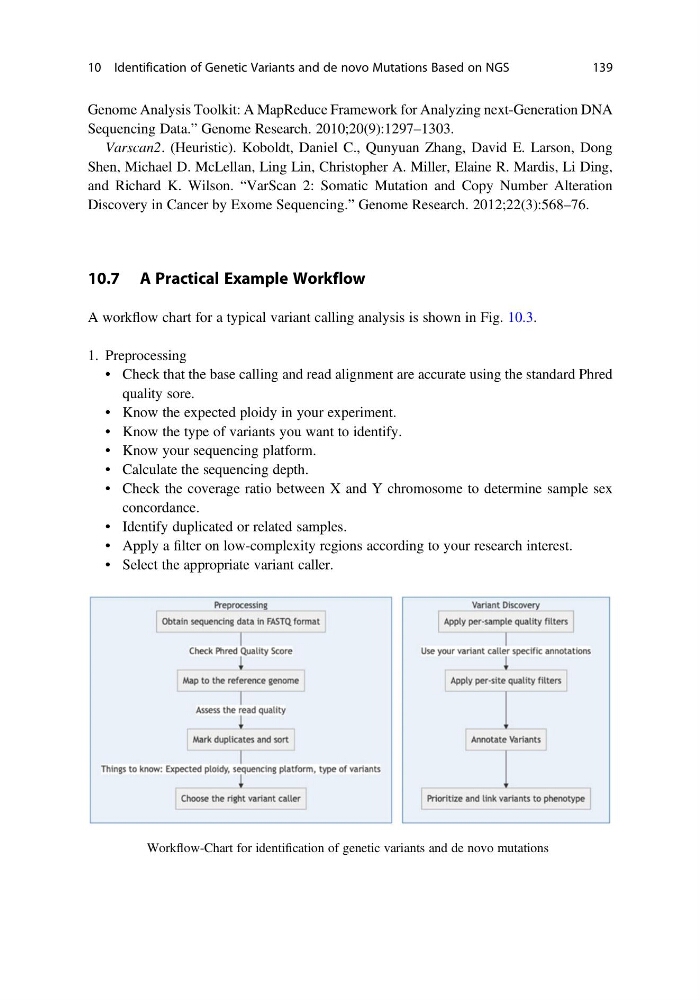
A workflow chart for a typical variant calling analysis is shown in Fig. 10.3.
1. Preprocessing
• Check that the base calling and read alignment are accurate using the standard Phred
quality sore.
• Know the expected ploidy in your experiment.
• Know the type of variants you want to identify.
• Know your sequencing platform.
• Calculate the sequencing depth.
• Check the coverage ratio between X and Y chromosome to determine sample sex
concordance.
• Identify duplicated or related samples.
• Apply a filter on low-complexity regions according to your research interest.
• Select the appropriate variant caller.
Fig. 10.3 Workflow-Chart for identification of genetic variants and de novo mutations
10 Identification of Genetic Variants and de novo Mutations Based on NGS
139
Sequencing Data.” Genome Research. 2010;20(9):1297–1303.
Varscan2. (Heuristic). Koboldt, Daniel C., Qunyuan Zhang, David E. Larson, Dong
Shen, Michael D. McLellan, Ling Lin, Christopher A. Miller, Elaine R. Mardis, Li Ding,
and Richard K. Wilson. “VarScan 2: Somatic Mutation and Copy Number Alteration
Discovery in Cancer by Exome Sequencing.” Genome Research. 2012;22(3):568–76.
10.7 A Practical Example Workflow
A workflow chart for a typical variant calling analysis is shown in Fig. 10.3.
1. Preprocessing
• Check that the base calling and read alignment are accurate using the standard Phred
quality sore.
• Know the expected ploidy in your experiment.
• Know the type of variants you want to identify.
• Know your sequencing platform.
• Calculate the sequencing depth.
• Check the coverage ratio between X and Y chromosome to determine sample sex
concordance.
• Identify duplicated or related samples.
• Apply a filter on low-complexity regions according to your research interest.
• Select the appropriate variant caller.
Fig. 10.3 Workflow-Chart for identification of genetic variants and de novo mutations
10 Identification of Genetic Variants and de novo Mutations Based on NGS
139