

89
B–Z reaction
b
called isobutene or isobutylene. See
alkenes.
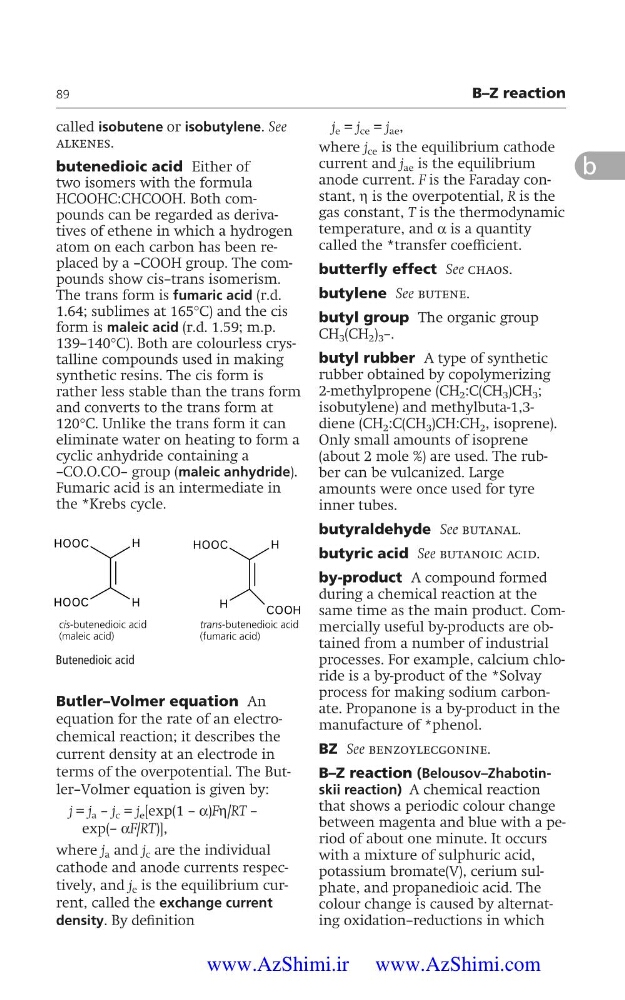
butenedioic acid Either of
two isomers with the formula
HCOOHC:CHCOOH. Both compounds can be regarded as derivatives of ethene in which a hydrogen
atom on each carbon has been replaced by a –COOH group. The compounds show cis–trans isomerism.
The trans form is fumaric acid (r.d.
1.64; sublimes at 165°C) and the cis
form is maleic acid (r.d. 1.59; m.p.
139–140°C). Both are colourless crystalline compounds used in making
synthetic resins. The cis form is
rather less stable than the trans form
and converts to the trans form at
120°C. Unlike the trans form it can
eliminate water on heating to form a
cyclic anhydride containing a
–CO.O.CO– group (maleic anhydride).
Fumaric acid is an intermediate in
the *Krebs cycle.
*
*
*11%
*11%
*11%
%11*
*
*
cis-butenedioic acid
(maleic acid)
trans-butenedioic acid
(fumaric acid)
Butenedioic acid
Butler–Volmer equation An
equation for the rate of an electrochemical reaction; it describes the
current density at an electrode in
terms of the overpotential. The Butler–Volmer equation is given by:
j = j a – j c = j e [exp(1 – α)Fη/RT –
exp(– αF/RT)],
where j a and j c are the individual
cathode and anode currents respectively, and j e is the equilibrium current, called the exchange current
density. By deÜnition
j e = j ce = j ae ,
where j ce is the equilibrium cathode
current and j ae is the equilibrium
anode current. F is the Faraday constant, η is the overpotential, R is the
gas constant, T is the thermodynamic
temperature, and α is a quantity
called the *transfer coefÜcient.
butterÛy effect See chaos.
butylene See butene.
butyl group The organic group
CH 3 (CH 2 ) 3 –.
butyl rubber A type of synthetic
rubber obtained by copolymerizing
2-methylpropene (CH 2 :C(CH 3 )CH 3 ;
isobutylene) and methylbuta-1,3diene (CH 2 :C(CH 3 )CH:CH 2 , isoprene).
Only small amounts of isoprene
(about 2 mole %) are used. The rubber can be vulcanized. Large
amounts were once used for tyre
inner tubes.
butyraldehyde See butanal.
butyric acid See butanoic acid.
by-product A compound formed
during a chemical reaction at the
same time as the main product. Commercially useful by-products are obtained from a number of industrial
processes. For example, calcium chloride is a by-product of the *Solvay
process for making sodium carbonate. Propanone is a by-product in the
manufacture of *phenol.
BZ See benzoylecgonine.
B–Z reaction (Belousov–Zhabotinskii reaction) A chemical reaction
that shows a periodic colour change
between magenta and blue with a period of about one minute. It occurs
with a mixture of sulphuric acid,
potassium bromate(V), cerium sulphate, and propanedioic acid. The
colour change is caused by alternating oxidation–reductions in which
www.AzShimi.ir www.AzShimi.com
B–Z reaction
b
called isobutene or isobutylene. See
alkenes.
butenedioic acid Either of
two isomers with the formula
HCOOHC:CHCOOH. Both compounds can be regarded as derivatives of ethene in which a hydrogen
atom on each carbon has been replaced by a –COOH group. The compounds show cis–trans isomerism.
The trans form is fumaric acid (r.d.
1.64; sublimes at 165°C) and the cis
form is maleic acid (r.d. 1.59; m.p.
139–140°C). Both are colourless crystalline compounds used in making
synthetic resins. The cis form is
rather less stable than the trans form
and converts to the trans form at
120°C. Unlike the trans form it can
eliminate water on heating to form a
cyclic anhydride containing a
–CO.O.CO– group (maleic anhydride).
Fumaric acid is an intermediate in
the *Krebs cycle.
*
*
*11%
*11%
*11%
%11*
*
*
cis-butenedioic acid
(maleic acid)
trans-butenedioic acid
(fumaric acid)
Butenedioic acid
Butler–Volmer equation An
equation for the rate of an electrochemical reaction; it describes the
current density at an electrode in
terms of the overpotential. The Butler–Volmer equation is given by:
j = j a – j c = j e [exp(1 – α)Fη/RT –
exp(– αF/RT)],
where j a and j c are the individual
cathode and anode currents respectively, and j e is the equilibrium current, called the exchange current
density. By deÜnition
j e = j ce = j ae ,
where j ce is the equilibrium cathode
current and j ae is the equilibrium
anode current. F is the Faraday constant, η is the overpotential, R is the
gas constant, T is the thermodynamic
temperature, and α is a quantity
called the *transfer coefÜcient.
butterÛy effect See chaos.
butylene See butene.
butyl group The organic group
CH 3 (CH 2 ) 3 –.
butyl rubber A type of synthetic
rubber obtained by copolymerizing
2-methylpropene (CH 2 :C(CH 3 )CH 3 ;
isobutylene) and methylbuta-1,3diene (CH 2 :C(CH 3 )CH:CH 2 , isoprene).
Only small amounts of isoprene
(about 2 mole %) are used. The rubber can be vulcanized. Large
amounts were once used for tyre
inner tubes.
butyraldehyde See butanal.
butyric acid See butanoic acid.
by-product A compound formed
during a chemical reaction at the
same time as the main product. Commercially useful by-products are obtained from a number of industrial
processes. For example, calcium chloride is a by-product of the *Solvay
process for making sodium carbonate. Propanone is a by-product in the
manufacture of *phenol.
BZ See benzoylecgonine.
B–Z reaction (Belousov–Zhabotinskii reaction) A chemical reaction
that shows a periodic colour change
between magenta and blue with a period of about one minute. It occurs
with a mixture of sulphuric acid,
potassium bromate(V), cerium sulphate, and propanedioic acid. The
colour change is caused by alternating oxidation–reductions in which
www.AzShimi.ir www.AzShimi.com