

The electrolytes are separated by a
porous pot. The cell gives an e.m.f. of
about 1.9 volts.
burette A graduated glass tube
with a tap at one end leading to a
Üne outlet tube, used for delivering
known volumes of a liquid (e.g. in
titration).
buta-1,3-diene (butadiene) A
colourless gaseous hydrocarbon,
CH 2 :CHCH:CH 2 ; m.p. –109°C; b.p.
–4.5°C. It is made by catalytic dehydrogenation of butane (from petroleum or natural gas) and polymerized
in the production of synthetic rubbers. The compound is a conjugated
*diene in which the electrons in the
pi orbitals are partially delocalized
over the whole molecule. It can have
trans and cis forms, the latter taking
part in *Diels–Alder reactions.
butanal (butyraldehyde) A colourless Ûammable liquid aldehyde,
C 3 H 7 CHO; r.d. 0.8; m.p. –99°C; b.p.
75.7°C.
butane A gaseous hydrocarbon,
C 4 H 10 ; d. 0.58 g cm
–3 ; m.p. –138°C;
b.p. 0°C. Butane is obtained from
petroleum (from reÜnery gas or
by cracking higher hydrocarbons).
The fourth member of the *alkane
series, it has a straight chain of
carbon atoms and is isomeric with
2-methylpropane (CH 3 CH(CH 3 )CH 3 ,
formerly called isobutane). It can easily be liqueÜed under pressure and is
supplied in cylinders for use as a fuel
gas. It is also a raw material for making buta-1,3-diene (for synthetic rubber).
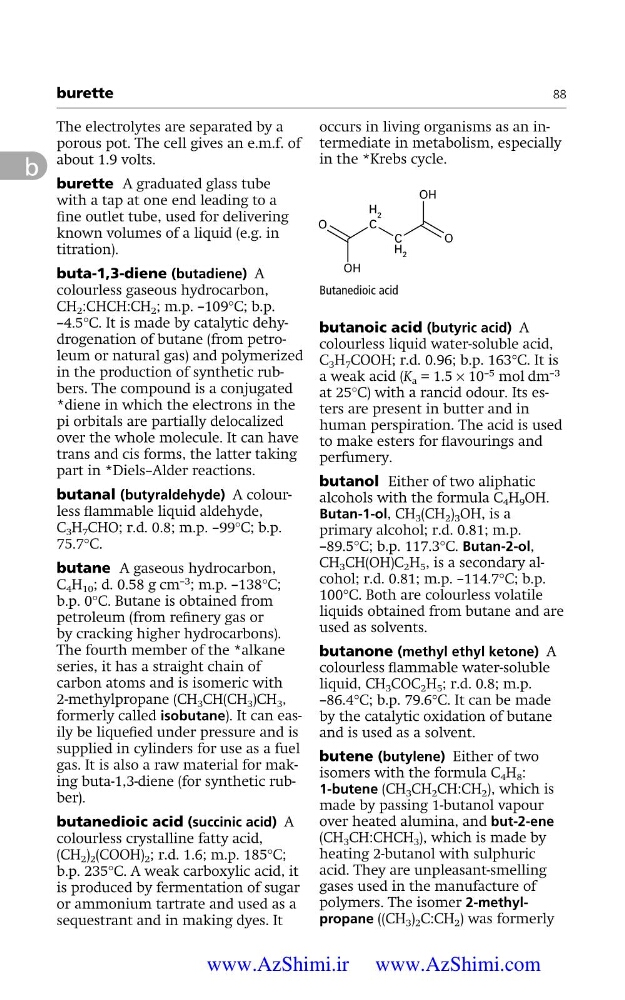
butanedioic acid (succinic acid) A
colourless crystalline fatty acid,
(CH 2 ) 2 (COOH) 2 ; r.d. 1.6; m.p. 185°C;
b.p. 235°C. A weak carboxylic acid, it
is produced by fermentation of sugar
or ammonium tartrate and used as a
sequestrant and in making dyes. It
occurs in living organisms as an intermediate in metabolism, especially
in the *Krebs cycle.
burette
88
b
C
H 2
C
H 2
O
OH
OH
O
Butanedioic acid
butanoic acid (butyric acid) A
colourless liquid water-soluble acid,
C 3 H 7 COOH; r.d. 0.96; b.p. 163°C. It is
a weak acid (K a = 1.5 × 10
–5 mol dm
–3
at 25°C) with a rancid odour. Its esters are present in butter and in
human perspiration. The acid is used
to make esters for Ûavourings and
perfumery.
butanol Either of two aliphatic
alcohols with the formula C 4 H 9 OH.
Butan-1-ol, CH 3 (CH 2 ) 3 OH, is a
primary alcohol; r.d. 0.81; m.p.
–89.5°C; b.p. 117.3°C. Butan-2-ol,
CH 3 CH(OH)C 2 H 5 , is a secondary alcohol; r.d. 0.81; m.p. –114.7°C; b.p.
100°C. Both are colourless volatile
liquids obtained from butane and are
used as solvents.
butanone (methyl ethyl ketone) A
colourless Ûammable water-soluble
liquid, CH 3 COC 2 H 5 ; r.d. 0.8; m.p.
–86.4°C; b.p. 79.6°C. It can be made
by the catalytic oxidation of butane
and is used as a solvent.
butene (butylene) Either of two
isomers with the formula C 4 H 8 :
1-butene (CH 3 CH 2 CH:CH 2 ), which is
made by passing 1-butanol vapour
over heated alumina, and but-2-ene
(CH 3 CH:CHCH 3 ), which is made by
heating 2-butanol with sulphuric
acid. They are unpleasant-smelling
gases used in the manufacture of
polymers. The isomer 2-methylpropane ((CH 3 ) 2 C:CH 2 ) was formerly
www.AzShimi.ir www.AzShimi.com
porous pot. The cell gives an e.m.f. of
about 1.9 volts.
burette A graduated glass tube
with a tap at one end leading to a
Üne outlet tube, used for delivering
known volumes of a liquid (e.g. in
titration).
buta-1,3-diene (butadiene) A
colourless gaseous hydrocarbon,
CH 2 :CHCH:CH 2 ; m.p. –109°C; b.p.
–4.5°C. It is made by catalytic dehydrogenation of butane (from petroleum or natural gas) and polymerized
in the production of synthetic rubbers. The compound is a conjugated
*diene in which the electrons in the
pi orbitals are partially delocalized
over the whole molecule. It can have
trans and cis forms, the latter taking
part in *Diels–Alder reactions.
butanal (butyraldehyde) A colourless Ûammable liquid aldehyde,
C 3 H 7 CHO; r.d. 0.8; m.p. –99°C; b.p.
75.7°C.
butane A gaseous hydrocarbon,
C 4 H 10 ; d. 0.58 g cm
–3 ; m.p. –138°C;
b.p. 0°C. Butane is obtained from
petroleum (from reÜnery gas or
by cracking higher hydrocarbons).
The fourth member of the *alkane
series, it has a straight chain of
carbon atoms and is isomeric with
2-methylpropane (CH 3 CH(CH 3 )CH 3 ,
formerly called isobutane). It can easily be liqueÜed under pressure and is
supplied in cylinders for use as a fuel
gas. It is also a raw material for making buta-1,3-diene (for synthetic rubber).
butanedioic acid (succinic acid) A
colourless crystalline fatty acid,
(CH 2 ) 2 (COOH) 2 ; r.d. 1.6; m.p. 185°C;
b.p. 235°C. A weak carboxylic acid, it
is produced by fermentation of sugar
or ammonium tartrate and used as a
sequestrant and in making dyes. It
occurs in living organisms as an intermediate in metabolism, especially
in the *Krebs cycle.
burette
88
b
C
H 2
C
H 2
O
OH
OH
O
Butanedioic acid
butanoic acid (butyric acid) A
colourless liquid water-soluble acid,
C 3 H 7 COOH; r.d. 0.96; b.p. 163°C. It is
a weak acid (K a = 1.5 × 10
–5 mol dm
–3
at 25°C) with a rancid odour. Its esters are present in butter and in
human perspiration. The acid is used
to make esters for Ûavourings and
perfumery.
butanol Either of two aliphatic
alcohols with the formula C 4 H 9 OH.
Butan-1-ol, CH 3 (CH 2 ) 3 OH, is a
primary alcohol; r.d. 0.81; m.p.
–89.5°C; b.p. 117.3°C. Butan-2-ol,
CH 3 CH(OH)C 2 H 5 , is a secondary alcohol; r.d. 0.81; m.p. –114.7°C; b.p.
100°C. Both are colourless volatile
liquids obtained from butane and are
used as solvents.
butanone (methyl ethyl ketone) A
colourless Ûammable water-soluble
liquid, CH 3 COC 2 H 5 ; r.d. 0.8; m.p.
–86.4°C; b.p. 79.6°C. It can be made
by the catalytic oxidation of butane
and is used as a solvent.
butene (butylene) Either of two
isomers with the formula C 4 H 8 :
1-butene (CH 3 CH 2 CH:CH 2 ), which is
made by passing 1-butanol vapour
over heated alumina, and but-2-ene
(CH 3 CH:CHCH 3 ), which is made by
heating 2-butanol with sulphuric
acid. They are unpleasant-smelling
gases used in the manufacture of
polymers. The isomer 2-methylpropane ((CH 3 ) 2 C:CH 2 ) was formerly
www.AzShimi.ir www.AzShimi.com