

Autocatalysis occurs as in the
*Lotka–Volterra mechanism and the
*oregonator. If the concentrations of
A and B are maintained constant, the
concentrations of X and Y oscillate
with time. A graph of the concentration of X against that of Y is a closed
loop (the limit cycle of the reaction).
The reaction settles down to this
limit cycle whatever the initial concentrations of X and Y, i.e. the limit
cycle is an *attractor for the system.
The reaction mechanism is named
after the city of Brussels, where the
research group that discovered it is
based.
Buchner funnel A type of funnel
with an internal perforated tray on
which a Ûat circular Ülter paper can
be placed, used for Ültering by suction. It is named after the German
chemist Eduard Buchner (1860–
1917).
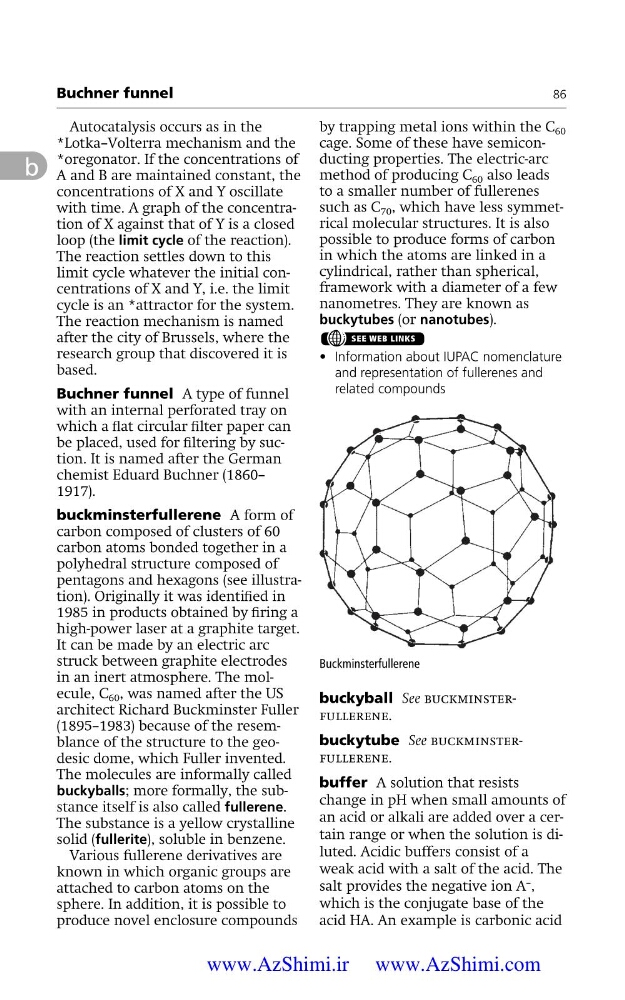
buckminsterfullerene A form of
carbon composed of clusters of 60
carbon atoms bonded together in a
polyhedral structure composed of
pentagons and hexagons (see illustration). Originally it was identiÜed in
1985 in products obtained by Üring a
high-power laser at a graphite target.
It can be made by an electric arc
struck between graphite electrodes
in an inert atmosphere. The molecule, C 60 , was named after the US
architect Richard Buckminster Fuller
(1895–1983) because of the resemblance of the structure to the geodesic dome, which Fuller invented.
The molecules are informally called
buckyballs; more formally, the substance itself is also called fullerene.
The substance is a yellow crystalline
solid (fullerite), soluble in benzene.
Various fullerene derivatives are
known in which organic groups are
attached to carbon atoms on the
sphere. In addition, it is possible to
produce novel enclosure compounds
by trapping metal ions within the C 60
cage. Some of these have semiconducting properties. The electric-arc
method of producing C 60 also leads
to a smaller number of fullerenes
such as C 70 , which have less symmetrical molecular structures. It is also
possible to produce forms of carbon
in which the atoms are linked in a
cylindrical, rather than spherical,
framework with a diameter of a few
nanometres. They are known as
buckytubes (or nanotubes).
A
• Information about IUPAC nomenclature
and representation of fullerenes and
related compounds
Buchner funnel
86
b
Buckminsterfullerene
buckyball See buckminsterfullerene.
buckytube See buckminsterfullerene.
buffer A solution that resists
change in pH when small amounts of
an acid or alkali are added over a certain range or when the solution is diluted. Acidic buffers consist of a
weak acid with a salt of the acid. The
salt provides the negative ion A
– ,
which is the conjugate base of the
acid HA. An example is carbonic acid
www.AzShimi.ir www.AzShimi.com
*Lotka–Volterra mechanism and the
*oregonator. If the concentrations of
A and B are maintained constant, the
concentrations of X and Y oscillate
with time. A graph of the concentration of X against that of Y is a closed
loop (the limit cycle of the reaction).
The reaction settles down to this
limit cycle whatever the initial concentrations of X and Y, i.e. the limit
cycle is an *attractor for the system.
The reaction mechanism is named
after the city of Brussels, where the
research group that discovered it is
based.
Buchner funnel A type of funnel
with an internal perforated tray on
which a Ûat circular Ülter paper can
be placed, used for Ültering by suction. It is named after the German
chemist Eduard Buchner (1860–
1917).
buckminsterfullerene A form of
carbon composed of clusters of 60
carbon atoms bonded together in a
polyhedral structure composed of
pentagons and hexagons (see illustration). Originally it was identiÜed in
1985 in products obtained by Üring a
high-power laser at a graphite target.
It can be made by an electric arc
struck between graphite electrodes
in an inert atmosphere. The molecule, C 60 , was named after the US
architect Richard Buckminster Fuller
(1895–1983) because of the resemblance of the structure to the geodesic dome, which Fuller invented.
The molecules are informally called
buckyballs; more formally, the substance itself is also called fullerene.
The substance is a yellow crystalline
solid (fullerite), soluble in benzene.
Various fullerene derivatives are
known in which organic groups are
attached to carbon atoms on the
sphere. In addition, it is possible to
produce novel enclosure compounds
by trapping metal ions within the C 60
cage. Some of these have semiconducting properties. The electric-arc
method of producing C 60 also leads
to a smaller number of fullerenes
such as C 70 , which have less symmetrical molecular structures. It is also
possible to produce forms of carbon
in which the atoms are linked in a
cylindrical, rather than spherical,
framework with a diameter of a few
nanometres. They are known as
buckytubes (or nanotubes).
A
• Information about IUPAC nomenclature
and representation of fullerenes and
related compounds
Buchner funnel
86
b
Buckminsterfullerene
buckyball See buckminsterfullerene.
buckytube See buckminsterfullerene.
buffer A solution that resists
change in pH when small amounts of
an acid or alkali are added over a certain range or when the solution is diluted. Acidic buffers consist of a
weak acid with a salt of the acid. The
salt provides the negative ion A
– ,
which is the conjugate base of the
acid HA. An example is carbonic acid
www.AzShimi.ir www.AzShimi.com