

bromomethane (methyl bromide)
A colourless volatile nonÛammable
liquid, CH 3 Br; r.d. 1.68; m.p. –93°C;
b.p. 3.56°C. It is a typical *haloalkane.
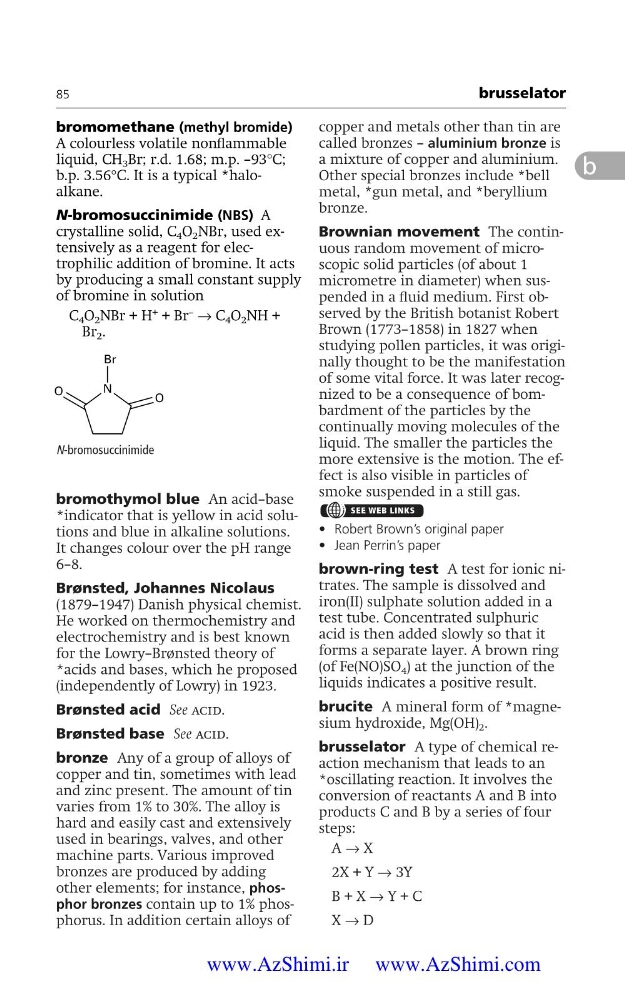
N-bromosuccinimide (NBS) A
crystalline solid, C 4 O 2 NBr, used extensively as a reagent for electrophilic addition of bromine. It acts
by producing a small constant supply
of bromine in solution
C 4 O 2 NBr + H
+ + Br
–
→ C 4 O 2 NH +
Br 2 .
85
brusselator
b
N
O
O
Br
N-bromosuccinimide
bromothymol blue An acid–base
*indicator that is yellow in acid solutions and blue in alkaline solutions.
It changes colour over the pH range
6–8.
Brønsted, Johannes Nicolaus
(1879–1947) Danish physical chemist.
He worked on thermochemistry and
electrochemistry and is best known
for the Lowry–Brønsted theory of
*acids and bases, which he proposed
(independently of Lowry) in 1923.
Brønsted acid See acid.
Brønsted base See acid.
bronze Any of a group of alloys of
copper and tin, sometimes with lead
and zinc present. The amount of tin
varies from 1% to 30%. The alloy is
hard and easily cast and extensively
used in bearings, valves, and other
machine parts. Various improved
bronzes are produced by adding
other elements; for instance, phosphor bronzes contain up to 1% phosphorus. In addition certain alloys of
copper and metals other than tin are
called bronzes – aluminium bronze is
a mixture of copper and aluminium.
Other special bronzes include *bell
metal, *gun metal, and *beryllium
bronze.
Brownian movement The continuous random movement of microscopic solid particles (of about 1
micrometre in diameter) when suspended in a Ûuid medium. First observed by the British botanist Robert
Brown (1773–1858) in 1827 when
studying pollen particles, it was originally thought to be the manifestation
of some vital force. It was later recognized to be a consequence of bombardment of the particles by the
continually moving molecules of the
liquid. The smaller the particles the
more extensive is the motion. The effect is also visible in particles of
smoke suspended in a still gas.
A
• Robert Brown’s original paper
• Jean Perrin’s paper
brown-ring test A test for ionic nitrates. The sample is dissolved and
iron(II) sulphate solution added in a
test tube. Concentrated sulphuric
acid is then added slowly so that it
forms a separate layer. A brown ring
(of Fe(NO)SO 4 ) at the junction of the
liquids indicates a positive result.
brucite A mineral form of *magnesium hydroxide, Mg(OH) 2 .
brusselator A type of chemical reaction mechanism that leads to an
*oscillating reaction. It involves the
conversion of reactants A and B into
products C and B by a series of four
steps:
A → X
2X + Y → 3Y
B + X → Y + C
X → D
www.AzShimi.ir www.AzShimi.com
A colourless volatile nonÛammable
liquid, CH 3 Br; r.d. 1.68; m.p. –93°C;
b.p. 3.56°C. It is a typical *haloalkane.
N-bromosuccinimide (NBS) A
crystalline solid, C 4 O 2 NBr, used extensively as a reagent for electrophilic addition of bromine. It acts
by producing a small constant supply
of bromine in solution
C 4 O 2 NBr + H
+ + Br
–
→ C 4 O 2 NH +
Br 2 .
85
brusselator
b
N
O
O
Br
N-bromosuccinimide
bromothymol blue An acid–base
*indicator that is yellow in acid solutions and blue in alkaline solutions.
It changes colour over the pH range
6–8.
Brønsted, Johannes Nicolaus
(1879–1947) Danish physical chemist.
He worked on thermochemistry and
electrochemistry and is best known
for the Lowry–Brønsted theory of
*acids and bases, which he proposed
(independently of Lowry) in 1923.
Brønsted acid See acid.
Brønsted base See acid.
bronze Any of a group of alloys of
copper and tin, sometimes with lead
and zinc present. The amount of tin
varies from 1% to 30%. The alloy is
hard and easily cast and extensively
used in bearings, valves, and other
machine parts. Various improved
bronzes are produced by adding
other elements; for instance, phosphor bronzes contain up to 1% phosphorus. In addition certain alloys of
copper and metals other than tin are
called bronzes – aluminium bronze is
a mixture of copper and aluminium.
Other special bronzes include *bell
metal, *gun metal, and *beryllium
bronze.
Brownian movement The continuous random movement of microscopic solid particles (of about 1
micrometre in diameter) when suspended in a Ûuid medium. First observed by the British botanist Robert
Brown (1773–1858) in 1827 when
studying pollen particles, it was originally thought to be the manifestation
of some vital force. It was later recognized to be a consequence of bombardment of the particles by the
continually moving molecules of the
liquid. The smaller the particles the
more extensive is the motion. The effect is also visible in particles of
smoke suspended in a still gas.
A
• Robert Brown’s original paper
• Jean Perrin’s paper
brown-ring test A test for ionic nitrates. The sample is dissolved and
iron(II) sulphate solution added in a
test tube. Concentrated sulphuric
acid is then added slowly so that it
forms a separate layer. A brown ring
(of Fe(NO)SO 4 ) at the junction of the
liquids indicates a positive result.
brucite A mineral form of *magnesium hydroxide, Mg(OH) 2 .
brusselator A type of chemical reaction mechanism that leads to an
*oscillating reaction. It involves the
conversion of reactants A and B into
products C and B by a series of four
steps:
A → X
2X + Y → 3Y
B + X → Y + C
X → D
www.AzShimi.ir www.AzShimi.com