

vitamin B complex
548
v
blindness. The role of vitamin A in
other aspects of metabolism is less
clear.
A
• Information about IUPAC nomenclature
vitamin B complex A group of
water-soluble vitamins that characteristically serve as components of
*coenzymes. Plants and many microorganisms can manufacture B
vitamins but dietary sources are essential for most animals. Heat and
light tend to destroy B vitamins.
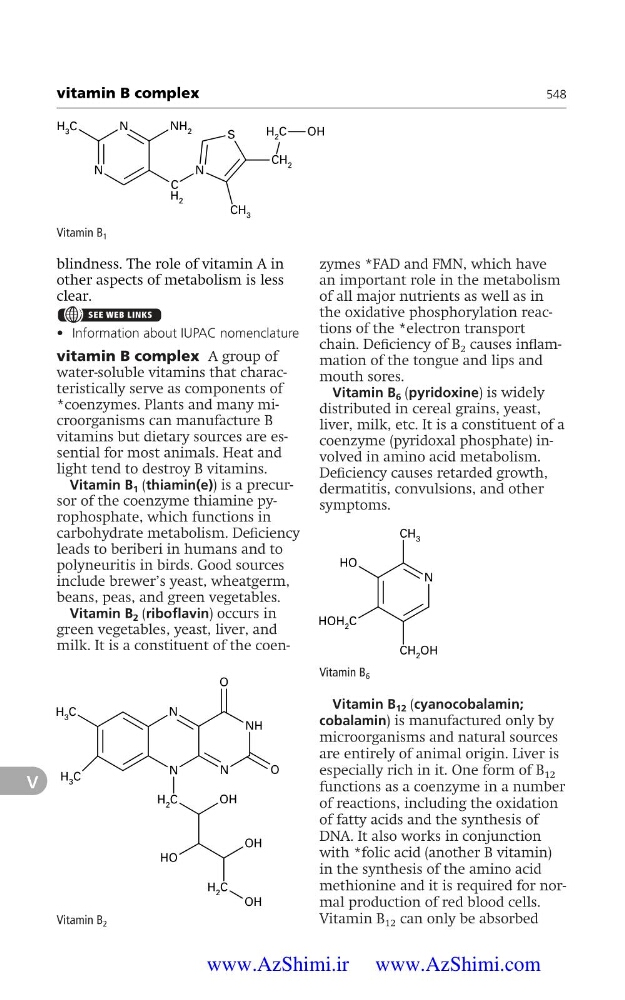
Vitamin B 1 (thiamin(e)) is a precursor of the coenzyme thiamine pyrophosphate, which functions in
carbohydrate metabolism. DeÜciency
leads to beriberi in humans and to
polyneuritis in birds. Good sources
include brewer’s yeast, wheatgerm,
beans, peas, and green vegetables.
Vitamin B 2 (riboÛavin) occurs in
green vegetables, yeast, liver, and
milk. It is a constituent of the coenzymes *FAD and FMN, which have
an important role in the metabolism
of all major nutrients as well as in
the oxidative phosphorylation reactions of the *electron transport
chain. DeÜciency of B 2 causes inÛammation of the tongue and lips and
mouth sores.
Vitamin B 6 (pyridoxine) is widely
distributed in cereal grains, yeast,
liver, milk, etc. It is a constituent of a
coenzyme (pyridoxal phosphate) involved in amino acid metabolism.
DeÜciency causes retarded growth,
dermatitis, convulsions, and other
symptoms.
N
N
C
H 2
S
N
CH 2
C
H 2
OH
C
H 3
NH 2
CH 3
Vitamin B 1
N
N
N
NH
O
O
C
H 3
C
H 3
C
H 2
C
H 2
OH
OH
O
H
OH
Vitamin B 2
N
CH 3
O
H
HOH 2 C
CH 2 OH
Vitamin B 6
Vitamin B 12 (cyanocobalamin;
cobalamin) is manufactured only by
microorganisms and natural sources
are entirely of animal origin. Liver is
especially rich in it. One form of B 12
functions as a coenzyme in a number
of reactions, including the oxidation
of fatty acids and the synthesis of
DNA. It also works in conjunction
with *folic acid (another B vitamin)
in the synthesis of the amino acid
methionine and it is required for normal production of red blood cells.
Vitamin B 12 can only be absorbed
www.AzShimi.ir www.AzShimi.com