

547
vitamin A
v
between ethyne and a compound
with an active hydrogen atom, such
as alcohol, amine, or carboxylic acid.
Addition takes place across the triple
bond of ethyne to produce an ethenyl (vinyl) compound, containing
the group CH 2 =CH–.
vinyl chloride See chloroethene.
vinyl group The organic group
CH 2 :CH–.
virial coefÜcients See virial equation.
virial equation A gas law that attempts to account for the behaviour
of real gases, as opposed to an ideal
gas. It takes the form
pV = RT + Bp + Cp
2 + Dp
3 + …,
where B, C, and D are known as virial
coefÜcients.
viscose process See rayon.
viscosity A measure of the resistance to Ûow that a Ûuid offers when
it is subjected to shear stress. For a
Newtonian Ûuid, the force, F, needed
to maintain a velocity gradient,
dv/dx, between adjacent planes of a
Ûuid of area A is given by: F =
ηA(dv/dx), where η is a constant,
called the coefÜcient of viscosity. In
SI units it has the unit pascal second
(in the c.g.s. system it was measured
in *poise). Non-Newtonian Ûuids,
such as clays, do not conform to this
simple model. See also kinematic viscosity.
visible spectrum The *spectrum
of electromagnetic radiations to
which the human eye is sensitive.
vitamin One of a number of organic compounds required by living
organisms in relatively small
amounts to maintain normal health.
There are some 14 generally recognized major vitamins: the watersoluble *vitamin B complex (containing 9) and *vitamin C and the fatsoluble *vitamin A, *vitamin D,
*vitamin E, and *vitamin K. Most B
vitamins and vitamin C occur in
plants, animals, and microorganisms;
they function typically as *coenzymes. Vitamins A, D, E, and K occur
only in animals, especially vertebrates, and perform a variety of
metabolic roles. Animals are unable
to manufacture many vitamins themselves and must have adequate
amounts in the diet. Foods may contain vitamin precursors (called provitamins) that are chemically changed
to the actual vitamin on entering the
body. Many vitamins are destroyed
by light and heat, e.g. during cooking.
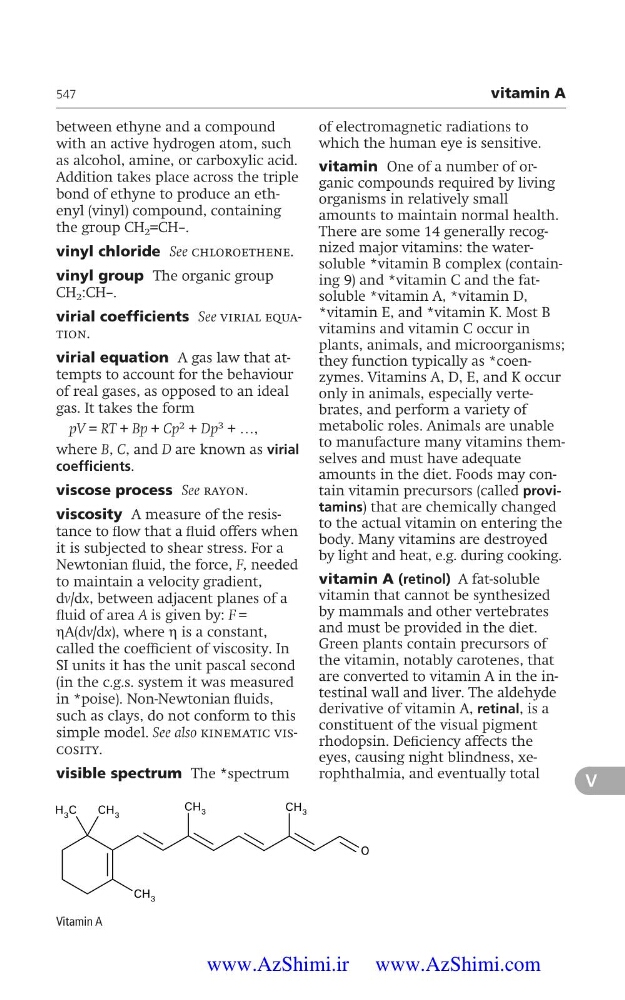
vitamin A (retinol) A fat-soluble
vitamin that cannot be synthesized
by mammals and other vertebrates
and must be provided in the diet.
Green plants contain precursors of
the vitamin, notably carotenes, that
are converted to vitamin A in the intestinal wall and liver. The aldehyde
derivative of vitamin A, retinal, is a
constituent of the visual pigment
rhodopsin. DeÜciency affects the
eyes, causing night blindness, xerophthalmia, and eventually total
1
%*
%
*
%*
%*
%*
Vitamin A
www.AzShimi.ir www.AzShimi.com