

angle between ±90° and 180°. Another distinction is between clinal
arrangements (value between 30°
and 150° or –30° and –150°) and periplanar arrangements (value between
0 and ±30° or ±150° and 180°). Combining the two gives four ranges of
torsion angle in an arrangement:
synperiplanar (sp) 0° to ±30°;
synclinal (sc) 30° to 90° or –30° to
–90°;
anticlinal (ac) 90° to 150° or –90° to
–150°;
antiperiplanar (ap) ±150° to 180°.
The antiperiplanar conformation is
also called a trans conformation; the
synperiplanar conformation corresponds to a cis conformation. The
synclinal conformation is also called
a gauche or skew conformation.
total-radiation pyrometer See pyrometry.
tourmaline A group of minerals
composed of complex cyclosilicates
containing boron with the general
formula NaR 3
2+ Al 6 B 3 Si 6 O 27 (H,F) 4 ,
where R = Fe
2+ , Mg, or (Al + Li). The
crystals are trigonal, elongated, and
variably coloured, the two ends of
the crystals often having different
colours. Tourmaline is used as a gemstone and because of its double refraction and piezoelectric properties
is also used in polarizers and some
pressure gauges.
town gas Any manufactured gas
supplied as a fuel gas to domestic
and industrial users. Examples include *coal gas, substitute natural
gas (*SNG), and *natural gas itself.
Most town gases are based on hydrogen or methane, although coal gas
also contains up to 8% carbon
monoxide.
trace element See essential element.
tracing (radioactive tracing) See labelling.
trans See isomerism; torsion
angle.
transactinide elements Elements
with an atomic number greater than
103, i.e. elements above lawrencium
in the *periodic table. So far, elements up to 116 have been detected. Because of the highly
radioactive and transient nature of
these elements, there has been much
dispute about priority of discovery
and, consequently, naming of the elements. The International Union of
Pure and Applied Chemistry (IUPAC)
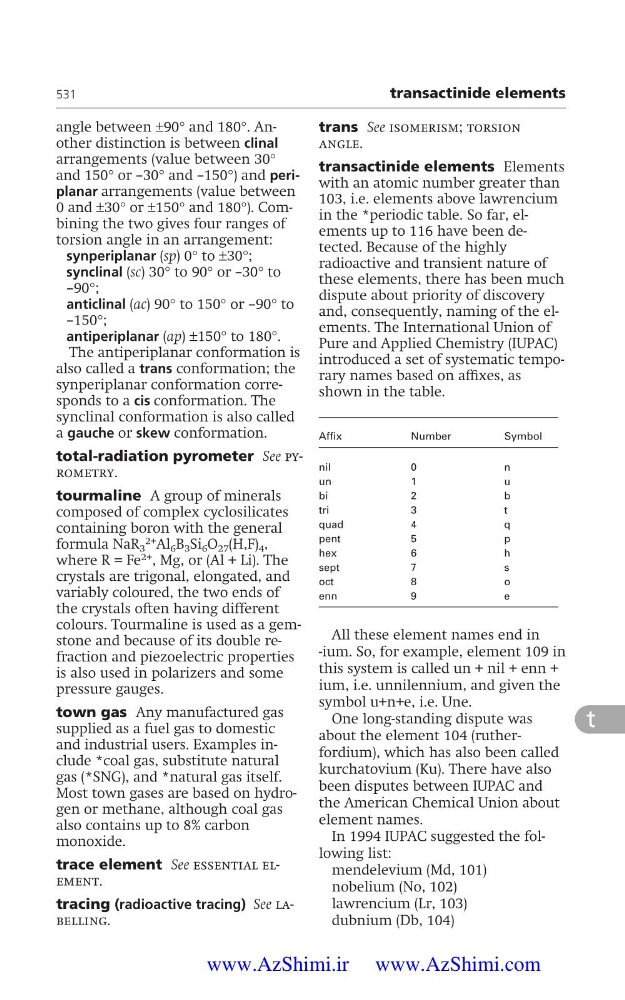
introduced a set of systematic temporary names based on afÜxes, as
shown in the table.
531
transactinide elements
t
Affix
Number
Symbol
nil
0
n
un
1
u
bi
2
b
tri
3
t
quad
4
q
pent
5
p
hex
6
h
sept
7
s
oct
8
o
enn
9
e
All these element names end in
-ium. So, for example, element 109 in
this system is called un + nil + enn +
ium, i.e. unnilennium, and given the
symbol u+n+e, i.e. Une.
One long-standing dispute was
about the element 104 (rutherfordium), which has also been called
kurchatovium (Ku). There have also
been disputes between IUPAC and
the American Chemical Union about
element names.
In 1994 IUPAC suggested the following list:
mendelevium (Md, 101)
nobelium (No, 102)
lawrencium (Lr, 103)
dubnium (Db, 104)
www.AzShimi.ir www.AzShimi.com
arrangements (value between 30°
and 150° or –30° and –150°) and periplanar arrangements (value between
0 and ±30° or ±150° and 180°). Combining the two gives four ranges of
torsion angle in an arrangement:
synperiplanar (sp) 0° to ±30°;
synclinal (sc) 30° to 90° or –30° to
–90°;
anticlinal (ac) 90° to 150° or –90° to
–150°;
antiperiplanar (ap) ±150° to 180°.
The antiperiplanar conformation is
also called a trans conformation; the
synperiplanar conformation corresponds to a cis conformation. The
synclinal conformation is also called
a gauche or skew conformation.
total-radiation pyrometer See pyrometry.
tourmaline A group of minerals
composed of complex cyclosilicates
containing boron with the general
formula NaR 3
2+ Al 6 B 3 Si 6 O 27 (H,F) 4 ,
where R = Fe
2+ , Mg, or (Al + Li). The
crystals are trigonal, elongated, and
variably coloured, the two ends of
the crystals often having different
colours. Tourmaline is used as a gemstone and because of its double refraction and piezoelectric properties
is also used in polarizers and some
pressure gauges.
town gas Any manufactured gas
supplied as a fuel gas to domestic
and industrial users. Examples include *coal gas, substitute natural
gas (*SNG), and *natural gas itself.
Most town gases are based on hydrogen or methane, although coal gas
also contains up to 8% carbon
monoxide.
trace element See essential element.
tracing (radioactive tracing) See labelling.
trans See isomerism; torsion
angle.
transactinide elements Elements
with an atomic number greater than
103, i.e. elements above lawrencium
in the *periodic table. So far, elements up to 116 have been detected. Because of the highly
radioactive and transient nature of
these elements, there has been much
dispute about priority of discovery
and, consequently, naming of the elements. The International Union of
Pure and Applied Chemistry (IUPAC)
introduced a set of systematic temporary names based on afÜxes, as
shown in the table.
531
transactinide elements
t
Affix
Number
Symbol
nil
0
n
un
1
u
bi
2
b
tri
3
t
quad
4
q
pent
5
p
hex
6
h
sept
7
s
oct
8
o
enn
9
e
All these element names end in
-ium. So, for example, element 109 in
this system is called un + nil + enn +
ium, i.e. unnilennium, and given the
symbol u+n+e, i.e. Une.
One long-standing dispute was
about the element 104 (rutherfordium), which has also been called
kurchatovium (Ku). There have also
been disputes between IUPAC and
the American Chemical Union about
element names.
In 1994 IUPAC suggested the following list:
mendelevium (Md, 101)
nobelium (No, 102)
lawrencium (Lr, 103)
dubnium (Db, 104)
www.AzShimi.ir www.AzShimi.com