

used to produce other titanium compounds and pure titanium metal.
titanium dioxide See titanium(iv)
oxide.
titanium(IV) oxide (titania; titanium dioxide) A white oxide, TiO 2 ,
occurring naturally in various forms,
particularly the mineral rutile. It is
used as a white pigment and as a
Üller for plastics, rubber, etc.
titration A method of volumetric
analysis in which a volume of one
reagent (the titrant) is added to a
known volume of another reagent
slowly from a burette until an end
point is reached (see indicator). The
volume added before the end point is
reached is noted. If one of the solutions has a known concentration,
that of the other can be calculated.
TNT See trinitrotoluene.
tocopherol See vitamin e.
Tollens reagent A reagent used in
testing for aldehydes. It is made by
adding sodium hydroxide to silver nitrate to give silver(I) oxide, which is
dissolved in aqueous ammonia (giving the complex ion [Ag(NH 3 ) 2 ]
+ ). The
sample is warmed with the reagent
in a test tube. Aldehydes reduce the
complex Ag
+ ion to metallic silver,
forming a bright silver mirror on the
inside of the tube (hence the name
silver-mirror test). Ketones give a negative result. It is named after Bernhard Tollens (1841–1918).
toluene See methylbenzene.
topaz A variably coloured aluminium silicate mineral,
Al 2 (SiO 4 )(OH , F) 2 , that forms orthorhombic crystals. It occurs chieÛy
in acid igneous rocks, such as granites and pegmatites. Topaz is valued
as a gemstone because of its transparency, variety of colours (the wineyellow variety being most highly
prized), and great hardness (8 on the
Mohs’ scale). When heated, yellow or
brownish topaz often becomes a
rose-pink colour. The main sources of
topaz are Brazil, Russia, and the USA.
torr A unit of pressure, used in
high-vacuum technology, deÜned as
1 mmHg. 1 torr is equal to 133.322
pascals. The unit is named after
Evangelista Torricelli (1609–47).
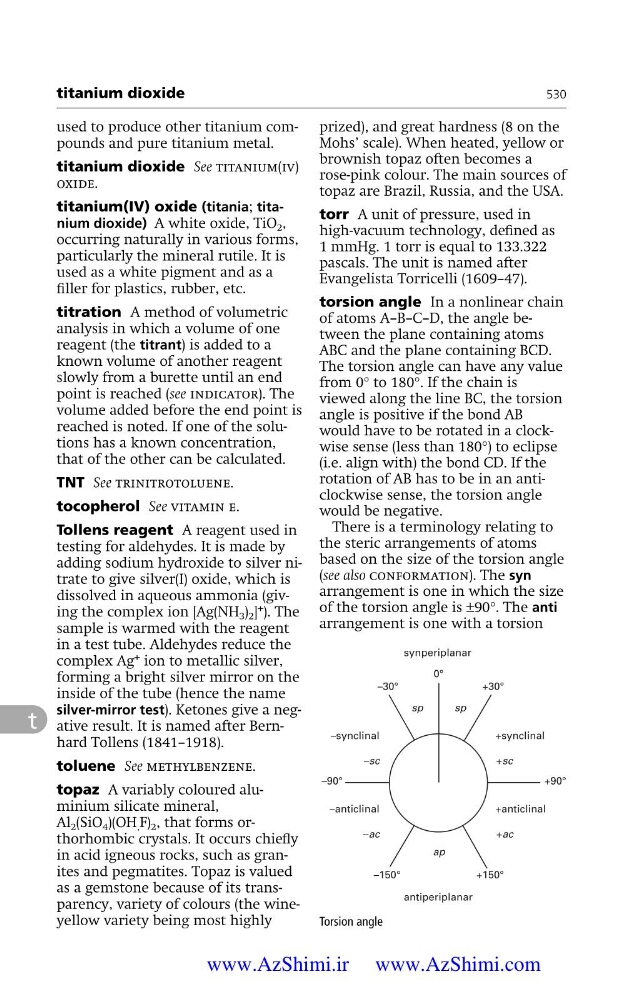
torsion angle In a nonlinear chain
of atoms A–B–C–D, the angle between the plane containing atoms
ABC and the plane containing BCD.
The torsion angle can have any value
from 0° to 180°. If the chain is
viewed along the line BC, the torsion
angle is positive if the bond AB
would have to be rotated in a clockwise sense (less than 180°) to eclipse
(i.e. align with) the bond CD. If the
rotation of AB has to be in an anticlockwise sense, the torsion angle
would be negative.
There is a terminology relating to
the steric arrangements of atoms
based on the size of the torsion angle
(see also conformation). The syn
arrangement is one in which the size
of the torsion angle is ±90°. The anti
arrangement is one with a torsion
titanium dioxide
530
t
synperiplanar
antiperiplanar
+synclinal
+anticlinal
–synclinal
–anticlinal
–30°
0°
+30°
sp
sp
+sc
+90°
+ac
+150°
ap
–150°
–ac
–90°
–sc
Torsion angle
www.AzShimi.ir www.AzShimi.com
titanium dioxide See titanium(iv)
oxide.
titanium(IV) oxide (titania; titanium dioxide) A white oxide, TiO 2 ,
occurring naturally in various forms,
particularly the mineral rutile. It is
used as a white pigment and as a
Üller for plastics, rubber, etc.
titration A method of volumetric
analysis in which a volume of one
reagent (the titrant) is added to a
known volume of another reagent
slowly from a burette until an end
point is reached (see indicator). The
volume added before the end point is
reached is noted. If one of the solutions has a known concentration,
that of the other can be calculated.
TNT See trinitrotoluene.
tocopherol See vitamin e.
Tollens reagent A reagent used in
testing for aldehydes. It is made by
adding sodium hydroxide to silver nitrate to give silver(I) oxide, which is
dissolved in aqueous ammonia (giving the complex ion [Ag(NH 3 ) 2 ]
+ ). The
sample is warmed with the reagent
in a test tube. Aldehydes reduce the
complex Ag
+ ion to metallic silver,
forming a bright silver mirror on the
inside of the tube (hence the name
silver-mirror test). Ketones give a negative result. It is named after Bernhard Tollens (1841–1918).
toluene See methylbenzene.
topaz A variably coloured aluminium silicate mineral,
Al 2 (SiO 4 )(OH , F) 2 , that forms orthorhombic crystals. It occurs chieÛy
in acid igneous rocks, such as granites and pegmatites. Topaz is valued
as a gemstone because of its transparency, variety of colours (the wineyellow variety being most highly
prized), and great hardness (8 on the
Mohs’ scale). When heated, yellow or
brownish topaz often becomes a
rose-pink colour. The main sources of
topaz are Brazil, Russia, and the USA.
torr A unit of pressure, used in
high-vacuum technology, deÜned as
1 mmHg. 1 torr is equal to 133.322
pascals. The unit is named after
Evangelista Torricelli (1609–47).
torsion angle In a nonlinear chain
of atoms A–B–C–D, the angle between the plane containing atoms
ABC and the plane containing BCD.
The torsion angle can have any value
from 0° to 180°. If the chain is
viewed along the line BC, the torsion
angle is positive if the bond AB
would have to be rotated in a clockwise sense (less than 180°) to eclipse
(i.e. align with) the bond CD. If the
rotation of AB has to be in an anticlockwise sense, the torsion angle
would be negative.
There is a terminology relating to
the steric arrangements of atoms
based on the size of the torsion angle
(see also conformation). The syn
arrangement is one in which the size
of the torsion angle is ±90°. The anti
arrangement is one with a torsion
titanium dioxide
530
t
synperiplanar
antiperiplanar
+synclinal
+anticlinal
–synclinal
–anticlinal
–30°
0°
+30°
sp
sp
+sc
+90°
+ac
+150°
ap
–150°
–ac
–90°
–sc
Torsion angle
www.AzShimi.ir www.AzShimi.com