

430
p
POLYMERS
Polymers are substances that have *macromolecules composed of many repeating
units (known as ‘mers’). A large number of naturally occurring substances are
polymers including *rubber and many substances based on glucose, such as the
polysaccharides *cellulose and *starch (in plants) and *glycogen (in animals).
*Proteins, nucleic acids, and inorganic macromolecular substances, such as
*silicates, are other examples.
Synthetic polymers
One of the unique features of the chemistry of carbon is its ability to form long
chains of atoms. This property is the basis of an important area of industrial
chemistry concerned with the manufacture of polymeric materials with a variety
of properties (see plastics). The molecules in these materials are essentially long
chains of atoms of various lengths. In some polymers, cross-linkage occurs
between the chains. Synthetic polymers are formed by chemical reactions in
which individual molecules (monomers) join together to form larger units (see
polymerization). Two types of polymer, homopolymers and heteropolymers, can
be distinguished
Homopolymers
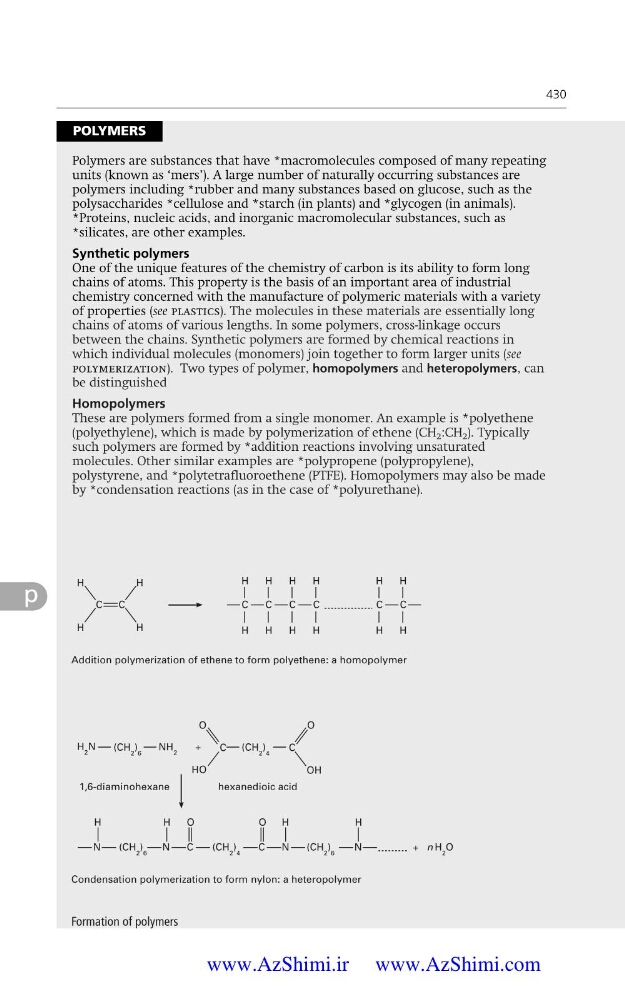
These are polymers formed from a single monomer. An example is *polyethene
(polyethylene), which is made by polymerization of ethene (CH 2 :CH 2 ). Typically
such polymers are formed by *addition reactions involving unsaturated
molecules. Other similar examples are *polypropene (polypropylene),
polystyrene, and *polytetrafluoroethene (PTFE). Homopolymers may also be made
by *condensation reactions (as in the case of *polyurethane).
H
H
C
C
H
H
C
H
H
C
H
H
C
H
H
C
H
H
C
H
H
C
H
H
Addition polymerization of ethene to form polyethene: a homopolymer
H 2 N
(CH 2 ) 6
NH 2
O
C
HO
(CH 2 ) 4
O
C
OH
+
1,6-diaminohexane
hexanedioic acid
H
N
( C H 2 ) 6
(CH 2 ) 4
(CH 2 ) 6
n H 2 O
+
N
C
C
N
N
H
O
O
H
H
Condensation polymerization to form nylon: a heteropolymer
Formation of polymers
www.AzShimi.ir www.AzShimi.com
p
POLYMERS
Polymers are substances that have *macromolecules composed of many repeating
units (known as ‘mers’). A large number of naturally occurring substances are
polymers including *rubber and many substances based on glucose, such as the
polysaccharides *cellulose and *starch (in plants) and *glycogen (in animals).
*Proteins, nucleic acids, and inorganic macromolecular substances, such as
*silicates, are other examples.
Synthetic polymers
One of the unique features of the chemistry of carbon is its ability to form long
chains of atoms. This property is the basis of an important area of industrial
chemistry concerned with the manufacture of polymeric materials with a variety
of properties (see plastics). The molecules in these materials are essentially long
chains of atoms of various lengths. In some polymers, cross-linkage occurs
between the chains. Synthetic polymers are formed by chemical reactions in
which individual molecules (monomers) join together to form larger units (see
polymerization). Two types of polymer, homopolymers and heteropolymers, can
be distinguished
Homopolymers
These are polymers formed from a single monomer. An example is *polyethene
(polyethylene), which is made by polymerization of ethene (CH 2 :CH 2 ). Typically
such polymers are formed by *addition reactions involving unsaturated
molecules. Other similar examples are *polypropene (polypropylene),
polystyrene, and *polytetrafluoroethene (PTFE). Homopolymers may also be made
by *condensation reactions (as in the case of *polyurethane).
H
H
C
C
H
H
C
H
H
C
H
H
C
H
H
C
H
H
C
H
H
C
H
H
Addition polymerization of ethene to form polyethene: a homopolymer
H 2 N
(CH 2 ) 6
NH 2
O
C
HO
(CH 2 ) 4
O
C
OH
+
1,6-diaminohexane
hexanedioic acid
H
N
( C H 2 ) 6
(CH 2 ) 4
(CH 2 ) 6
n H 2 O
+
N
C
C
N
N
H
O
O
H
H
Condensation polymerization to form nylon: a heteropolymer
Formation of polymers
www.AzShimi.ir www.AzShimi.com