

N
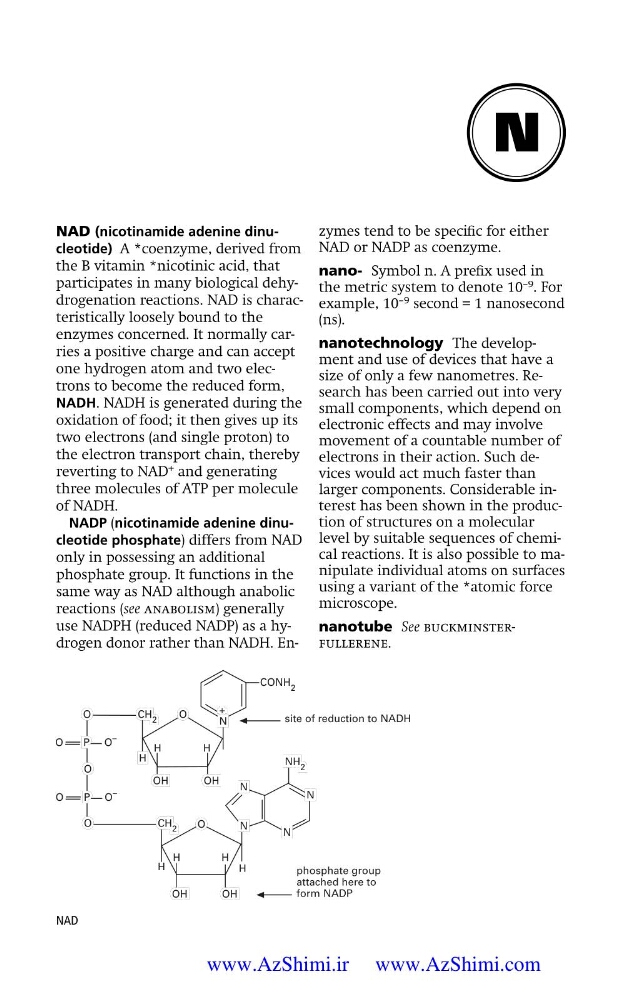
NAD (nicotinamide adenine dinucleotide) A *coenzyme, derived from
the B vitamin *nicotinic acid, that
participates in many biological dehydrogenation reactions. NAD is characteristically loosely bound to the
enzymes concerned. It normally carries a positive charge and can accept
one hydrogen atom and two electrons to become the reduced form,
NADH. NADH is generated during the
oxidation of food; it then gives up its
two electrons (and single proton) to
the electron transport chain, thereby
reverting to NAD
+ and generating
three molecules of ATP per molecule
of NADH.
NADP (nicotinamide adenine dinucleotide phosphate) differs from NAD
only in possessing an additional
phosphate group. It functions in the
same way as NAD although anabolic
reactions (see anabolism) generally
use NADPH (reduced NADP) as a hydrogen donor rather than NADH. Enzymes tend to be speciÜc for either
NAD or NADP as coenzyme.
nano- Symbol n. A preÜx used in
the metric system to denote 10
–9
. For
example, 10
–9 second = 1 nanosecond
(ns).
nanotechnology The development and use of devices that have a
size of only a few nanometres. Research has been carried out into very
small components, which depend on
electronic effects and may involve
movement of a countable number of
electrons in their action. Such devices would act much faster than
larger components. Considerable interest has been shown in the production of structures on a molecular
level by suitable sequences of chemical reactions. It is also possible to manipulate individual atoms on surfaces
using a variant of the *atomic force
microscope.
nanotube See buckminsterfullerene.
CONH 2
site of reduction to NADH
phosphate group
attached here to
form NADP
NH 2
NH 2
NH 2
N N N
N N N
N N N
N N N
+ + +
N N N
O O O
H
H
OH OH OH
OH OH OH
CH 2
CH 2
CH 2
H H H
O O O
O
P P P O
–
O O O
O O O
CH 2
CH 2
CH 2
H
O O O
H
H
OH OH OH
H
OH OH OH
O
P P P O
–
NAD
www.AzShimi.ir www.AzShimi.com
NAD (nicotinamide adenine dinucleotide) A *coenzyme, derived from
the B vitamin *nicotinic acid, that
participates in many biological dehydrogenation reactions. NAD is characteristically loosely bound to the
enzymes concerned. It normally carries a positive charge and can accept
one hydrogen atom and two electrons to become the reduced form,
NADH. NADH is generated during the
oxidation of food; it then gives up its
two electrons (and single proton) to
the electron transport chain, thereby
reverting to NAD
+ and generating
three molecules of ATP per molecule
of NADH.
NADP (nicotinamide adenine dinucleotide phosphate) differs from NAD
only in possessing an additional
phosphate group. It functions in the
same way as NAD although anabolic
reactions (see anabolism) generally
use NADPH (reduced NADP) as a hydrogen donor rather than NADH. Enzymes tend to be speciÜc for either
NAD or NADP as coenzyme.
nano- Symbol n. A preÜx used in
the metric system to denote 10
–9
. For
example, 10
–9 second = 1 nanosecond
(ns).
nanotechnology The development and use of devices that have a
size of only a few nanometres. Research has been carried out into very
small components, which depend on
electronic effects and may involve
movement of a countable number of
electrons in their action. Such devices would act much faster than
larger components. Considerable interest has been shown in the production of structures on a molecular
level by suitable sequences of chemical reactions. It is also possible to manipulate individual atoms on surfaces
using a variant of the *atomic force
microscope.
nanotube See buckminsterfullerene.
CONH 2
site of reduction to NADH
phosphate group
attached here to
form NADP
NH 2
NH 2
NH 2
N N N
N N N
N N N
N N N
+ + +
N N N
O O O
H
H
OH OH OH
OH OH OH
CH 2
CH 2
CH 2
H H H
O O O
O
P P P O
–
O O O
O O O
CH 2
CH 2
CH 2
H
O O O
H
H
OH OH OH
H
OH OH OH
O
P P P O
–
NAD
www.AzShimi.ir www.AzShimi.com