

with typical nonmetallic behaviour
of forming negative ions. The *transition elements (e.g. iron and copper)
are harder substances and generally
less reactive. They form coordination
complexes. All metals have oxides
that are basic, although some, such
as aluminium, have *amphoteric
properties.
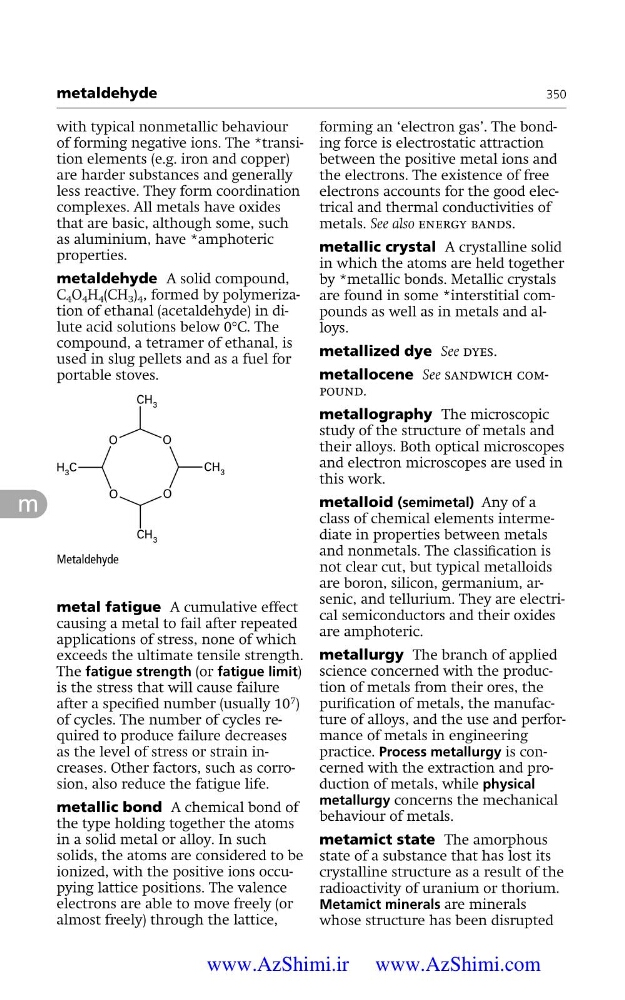
metaldehyde A solid compound,
C 4 O 4 H 4 (CH 3 ) 4 , formed by polymerization of ethanal (acetaldehyde) in dilute acid solutions below 0°C. The
compound, a tetramer of ethanal, is
used in slug pellets and as a fuel for
portable stoves.
metal fatigue A cumulative effect
causing a metal to fail after repeated
applications of stress, none of which
exceeds the ultimate tensile strength.
The fatigue strength (or fatigue limit)
is the stress that will cause failure
after a speciÜed number (usually 10
7 )
of cycles. The number of cycles required to produce failure decreases
as the level of stress or strain increases. Other factors, such as corrosion, also reduce the fatigue life.
metallic bond A chemical bond of
the type holding together the atoms
in a solid metal or alloy. In such
solids, the atoms are considered to be
ionized, with the positive ions occupying lattice positions. The valence
electrons are able to move freely (or
almost freely) through the lattice,
forming an ‘electron gas’. The bonding force is electrostatic attraction
between the positive metal ions and
the electrons. The existence of free
electrons accounts for the good electrical and thermal conductivities of
metals. See also energy bands.
metallic crystal A crystalline solid
in which the atoms are held together
by *metallic bonds. Metallic crystals
are found in some *interstitial compounds as well as in metals and alloys.
metallized dye See dyes.
metallocene See sandwich compound.
metallography The microscopic
study of the structure of metals and
their alloys. Both optical microscopes
and electron microscopes are used in
this work.
metalloid (semimetal) Any of a
class of chemical elements intermediate in properties between metals
and nonmetals. The classiÜcation is
not clear cut, but typical metalloids
are boron, silicon, germanium, arsenic, and tellurium. They are electrical semiconductors and their oxides
are amphoteric.
metallurgy The branch of applied
science concerned with the production of metals from their ores, the
puriÜcation of metals, the manufacture of alloys, and the use and performance of metals in engineering
practice. Process metallurgy is concerned with the extraction and production of metals, while physical
metallurgy concerns the mechanical
behaviour of metals.
metamict state The amorphous
state of a substance that has lost its
crystalline structure as a result of the
radioactivity of uranium or thorium.
Metamict minerals are minerals
whose structure has been disrupted
metaldehyde
350
m
O
O
O
O
CH 3
CH 3
CH 3
C
H 3
Metaldehyde
www.AzShimi.ir www.AzShimi.com
of forming negative ions. The *transition elements (e.g. iron and copper)
are harder substances and generally
less reactive. They form coordination
complexes. All metals have oxides
that are basic, although some, such
as aluminium, have *amphoteric
properties.
metaldehyde A solid compound,
C 4 O 4 H 4 (CH 3 ) 4 , formed by polymerization of ethanal (acetaldehyde) in dilute acid solutions below 0°C. The
compound, a tetramer of ethanal, is
used in slug pellets and as a fuel for
portable stoves.
metal fatigue A cumulative effect
causing a metal to fail after repeated
applications of stress, none of which
exceeds the ultimate tensile strength.
The fatigue strength (or fatigue limit)
is the stress that will cause failure
after a speciÜed number (usually 10
7 )
of cycles. The number of cycles required to produce failure decreases
as the level of stress or strain increases. Other factors, such as corrosion, also reduce the fatigue life.
metallic bond A chemical bond of
the type holding together the atoms
in a solid metal or alloy. In such
solids, the atoms are considered to be
ionized, with the positive ions occupying lattice positions. The valence
electrons are able to move freely (or
almost freely) through the lattice,
forming an ‘electron gas’. The bonding force is electrostatic attraction
between the positive metal ions and
the electrons. The existence of free
electrons accounts for the good electrical and thermal conductivities of
metals. See also energy bands.
metallic crystal A crystalline solid
in which the atoms are held together
by *metallic bonds. Metallic crystals
are found in some *interstitial compounds as well as in metals and alloys.
metallized dye See dyes.
metallocene See sandwich compound.
metallography The microscopic
study of the structure of metals and
their alloys. Both optical microscopes
and electron microscopes are used in
this work.
metalloid (semimetal) Any of a
class of chemical elements intermediate in properties between metals
and nonmetals. The classiÜcation is
not clear cut, but typical metalloids
are boron, silicon, germanium, arsenic, and tellurium. They are electrical semiconductors and their oxides
are amphoteric.
metallurgy The branch of applied
science concerned with the production of metals from their ores, the
puriÜcation of metals, the manufacture of alloys, and the use and performance of metals in engineering
practice. Process metallurgy is concerned with the extraction and production of metals, while physical
metallurgy concerns the mechanical
behaviour of metals.
metamict state The amorphous
state of a substance that has lost its
crystalline structure as a result of the
radioactivity of uranium or thorium.
Metamict minerals are minerals
whose structure has been disrupted
metaldehyde
350
m
O
O
O
O
CH 3
CH 3
CH 3
C
H 3
Metaldehyde
www.AzShimi.ir www.AzShimi.com