

ide solution is added to a solution of
mercury(II) nitrate. Both forms decompose to the elements at high
temperature. The black precipitate
formed when sodium hydroxide is
added to mercury(I) nitrate solution
is sometimes referred to as
mercury(I) oxide (Hg 2 O) but is probably a mixture of HgO and free mercury.
mercury(II) sulphide A red or
black compound, HgS, occurring naturally as the minerals cinnabar (red)
and metacinnabar (black). It can be
obtained as a black precipitate by
bubbling hydrogen sulphide through
a solution of mercury(II) nitrate. The
red form is obtained by sublimation.
The compound is also called vermilion (used as a pigment).
mer isomer See isomerism.
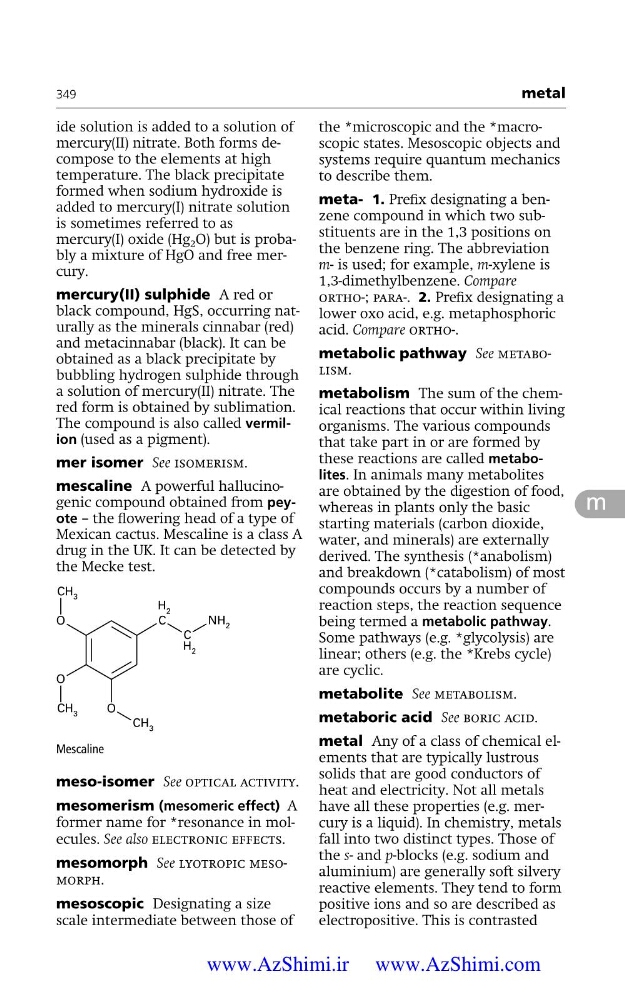
mescaline A powerful hallucinogenic compound obtained from peyote – the Ûowering head of a type of
Mexican cactus. Mescaline is a class A
drug in the UK. It can be detected by
the Mecke test.
349
metal
m
O
O
O
CH 3
CH 3
CH 3
C
H 2
C
H 2
NH 2
Mescaline
meso-isomer See optical activity.
mesomerism (mesomeric effect) A
former name for *resonance in molecules. See also electronic effects.
mesomorph See lyotropic mesomorph.
mesoscopic Designating a size
scale intermediate between those of
the *microscopic and the *macroscopic states. Mesoscopic objects and
systems require quantum mechanics
to describe them.
meta- 1. PreÜx designating a benzene compound in which two substituents are in the 1,3 positions on
the benzene ring. The abbreviation
m- is used; for example, m-xylene is
1,3-dimethylbenzene. Compare
ortho-; para-. 2. PreÜx designating a
lower oxo acid, e.g. metaphosphoric
acid. Compare ortho-.
metabolic pathway See metabolism.
metabolism The sum of the chemical reactions that occur within living
organisms. The various compounds
that take part in or are formed by
these reactions are called metabolites. In animals many metabolites
are obtained by the digestion of food,
whereas in plants only the basic
starting materials (carbon dioxide,
water, and minerals) are externally
derived. The synthesis (*anabolism)
and breakdown (*catabolism) of most
compounds occurs by a number of
reaction steps, the reaction sequence
being termed a metabolic pathway.
Some pathways (e.g. *glycolysis) are
linear; others (e.g. the *Krebs cycle)
are cyclic.
metabolite See metabolism.
metaboric acid See boric acid.
metal Any of a class of chemical elements that are typically lustrous
solids that are good conductors of
heat and electricity. Not all metals
have all these properties (e.g. mercury is a liquid). In chemistry, metals
fall into two distinct types. Those of
the s- and p-blocks (e.g. sodium and
aluminium) are generally soft silvery
reactive elements. They tend to form
positive ions and so are described as
electropositive. This is contrasted
www.AzShimi.ir www.AzShimi.com
mercury(II) nitrate. Both forms decompose to the elements at high
temperature. The black precipitate
formed when sodium hydroxide is
added to mercury(I) nitrate solution
is sometimes referred to as
mercury(I) oxide (Hg 2 O) but is probably a mixture of HgO and free mercury.
mercury(II) sulphide A red or
black compound, HgS, occurring naturally as the minerals cinnabar (red)
and metacinnabar (black). It can be
obtained as a black precipitate by
bubbling hydrogen sulphide through
a solution of mercury(II) nitrate. The
red form is obtained by sublimation.
The compound is also called vermilion (used as a pigment).
mer isomer See isomerism.
mescaline A powerful hallucinogenic compound obtained from peyote – the Ûowering head of a type of
Mexican cactus. Mescaline is a class A
drug in the UK. It can be detected by
the Mecke test.
349
metal
m
O
O
O
CH 3
CH 3
CH 3
C
H 2
C
H 2
NH 2
Mescaline
meso-isomer See optical activity.
mesomerism (mesomeric effect) A
former name for *resonance in molecules. See also electronic effects.
mesomorph See lyotropic mesomorph.
mesoscopic Designating a size
scale intermediate between those of
the *microscopic and the *macroscopic states. Mesoscopic objects and
systems require quantum mechanics
to describe them.
meta- 1. PreÜx designating a benzene compound in which two substituents are in the 1,3 positions on
the benzene ring. The abbreviation
m- is used; for example, m-xylene is
1,3-dimethylbenzene. Compare
ortho-; para-. 2. PreÜx designating a
lower oxo acid, e.g. metaphosphoric
acid. Compare ortho-.
metabolic pathway See metabolism.
metabolism The sum of the chemical reactions that occur within living
organisms. The various compounds
that take part in or are formed by
these reactions are called metabolites. In animals many metabolites
are obtained by the digestion of food,
whereas in plants only the basic
starting materials (carbon dioxide,
water, and minerals) are externally
derived. The synthesis (*anabolism)
and breakdown (*catabolism) of most
compounds occurs by a number of
reaction steps, the reaction sequence
being termed a metabolic pathway.
Some pathways (e.g. *glycolysis) are
linear; others (e.g. the *Krebs cycle)
are cyclic.
metabolite See metabolism.
metaboric acid See boric acid.
metal Any of a class of chemical elements that are typically lustrous
solids that are good conductors of
heat and electricity. Not all metals
have all these properties (e.g. mercury is a liquid). In chemistry, metals
fall into two distinct types. Those of
the s- and p-blocks (e.g. sodium and
aluminium) are generally soft silvery
reactive elements. They tend to form
positive ions and so are described as
electropositive. This is contrasted
www.AzShimi.ir www.AzShimi.com