

amidol
28
a
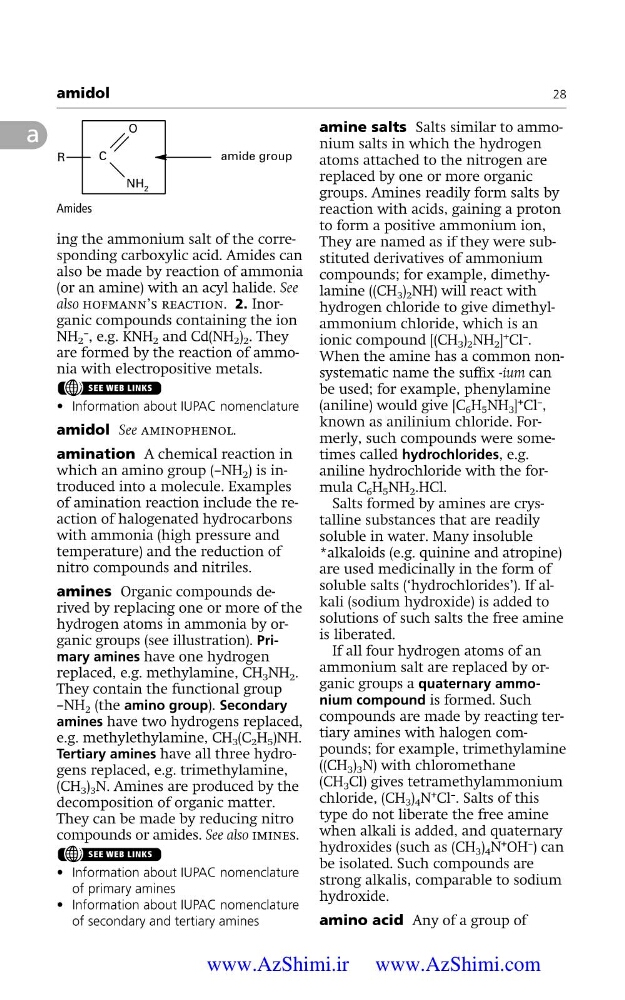
C
O
NH 2
R
amide group
Amides
ing the ammonium salt of the corresponding carboxylic acid. Amides can
also be made by reaction of ammonia
(or an amine) with an acyl halide. See
also hofmann’s reaction. 2. Inorganic compounds containing the ion
NH 2
– , e.g. KNH 2 and Cd(NH 2 ) 2 . They
are formed by the reaction of ammonia with electropositive metals.
A
• Information about IUPAC nomenclature
amidol See aminophenol.
amination A chemical reaction in
which an amino group (–NH 2 ) is introduced into a molecule. Examples
of amination reaction include the reaction of halogenated hydrocarbons
with ammonia (high pressure and
temperature) and the reduction of
nitro compounds and nitriles.
amines Organic compounds derived by replacing one or more of the
hydrogen atoms in ammonia by organic groups (see illustration). Primary amines have one hydrogen
replaced, e.g. methylamine, CH 3 NH 2 .
They contain the functional group
–NH 2 (the amino group). Secondary
amines have two hydrogens replaced,
e.g. methylethylamine, CH 3 (C 2 H 5 )NH.
Tertiary amines have all three hydrogens replaced, e.g. trimethylamine,
(CH 3 ) 3 N. Amines are produced by the
decomposition of organic matter.
They can be made by reducing nitro
compounds or amides. See also imines.
A
• Information about IUPAC nomenclature
of primary amines
• Information about IUPAC nomenclature
of secondary and tertiary amines
amine salts Salts similar to ammonium salts in which the hydrogen
atoms attached to the nitrogen are
replaced by one or more organic
groups. Amines readily form salts by
reaction with acids, gaining a proton
to form a positive ammonium ion,
They are named as if they were substituted derivatives of ammonium
compounds; for example, dimethylamine ((CH 3 ) 2 NH) will react with
hydrogen chloride to give dimethylammonium chloride, which is an
ionic compound [(CH 3 ) 2 NH 2 ]
+ Cl
– .
When the amine has a common nonsystematic name the sufÜx -ium can
be used; for example, phenylamine
(aniline) would give [C 6 H 5 NH 3 ]
+
Cl
–
,
known as anilinium chloride. Formerly, such compounds were sometimes called hydrochlorides, e.g.
aniline hydrochloride with the formula C 6 H 5 NH 2 .HCl.
Salts formed by amines are crystalline substances that are readily
soluble in water. Many insoluble
*alkaloids (e.g. quinine and atropine)
are used medicinally in the form of
soluble salts (‘hydrochlorides’). If alkali (sodium hydroxide) is added to
solutions of such salts the free amine
is liberated.
If all four hydrogen atoms of an
ammonium salt are replaced by organic groups a quaternary ammonium compound is formed. Such
compounds are made by reacting tertiary amines with halogen compounds; for example, trimethylamine
((CH 3 ) 3 N) with chloromethane
(CH 3 Cl) gives tetramethylammonium
chloride, (CH 3 ) 4 N
+ Cl
– . Salts of this
type do not liberate the free amine
when alkali is added, and quaternary
hydroxides (such as (CH 3 ) 4 N
+ OH
– ) can
be isolated. Such compounds are
strong alkalis, comparable to sodium
hydroxide.
amino acid Any of a group of
www.AzShimi.ir www.AzShimi.com
28
a
C
O
NH 2
R
amide group
Amides
ing the ammonium salt of the corresponding carboxylic acid. Amides can
also be made by reaction of ammonia
(or an amine) with an acyl halide. See
also hofmann’s reaction. 2. Inorganic compounds containing the ion
NH 2
– , e.g. KNH 2 and Cd(NH 2 ) 2 . They
are formed by the reaction of ammonia with electropositive metals.
A
• Information about IUPAC nomenclature
amidol See aminophenol.
amination A chemical reaction in
which an amino group (–NH 2 ) is introduced into a molecule. Examples
of amination reaction include the reaction of halogenated hydrocarbons
with ammonia (high pressure and
temperature) and the reduction of
nitro compounds and nitriles.
amines Organic compounds derived by replacing one or more of the
hydrogen atoms in ammonia by organic groups (see illustration). Primary amines have one hydrogen
replaced, e.g. methylamine, CH 3 NH 2 .
They contain the functional group
–NH 2 (the amino group). Secondary
amines have two hydrogens replaced,
e.g. methylethylamine, CH 3 (C 2 H 5 )NH.
Tertiary amines have all three hydrogens replaced, e.g. trimethylamine,
(CH 3 ) 3 N. Amines are produced by the
decomposition of organic matter.
They can be made by reducing nitro
compounds or amides. See also imines.
A
• Information about IUPAC nomenclature
of primary amines
• Information about IUPAC nomenclature
of secondary and tertiary amines
amine salts Salts similar to ammonium salts in which the hydrogen
atoms attached to the nitrogen are
replaced by one or more organic
groups. Amines readily form salts by
reaction with acids, gaining a proton
to form a positive ammonium ion,
They are named as if they were substituted derivatives of ammonium
compounds; for example, dimethylamine ((CH 3 ) 2 NH) will react with
hydrogen chloride to give dimethylammonium chloride, which is an
ionic compound [(CH 3 ) 2 NH 2 ]
+ Cl
– .
When the amine has a common nonsystematic name the sufÜx -ium can
be used; for example, phenylamine
(aniline) would give [C 6 H 5 NH 3 ]
+
Cl
–
,
known as anilinium chloride. Formerly, such compounds were sometimes called hydrochlorides, e.g.
aniline hydrochloride with the formula C 6 H 5 NH 2 .HCl.
Salts formed by amines are crystalline substances that are readily
soluble in water. Many insoluble
*alkaloids (e.g. quinine and atropine)
are used medicinally in the form of
soluble salts (‘hydrochlorides’). If alkali (sodium hydroxide) is added to
solutions of such salts the free amine
is liberated.
If all four hydrogen atoms of an
ammonium salt are replaced by organic groups a quaternary ammonium compound is formed. Such
compounds are made by reacting tertiary amines with halogen compounds; for example, trimethylamine
((CH 3 ) 3 N) with chloromethane
(CH 3 Cl) gives tetramethylammonium
chloride, (CH 3 ) 4 N
+ Cl
– . Salts of this
type do not liberate the free amine
when alkali is added, and quaternary
hydroxides (such as (CH 3 ) 4 N
+ OH
– ) can
be isolated. Such compounds are
strong alkalis, comparable to sodium
hydroxide.
amino acid Any of a group of
www.AzShimi.ir www.AzShimi.com