

amalgam An alloy of mercury with
one or more other metals. Most metals form amalgams (iron and platinum are exceptions), which may be
liquid or solid. Some contain deÜnite
intermetallic compounds, such as
NaHg 2 .
amatol A high explosive consisting
of a mixture of ammonium nitrate
and trinitrotoluene.
ambident Describing a chemical
species that has two alternative reactive centres such that reaction at one
centre stops or inhibits reaction at
the other. An example is the *enolate ion in which electrophilic attack
can occur at either the oxygen atom
or at the beta-carbon atom.
ambidentate Describing a ligand
that can coordinate at two different
sites. For example, the NO 2 molecule
can coordinate through the N atom
(the nitro ligand) or through an O
atom (the nitrido ligand). Complexes
that differ only in the way the ligand
coordinates display linkage isomerism.
ambo- A preÜx used to indicate that
a substance is present as a mixture
of racemic diastereoisomers in unspeciÜed proportions. For example, if
l-alanine is reacted with dl-leucine,
the resulting dipeptide can be described as l-alanyl-ambo-leucine, to
indicate the mixture.
americium Symbol Am. A radioactive metallic transuranic element
belonging to the *actinoids; a.n. 95;
mass number of most stable isotope
243 (half-life 7.95 × 10
3 years); r.d.
13.67 (20°C); m.p. 994 ± 4°C; b.p.
2607°C. Ten isotopes are known. The
element was discovered by G. T.
Seaborg and associates in 1945, who
obtained it by bombarding uranium–238 with alpha particles.
A
• Information from the WebElements site
amethyst The purple variety of the
mineral *quartz. It is found chieÛy in
Brazil, the Urals (Soviet Union), Arizona (USA), and Uruguay. The colour
is due to impurities, especially iron
oxide. It is used as a gemstone.
amides 1. Organic compounds containing the group –CO.NH 2 (the
amide group). Compounds containing this group are primary amides.
Secondary and tertiary amides can
also exist, in which the hydrogen
atoms on the nitrogen are replaced
by one or two other organic groups
respectively. Simple examples of primary amides are ethanamide,
CH 3 CONH 2 , and propanamide,
C 2 H 5 CONH 2 . They are made by heat27
amides
a
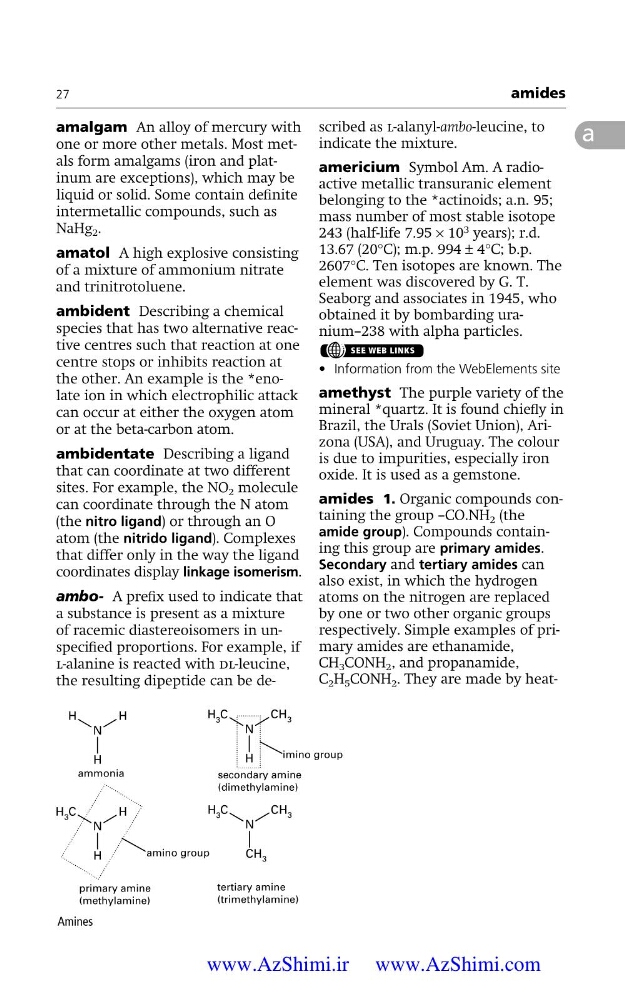
H
N
H
H
C
H 3
N
H
H
C
H 3
N
CH 3
H
C
H 3
N
CH 3
CH 3
ammonia
primary amine
(methylamine)
secondary amine
(dimethylamine)
tertiary amine
(trimethylamine)
amino group
imino group
Amines
www.AzShimi.ir www.AzShimi.com
one or more other metals. Most metals form amalgams (iron and platinum are exceptions), which may be
liquid or solid. Some contain deÜnite
intermetallic compounds, such as
NaHg 2 .
amatol A high explosive consisting
of a mixture of ammonium nitrate
and trinitrotoluene.
ambident Describing a chemical
species that has two alternative reactive centres such that reaction at one
centre stops or inhibits reaction at
the other. An example is the *enolate ion in which electrophilic attack
can occur at either the oxygen atom
or at the beta-carbon atom.
ambidentate Describing a ligand
that can coordinate at two different
sites. For example, the NO 2 molecule
can coordinate through the N atom
(the nitro ligand) or through an O
atom (the nitrido ligand). Complexes
that differ only in the way the ligand
coordinates display linkage isomerism.
ambo- A preÜx used to indicate that
a substance is present as a mixture
of racemic diastereoisomers in unspeciÜed proportions. For example, if
l-alanine is reacted with dl-leucine,
the resulting dipeptide can be described as l-alanyl-ambo-leucine, to
indicate the mixture.
americium Symbol Am. A radioactive metallic transuranic element
belonging to the *actinoids; a.n. 95;
mass number of most stable isotope
243 (half-life 7.95 × 10
3 years); r.d.
13.67 (20°C); m.p. 994 ± 4°C; b.p.
2607°C. Ten isotopes are known. The
element was discovered by G. T.
Seaborg and associates in 1945, who
obtained it by bombarding uranium–238 with alpha particles.
A
• Information from the WebElements site
amethyst The purple variety of the
mineral *quartz. It is found chieÛy in
Brazil, the Urals (Soviet Union), Arizona (USA), and Uruguay. The colour
is due to impurities, especially iron
oxide. It is used as a gemstone.
amides 1. Organic compounds containing the group –CO.NH 2 (the
amide group). Compounds containing this group are primary amides.
Secondary and tertiary amides can
also exist, in which the hydrogen
atoms on the nitrogen are replaced
by one or two other organic groups
respectively. Simple examples of primary amides are ethanamide,
CH 3 CONH 2 , and propanamide,
C 2 H 5 CONH 2 . They are made by heat27
amides
a
H
N
H
H
C
H 3
N
H
H
C
H 3
N
CH 3
H
C
H 3
N
CH 3
CH 3
ammonia
primary amine
(methylamine)
secondary amine
(dimethylamine)
tertiary amine
(trimethylamine)
amino group
imino group
Amines
www.AzShimi.ir www.AzShimi.com