

has only a few minor uses (e.g. as an
activator in luminous paints), but gallium arsenide is extensively used as a
semiconductor in many applications.
Gallium corrodes most other metals
because it rapidly diffuses into their
lattices. Most gallium(I) and some gallium(II) compounds are unstable. The
element was Ürst identiÜed by Paul
Lecoq de Boisbaudran (1838–1912) in
1875.
A
• Information from the WebElements site
GALP See glyceraldehyde 3-phosphate.
galvanic cell See voltaic cell.
galvanized iron Iron or steel that
has been coated with a layer of zinc
to protect it from corrosion in a
process invented by Luigi Galvani.
Corrugated mild-steel sheets for
rooÜng and mild-steel sheets for dustbins, etc., are usually galvanized by
dipping them in molten zinc. The
formation of a brittle zinc–iron alloy
is prevented by the addition of small
quantities of aluminium or magnesium. Wire is often galvanized by a
cold electrolytic process as no alloy
forms in this process. Galvanizing is
an effective method of protecting
steel because even if the surface is
scratched, the zinc still protects the
underlying metal. See sacrificial
protection.
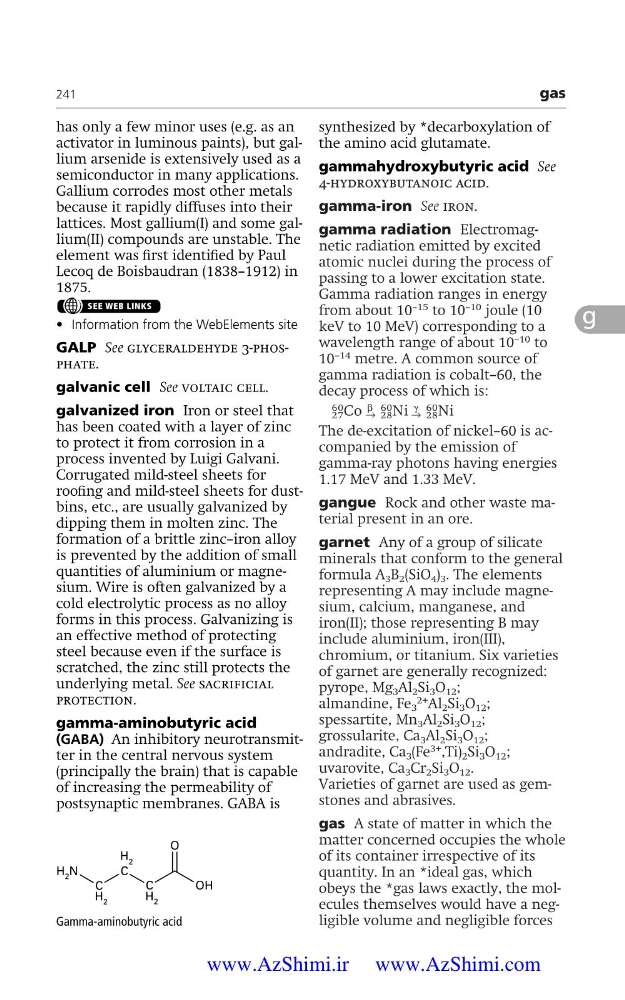
gamma-aminobutyric acid
(GABA) An inhibitory neurotransmitter in the central nervous system
(principally the brain) that is capable
of increasing the permeability of
postsynaptic membranes. GABA is
synthesized by *decarboxylation of
the amino acid glutamate.
gammahydroxybutyric acid See
4-hydroxybutanoic acid.
gamma-iron See iron.
gamma radiation Electromagnetic radiation emitted by excited
atomic nuclei during the process of
passing to a lower excitation state.
Gamma radiation ranges in energy
from about 10
–15 to 10
–10 joule (10
keV to 10 MeV) corresponding to a
wavelength range of about 10
–10 to
10
–14 metre. A common source of
gamma radiation is cobalt–60, the
decay process of which is:
6
2
0
7 Co
β
→
6
2
0
8 Ni
γ
→
6
2
0
8 Ni
The de-excitation of nickel–60 is accompanied by the emission of
gamma-ray photons having energies
1.17 MeV and 1.33 MeV.
gangue Rock and other waste material present in an ore.
garnet Any of a group of silicate
minerals that conform to the general
formula A 3 B 2 (SiO 4 ) 3 . The elements
representing A may include magnesium, calcium, manganese, and
iron(II); those representing B may
include aluminium, iron(III),
chromium, or titanium. Six varieties
of garnet are generally recognized:
pyrope, Mg 3 Al 2 Si 3 O 12 ;
almandine, Fe 3
2+ Al 2 Si 3 O 12 ;
spessartite, Mn 3 Al 2 Si 3 O 12 ;
grossularite, Ca 3 Al 2 Si 3 O 12 ;
andradite, Ca 3 (Fe
3+ ,Ti) 2 Si 3 O 12 ;
uvarovite, Ca 3 Cr 2 Si 3 O 12 .
Varieties of garnet are used as gemstones and abrasives.
gas A state of matter in which the
matter concerned occupies the whole
of its container irrespective of its
quantity. In an *ideal gas, which
obeys the *gas laws exactly, the molecules themselves would have a negligible volume and negligible forces
241
gas
g
C
H 2
C
H 2
N
H 2
C
H 2
OH
O
Gamma-aminobutyric acid
www.AzShimi.ir www.AzShimi.com
activator in luminous paints), but gallium arsenide is extensively used as a
semiconductor in many applications.
Gallium corrodes most other metals
because it rapidly diffuses into their
lattices. Most gallium(I) and some gallium(II) compounds are unstable. The
element was Ürst identiÜed by Paul
Lecoq de Boisbaudran (1838–1912) in
1875.
A
• Information from the WebElements site
GALP See glyceraldehyde 3-phosphate.
galvanic cell See voltaic cell.
galvanized iron Iron or steel that
has been coated with a layer of zinc
to protect it from corrosion in a
process invented by Luigi Galvani.
Corrugated mild-steel sheets for
rooÜng and mild-steel sheets for dustbins, etc., are usually galvanized by
dipping them in molten zinc. The
formation of a brittle zinc–iron alloy
is prevented by the addition of small
quantities of aluminium or magnesium. Wire is often galvanized by a
cold electrolytic process as no alloy
forms in this process. Galvanizing is
an effective method of protecting
steel because even if the surface is
scratched, the zinc still protects the
underlying metal. See sacrificial
protection.
gamma-aminobutyric acid
(GABA) An inhibitory neurotransmitter in the central nervous system
(principally the brain) that is capable
of increasing the permeability of
postsynaptic membranes. GABA is
synthesized by *decarboxylation of
the amino acid glutamate.
gammahydroxybutyric acid See
4-hydroxybutanoic acid.
gamma-iron See iron.
gamma radiation Electromagnetic radiation emitted by excited
atomic nuclei during the process of
passing to a lower excitation state.
Gamma radiation ranges in energy
from about 10
–15 to 10
–10 joule (10
keV to 10 MeV) corresponding to a
wavelength range of about 10
–10 to
10
–14 metre. A common source of
gamma radiation is cobalt–60, the
decay process of which is:
6
2
0
7 Co
β
→
6
2
0
8 Ni
γ
→
6
2
0
8 Ni
The de-excitation of nickel–60 is accompanied by the emission of
gamma-ray photons having energies
1.17 MeV and 1.33 MeV.
gangue Rock and other waste material present in an ore.
garnet Any of a group of silicate
minerals that conform to the general
formula A 3 B 2 (SiO 4 ) 3 . The elements
representing A may include magnesium, calcium, manganese, and
iron(II); those representing B may
include aluminium, iron(III),
chromium, or titanium. Six varieties
of garnet are generally recognized:
pyrope, Mg 3 Al 2 Si 3 O 12 ;
almandine, Fe 3
2+ Al 2 Si 3 O 12 ;
spessartite, Mn 3 Al 2 Si 3 O 12 ;
grossularite, Ca 3 Al 2 Si 3 O 12 ;
andradite, Ca 3 (Fe
3+ ,Ti) 2 Si 3 O 12 ;
uvarovite, Ca 3 Cr 2 Si 3 O 12 .
Varieties of garnet are used as gemstones and abrasives.
gas A state of matter in which the
matter concerned occupies the whole
of its container irrespective of its
quantity. In an *ideal gas, which
obeys the *gas laws exactly, the molecules themselves would have a negligible volume and negligible forces
241
gas
g
C
H 2
C
H 2
N
H 2
C
H 2
OH
O
Gamma-aminobutyric acid
www.AzShimi.ir www.AzShimi.com