

G
GABA See gamma-aminobutyric
acid.
Gabriel reaction A method of
making a primary *amine (free from
any secondary or tertiary amine impurities) from a haloalkane (alkyl
halide) using potassium phthalimide.
It is named after Siegmund Gabriel
(1851–1924).
gadolinium Symbol Gd. A soft silvery metallic element belonging to
the *lanthanoids; a.n. 64; r.a.m.
157.25; r.d. 7.901 (20°C); m.p. 1313°C;
b.p. 3266°C. It occurs in gadolinite,
xenotime, monazite, and residues
from uranium ores. There are seven
stable natural isotopes and eleven
artiÜcial isotopes are known. Two of
the natural isotopes, gadolinium–155
and gadolinium–157, are the best
neutron absorbers of all the elements. The metal has found limited
applications in nuclear technology
and in ferromagnetic alloys (with
cobalt, copper, iron, and cerium).
Gadolinium compounds are used in
electronic components. The element
was discovered by Jean de Marignac
(1817–94) in 1880.
A
• Information from the WebElements site
galactose A simple sugar, C 6 H 12 O 6 ,
stereoisomeric with glucose, that occurs naturally as one of the products
of the enzymic digestion of milk
sugar (lactose) and as a constituent of
gum arabic.
galena A mineral form of lead(II)
sulphide, PbS, crystallizing in the
cubic system; the chief ore of lead. It
usually occurs as grey metallic cubes,
frequently in association with silver,
arsenic, copper, zinc, and antimony.
Important deposits occur in Australia
(at Broken Hill), Germany, the USA
(especially in Missouri, Kansas, and
Oklahoma), and the UK.
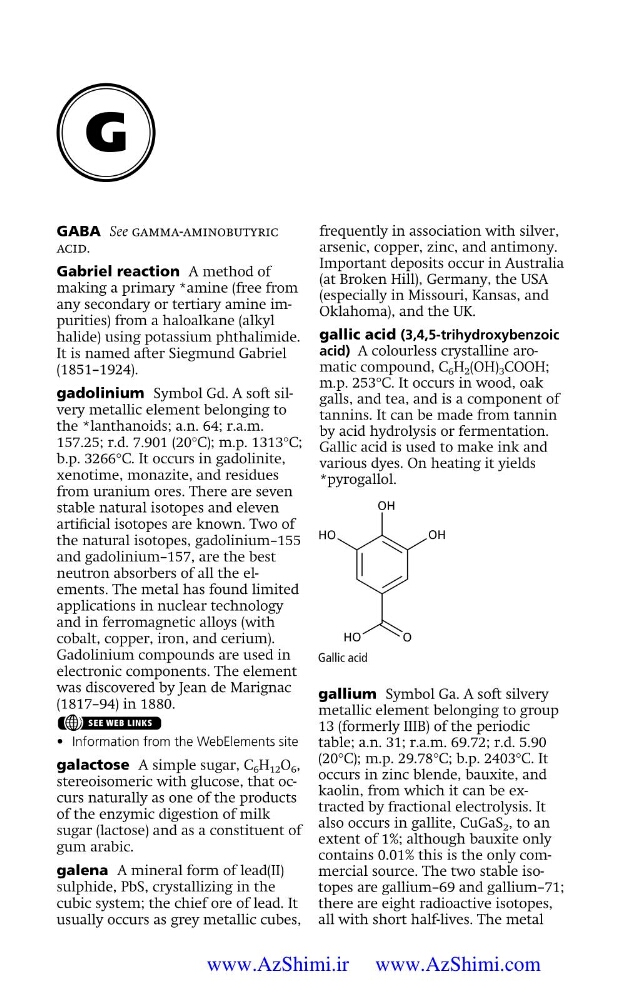
gallic acid (3,4,5-trihydroxybenzoic
acid) A colourless crystalline aromatic compound, C 6 H 2 (OH) 3 COOH;
m.p. 253°C. It occurs in wood, oak
galls, and tea, and is a component of
tannins. It can be made from tannin
by acid hydrolysis or fermentation.
Gallic acid is used to make ink and
various dyes. On heating it yields
*pyrogallol.
O
H
OH
OH
O
H
O
Gallic acid
gallium Symbol Ga. A soft silvery
metallic element belonging to group
13 (formerly IIIB) of the periodic
table; a.n. 31; r.a.m. 69.72; r.d. 5.90
(20°C); m.p. 29.78°C; b.p. 2403°C. It
occurs in zinc blende, bauxite, and
kaolin, from which it can be extracted by fractional electrolysis. It
also occurs in gallite, CuGaS 2 , to an
extent of 1%; although bauxite only
contains 0.01% this is the only commercial source. The two stable isotopes are gallium–69 and gallium–71;
there are eight radioactive isotopes,
all with short half-lives. The metal
www.AzShimi.ir www.AzShimi.com
GABA See gamma-aminobutyric
acid.
Gabriel reaction A method of
making a primary *amine (free from
any secondary or tertiary amine impurities) from a haloalkane (alkyl
halide) using potassium phthalimide.
It is named after Siegmund Gabriel
(1851–1924).
gadolinium Symbol Gd. A soft silvery metallic element belonging to
the *lanthanoids; a.n. 64; r.a.m.
157.25; r.d. 7.901 (20°C); m.p. 1313°C;
b.p. 3266°C. It occurs in gadolinite,
xenotime, monazite, and residues
from uranium ores. There are seven
stable natural isotopes and eleven
artiÜcial isotopes are known. Two of
the natural isotopes, gadolinium–155
and gadolinium–157, are the best
neutron absorbers of all the elements. The metal has found limited
applications in nuclear technology
and in ferromagnetic alloys (with
cobalt, copper, iron, and cerium).
Gadolinium compounds are used in
electronic components. The element
was discovered by Jean de Marignac
(1817–94) in 1880.
A
• Information from the WebElements site
galactose A simple sugar, C 6 H 12 O 6 ,
stereoisomeric with glucose, that occurs naturally as one of the products
of the enzymic digestion of milk
sugar (lactose) and as a constituent of
gum arabic.
galena A mineral form of lead(II)
sulphide, PbS, crystallizing in the
cubic system; the chief ore of lead. It
usually occurs as grey metallic cubes,
frequently in association with silver,
arsenic, copper, zinc, and antimony.
Important deposits occur in Australia
(at Broken Hill), Germany, the USA
(especially in Missouri, Kansas, and
Oklahoma), and the UK.
gallic acid (3,4,5-trihydroxybenzoic
acid) A colourless crystalline aromatic compound, C 6 H 2 (OH) 3 COOH;
m.p. 253°C. It occurs in wood, oak
galls, and tea, and is a component of
tannins. It can be made from tannin
by acid hydrolysis or fermentation.
Gallic acid is used to make ink and
various dyes. On heating it yields
*pyrogallol.
O
H
OH
OH
O
H
O
Gallic acid
gallium Symbol Ga. A soft silvery
metallic element belonging to group
13 (formerly IIIB) of the periodic
table; a.n. 31; r.a.m. 69.72; r.d. 5.90
(20°C); m.p. 29.78°C; b.p. 2403°C. It
occurs in zinc blende, bauxite, and
kaolin, from which it can be extracted by fractional electrolysis. It
also occurs in gallite, CuGaS 2 , to an
extent of 1%; although bauxite only
contains 0.01% this is the only commercial source. The two stable isotopes are gallium–69 and gallium–71;
there are eight radioactive isotopes,
all with short half-lives. The metal
www.AzShimi.ir www.AzShimi.com