

cohol with an acid to produce an
ester and water; e.g.
CH 3 OH + C 6 H 5 COOH ˆ
CH 3 OOCC 6 H 5 + H 2 O
The reaction is an equilibrium and is
slow under normal conditions, but
can be speeded up by addition of a
strong acid catalyst. The ester can
often be distilled off so that the reaction can proceed to completion. The
reverse reaction is ester hydrolysis or
*saponiÜcation. See also labelling.
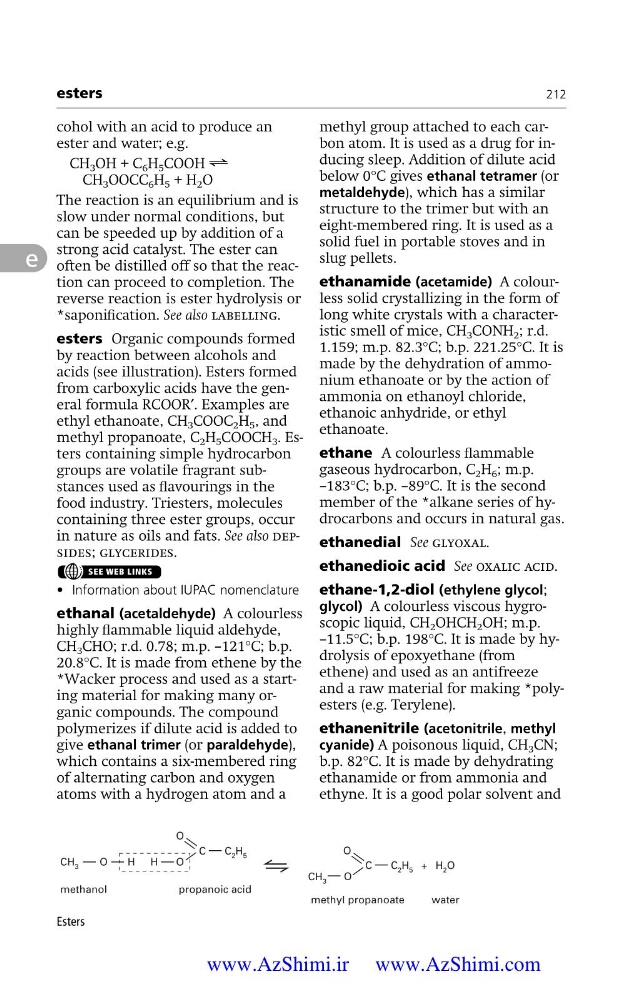
esters Organic compounds formed
by reaction between alcohols and
acids (see illustration). Esters formed
from carboxylic acids have the general formula RCOOR′. Examples are
ethyl ethanoate, CH 3 COOC 2 H 5 , and
methyl propanoate, C 2 H 5 COOCH 3 . Esters containing simple hydrocarbon
groups are volatile fragrant substances used as Ûavourings in the
food industry. Triesters, molecules
containing three ester groups, occur
in nature as oils and fats. See also depsides; glycerides.
A
• Information about IUPAC nomenclature
ethanal (acetaldehyde) A colourless
highly Ûammable liquid aldehyde,
CH 3 CHO; r.d. 0.78; m.p. –121°C; b.p.
20.8°C. It is made from ethene by the
*Wacker process and used as a starting material for making many organic compounds. The compound
polymerizes if dilute acid is added to
give ethanal trimer (or paraldehyde),
which contains a six-membered ring
of alternating carbon and oxygen
atoms with a hydrogen atom and a
methyl group attached to each carbon atom. It is used as a drug for inducing sleep. Addition of dilute acid
below 0°C gives ethanal tetramer (or
metaldehyde), which has a similar
structure to the trimer but with an
eight-membered ring. It is used as a
solid fuel in portable stoves and in
slug pellets.
ethanamide (acetamide) A colourless solid crystallizing in the form of
long white crystals with a characteristic smell of mice, CH 3 CONH 2 ; r.d.
1.159; m.p. 82.3°C; b.p. 221.25°C. It is
made by the dehydration of ammonium ethanoate or by the action of
ammonia on ethanoyl chloride,
ethanoic anhydride, or ethyl
ethanoate.
ethane A colourless Ûammable
gaseous hydrocarbon, C 2 H 6 ; m.p.
–183°C; b.p. –89°C. It is the second
member of the *alkane series of hydrocarbons and occurs in natural gas.
ethanedial See glyoxal.
ethanedioic acid See oxalic acid.
ethane-1,2-diol (ethylene glycol;
glycol) A colourless viscous hygroscopic liquid, CH 2 OHCH 2 OH; m.p.
–11.5°C; b.p. 198°C. It is made by hydrolysis of epoxyethane (from
ethene) and used as an antifreeze
and a raw material for making *polyesters (e.g. Terylene).
ethanenitrile (acetonitrile, methyl
cyanide) A poisonous liquid, CH 3 CN;
b.p. 82°C. It is made by dehydrating
ethanamide or from ammonia and
ethyne. It is a good polar solvent and
esters
212
e
CH 3
O
H H
O
O
C
C 2 H 5
CH 3
O
C
C 2 H 5
O
+ H 2 O
methanol
propanoic acid
methyl propanoate
water
Esters
www.AzShimi.ir www.AzShimi.com
ester and water; e.g.
CH 3 OH + C 6 H 5 COOH ˆ
CH 3 OOCC 6 H 5 + H 2 O
The reaction is an equilibrium and is
slow under normal conditions, but
can be speeded up by addition of a
strong acid catalyst. The ester can
often be distilled off so that the reaction can proceed to completion. The
reverse reaction is ester hydrolysis or
*saponiÜcation. See also labelling.
esters Organic compounds formed
by reaction between alcohols and
acids (see illustration). Esters formed
from carboxylic acids have the general formula RCOOR′. Examples are
ethyl ethanoate, CH 3 COOC 2 H 5 , and
methyl propanoate, C 2 H 5 COOCH 3 . Esters containing simple hydrocarbon
groups are volatile fragrant substances used as Ûavourings in the
food industry. Triesters, molecules
containing three ester groups, occur
in nature as oils and fats. See also depsides; glycerides.
A
• Information about IUPAC nomenclature
ethanal (acetaldehyde) A colourless
highly Ûammable liquid aldehyde,
CH 3 CHO; r.d. 0.78; m.p. –121°C; b.p.
20.8°C. It is made from ethene by the
*Wacker process and used as a starting material for making many organic compounds. The compound
polymerizes if dilute acid is added to
give ethanal trimer (or paraldehyde),
which contains a six-membered ring
of alternating carbon and oxygen
atoms with a hydrogen atom and a
methyl group attached to each carbon atom. It is used as a drug for inducing sleep. Addition of dilute acid
below 0°C gives ethanal tetramer (or
metaldehyde), which has a similar
structure to the trimer but with an
eight-membered ring. It is used as a
solid fuel in portable stoves and in
slug pellets.
ethanamide (acetamide) A colourless solid crystallizing in the form of
long white crystals with a characteristic smell of mice, CH 3 CONH 2 ; r.d.
1.159; m.p. 82.3°C; b.p. 221.25°C. It is
made by the dehydration of ammonium ethanoate or by the action of
ammonia on ethanoyl chloride,
ethanoic anhydride, or ethyl
ethanoate.
ethane A colourless Ûammable
gaseous hydrocarbon, C 2 H 6 ; m.p.
–183°C; b.p. –89°C. It is the second
member of the *alkane series of hydrocarbons and occurs in natural gas.
ethanedial See glyoxal.
ethanedioic acid See oxalic acid.
ethane-1,2-diol (ethylene glycol;
glycol) A colourless viscous hygroscopic liquid, CH 2 OHCH 2 OH; m.p.
–11.5°C; b.p. 198°C. It is made by hydrolysis of epoxyethane (from
ethene) and used as an antifreeze
and a raw material for making *polyesters (e.g. Terylene).
ethanenitrile (acetonitrile, methyl
cyanide) A poisonous liquid, CH 3 CN;
b.p. 82°C. It is made by dehydrating
ethanamide or from ammonia and
ethyne. It is a good polar solvent and
esters
212
e
CH 3
O
H H
O
O
C
C 2 H 5
CH 3
O
C
C 2 H 5
O
+ H 2 O
methanol
propanoic acid
methyl propanoate
water
Esters
www.AzShimi.ir www.AzShimi.com