

haviour can be very complex even
for simple *dynamical systems (see
attractor). Systems, such as *spin
glasses, in which ergodicity is
thought not to hold are described as
having broken ergodicity.
ergosterol A *sterol occurring in
fungi, bacteria, algae, and plants. It is
converted into vitamin D 2 by the action of ultraviolet light.
ESCA See photoelectron spectroscopy.
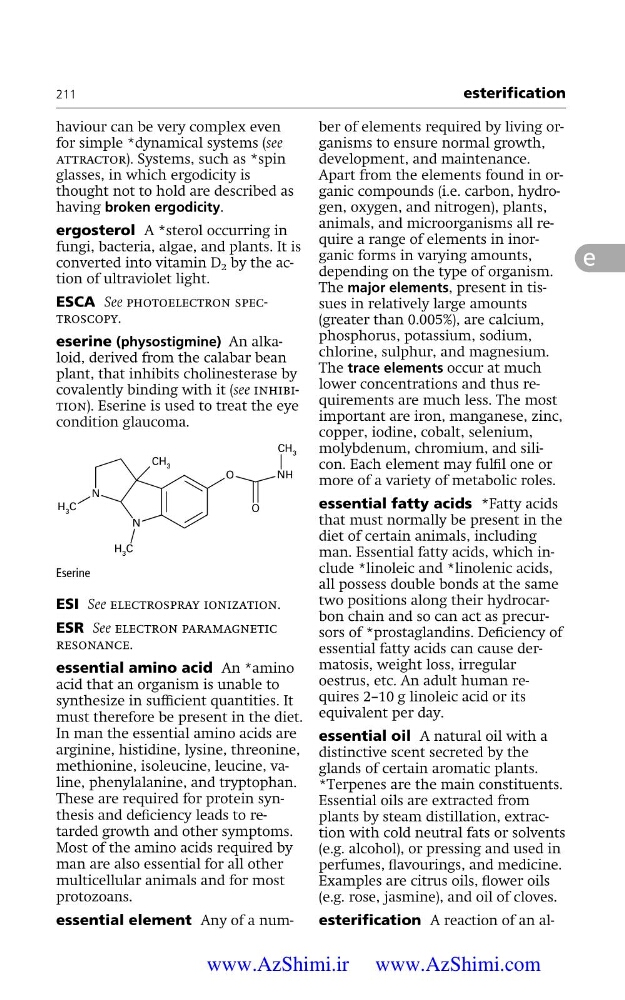
eserine (physostigmine) An alkaloid, derived from the calabar bean
plant, that inhibits cholinesterase by
covalently binding with it (see inhibition). Eserine is used to treat the eye
condition glaucoma.
211
esterification
e
N
N
O
NH
CH 3
O
C
H 3
CH 3
C
H 3
Eserine
ESI See electrospray ionization.
ESR See electron paramagnetic
resonance.
essential amino acid An *amino
acid that an organism is unable to
synthesize in sufÜcient quantities. It
must therefore be present in the diet.
In man the essential amino acids are
arginine, histidine, lysine, threonine,
methionine, isoleucine, leucine, valine, phenylalanine, and tryptophan.
These are required for protein synthesis and deÜciency leads to retarded growth and other symptoms.
Most of the amino acids required by
man are also essential for all other
multicellular animals and for most
protozoans.
essential element Any of a number of elements required by living organisms to ensure normal growth,
development, and maintenance.
Apart from the elements found in organic compounds (i.e. carbon, hydrogen, oxygen, and nitrogen), plants,
animals, and microorganisms all require a range of elements in inorganic forms in varying amounts,
depending on the type of organism.
The major elements, present in tissues in relatively large amounts
(greater than 0.005%), are calcium,
phosphorus, potassium, sodium,
chlorine, sulphur, and magnesium.
The trace elements occur at much
lower concentrations and thus requirements are much less. The most
important are iron, manganese, zinc,
copper, iodine, cobalt, selenium,
molybdenum, chromium, and silicon. Each element may fulÜl one or
more of a variety of metabolic roles.
essential fatty acids *Fatty acids
that must normally be present in the
diet of certain animals, including
man. Essential fatty acids, which include *linoleic and *linolenic acids,
all possess double bonds at the same
two positions along their hydrocarbon chain and so can act as precursors of *prostaglandins. DeÜciency of
essential fatty acids can cause dermatosis, weight loss, irregular
oestrus, etc. An adult human requires 2–10 g linoleic acid or its
equivalent per day.
essential oil A natural oil with a
distinctive scent secreted by the
glands of certain aromatic plants.
*Terpenes are the main constituents.
Essential oils are extracted from
plants by steam distillation, extraction with cold neutral fats or solvents
(e.g. alcohol), or pressing and used in
perfumes, Ûavourings, and medicine.
Examples are citrus oils, Ûower oils
(e.g. rose, jasmine), and oil of cloves.
esteriÜcation A reaction of an alwww.AzShimi.ir www.AzShimi.com
for simple *dynamical systems (see
attractor). Systems, such as *spin
glasses, in which ergodicity is
thought not to hold are described as
having broken ergodicity.
ergosterol A *sterol occurring in
fungi, bacteria, algae, and plants. It is
converted into vitamin D 2 by the action of ultraviolet light.
ESCA See photoelectron spectroscopy.
eserine (physostigmine) An alkaloid, derived from the calabar bean
plant, that inhibits cholinesterase by
covalently binding with it (see inhibition). Eserine is used to treat the eye
condition glaucoma.
211
esterification
e
N
N
O
NH
CH 3
O
C
H 3
CH 3
C
H 3
Eserine
ESI See electrospray ionization.
ESR See electron paramagnetic
resonance.
essential amino acid An *amino
acid that an organism is unable to
synthesize in sufÜcient quantities. It
must therefore be present in the diet.
In man the essential amino acids are
arginine, histidine, lysine, threonine,
methionine, isoleucine, leucine, valine, phenylalanine, and tryptophan.
These are required for protein synthesis and deÜciency leads to retarded growth and other symptoms.
Most of the amino acids required by
man are also essential for all other
multicellular animals and for most
protozoans.
essential element Any of a number of elements required by living organisms to ensure normal growth,
development, and maintenance.
Apart from the elements found in organic compounds (i.e. carbon, hydrogen, oxygen, and nitrogen), plants,
animals, and microorganisms all require a range of elements in inorganic forms in varying amounts,
depending on the type of organism.
The major elements, present in tissues in relatively large amounts
(greater than 0.005%), are calcium,
phosphorus, potassium, sodium,
chlorine, sulphur, and magnesium.
The trace elements occur at much
lower concentrations and thus requirements are much less. The most
important are iron, manganese, zinc,
copper, iodine, cobalt, selenium,
molybdenum, chromium, and silicon. Each element may fulÜl one or
more of a variety of metabolic roles.
essential fatty acids *Fatty acids
that must normally be present in the
diet of certain animals, including
man. Essential fatty acids, which include *linoleic and *linolenic acids,
all possess double bonds at the same
two positions along their hydrocarbon chain and so can act as precursors of *prostaglandins. DeÜciency of
essential fatty acids can cause dermatosis, weight loss, irregular
oestrus, etc. An adult human requires 2–10 g linoleic acid or its
equivalent per day.
essential oil A natural oil with a
distinctive scent secreted by the
glands of certain aromatic plants.
*Terpenes are the main constituents.
Essential oils are extracted from
plants by steam distillation, extraction with cold neutral fats or solvents
(e.g. alcohol), or pressing and used in
perfumes, Ûavourings, and medicine.
Examples are citrus oils, Ûower oils
(e.g. rose, jasmine), and oil of cloves.
esteriÜcation A reaction of an alwww.AzShimi.ir www.AzShimi.com