

ZrO 2 ) made by fusing ZrO 2 and allowing it to cool under controlled conditions. It is used as an inexpensive
diamond substitute in jewellery.
Often it is erroneously called *zircon.
cumene process An industrial
process for making phenol from benzene. A mixture of benzene vapour
and propene is passed over a phosphoric acid catalyst at 250°C and
high pressure
C 6 H 6 + CH 3 CH:CH 2 →
C 6 H 5 CH(CH 3 ) 2
The product is called cumene, and it
can be oxidized in air to a peroxide,
C 6 H 5 C(CH 3 ) 2 O 2 H. This reacts with dilute acid to give phenol (C 6 H 5 OH) and
propanone (acetone, CH 3 OCH 3 ),
which is a valuable by-product.
cupellation A method of separating noble metals (e.g. gold or silver)
from base metals (e.g. lead) by melting the mixture with a blast of hot
air in a shallow porous dish (the
cupel). The base metals are oxidized,
the oxide being carried away by the
blast of air or absorbed by the porous
container.
cuprammonium ion The tetraamminecopper(II) ion [Cu(NH 3 ) 4 ]
2+ . See
ammine.
cupric compounds Compounds
containing copper in its higher (+2)
oxidation state; e.g. cupric chloride is
copper(II) chloride (CuCl 2 ).
cuprite A red mineral cubic form of
copper(I) oxide, Cu 2 O; an important
ore of copper. It occurs where deposits of copper have been subjected
to oxidation. The mineral has been
mined as a copper ore in Chile,
Democratic Republic of Congo, Bolivia, Australia, Russia, and the USA.
cupronickel A type of corrosion-resistant alloy of copper and nickel
containing up to 45% nickel.
cuprous compounds Compounds
containing copper in its lower (+1)
oxidation state; e.g. cuprous chloride
is copper(I) chloride (CuCl).
curare A resin obtained from the
bark of South American trees of the
genera Strychnos and Chondrodendron
that causes paralysis of voluntary
muscle. It acts by blocking the action
of the neurotransmitter *acetylcholine at neuromuscular junctions.
Curare is used as an arrow poison by
South American Indians and was formerly used as a muscle relaxant in
surgery.
curie The former unit of *activity
(see radiation units). It is named
after Marie *Curie.
Curie, Marie (Marya Sklodowska;
1867–1934) Polish-born French
chemist, who went to Paris in 1891.
155
Curie, Marie
c
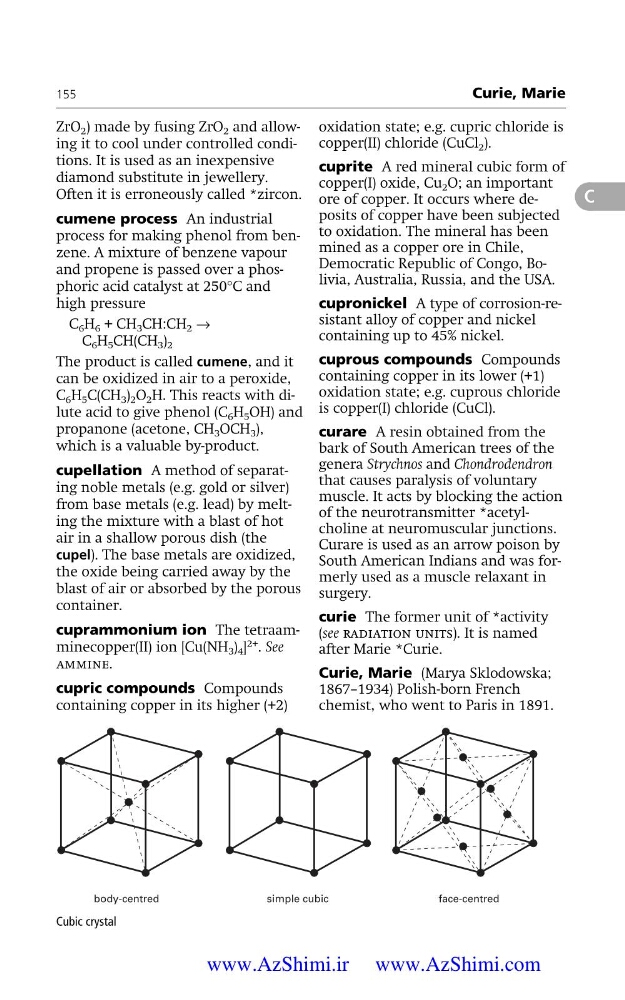
body-centred
simple cubic
face-centred
Cubic crystal
www.AzShimi.ir www.AzShimi.com
diamond substitute in jewellery.
Often it is erroneously called *zircon.
cumene process An industrial
process for making phenol from benzene. A mixture of benzene vapour
and propene is passed over a phosphoric acid catalyst at 250°C and
high pressure
C 6 H 6 + CH 3 CH:CH 2 →
C 6 H 5 CH(CH 3 ) 2
The product is called cumene, and it
can be oxidized in air to a peroxide,
C 6 H 5 C(CH 3 ) 2 O 2 H. This reacts with dilute acid to give phenol (C 6 H 5 OH) and
propanone (acetone, CH 3 OCH 3 ),
which is a valuable by-product.
cupellation A method of separating noble metals (e.g. gold or silver)
from base metals (e.g. lead) by melting the mixture with a blast of hot
air in a shallow porous dish (the
cupel). The base metals are oxidized,
the oxide being carried away by the
blast of air or absorbed by the porous
container.
cuprammonium ion The tetraamminecopper(II) ion [Cu(NH 3 ) 4 ]
2+ . See
ammine.
cupric compounds Compounds
containing copper in its higher (+2)
oxidation state; e.g. cupric chloride is
copper(II) chloride (CuCl 2 ).
cuprite A red mineral cubic form of
copper(I) oxide, Cu 2 O; an important
ore of copper. It occurs where deposits of copper have been subjected
to oxidation. The mineral has been
mined as a copper ore in Chile,
Democratic Republic of Congo, Bolivia, Australia, Russia, and the USA.
cupronickel A type of corrosion-resistant alloy of copper and nickel
containing up to 45% nickel.
cuprous compounds Compounds
containing copper in its lower (+1)
oxidation state; e.g. cuprous chloride
is copper(I) chloride (CuCl).
curare A resin obtained from the
bark of South American trees of the
genera Strychnos and Chondrodendron
that causes paralysis of voluntary
muscle. It acts by blocking the action
of the neurotransmitter *acetylcholine at neuromuscular junctions.
Curare is used as an arrow poison by
South American Indians and was formerly used as a muscle relaxant in
surgery.
curie The former unit of *activity
(see radiation units). It is named
after Marie *Curie.
Curie, Marie (Marya Sklodowska;
1867–1934) Polish-born French
chemist, who went to Paris in 1891.
155
Curie, Marie
c
body-centred
simple cubic
face-centred
Cubic crystal
www.AzShimi.ir www.AzShimi.com