

crystallite A small crystal, e.g. one
of the small crystals forming part of
a microcrystalline substance.
crystallization The process of
forming crystals from a liquid or gas.
crystallography The study of crystal form and structure. See also x-ray
crystallography.
crystalloids See colloids.
crystal meth See amphetamines.
crystal structure See crystal.
crystal system A method of classifying crystalline substances on the
basis of their unit cell. There are
seven crystal systems. If the cell is a
parallelopiped with sides a, b, and c
and if α is the angle between b and c,
β the angle between a and c, and γ
the angle between a and b, the systems are:
(1) cubic a=b=c and α=β=γ=90°
(2) tetragonal a=b≠c and α=β=γ=90°
(3) rhombic (or orthorhombic) a≠b≠c
and α=β=γ=90°
(4) hexagonal a=b≠c and α=β=γ=90°
(5) trigonal a=b≠c and α=β=γ≠90°
(6) monoclinic a≠b≠c and α=γ=90°≠β
(7) triclinic a=b=c and α≠β≠γ
crystal test A type of *presumptive test in which a substance is
identiÜed by the formation of characteristic crystals when a certain
reagent is added. Usually, such tests
are conducted using a microscope
(microcrystal test). An example is the
*acetone–chlor–haemin test for
blood.
CS gas The vapour from a white
solid, C 6 H 4 (Cl)CH:C(CN) 2 , causing
tears and choking, used in ‘crowd
control’.
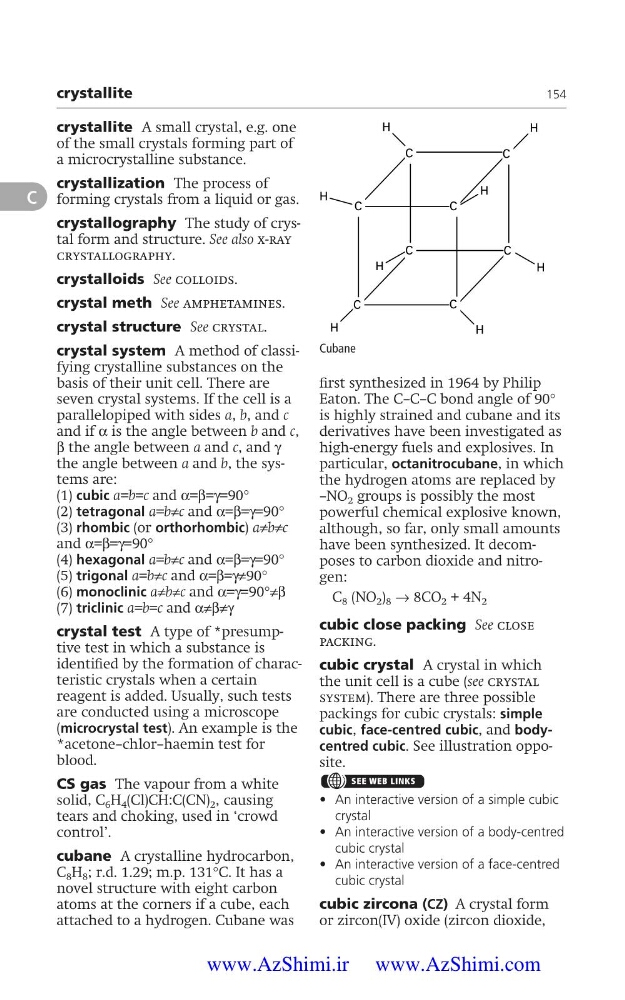
cubane A crystalline hydrocarbon,
C 8 H 8 ; r.d. 1.29; m.p. 131°C. It has a
novel structure with eight carbon
atoms at the corners if a cube, each
attached to a hydrogen. Cubane was
crystallite
154
c
H
H
H
H
H
H
H
H
C
C
C
C
C
C
C
C
Cubane
Ürst synthesized in 1964 by Philip
Eaton. The C–C–C bond angle of 90°
is highly strained and cubane and its
derivatives have been investigated as
high-energy fuels and explosives. In
particular, octanitrocubane, in which
the hydrogen atoms are replaced by
–NO 2 groups is possibly the most
powerful chemical explosive known,
although, so far, only small amounts
have been synthesized. It decomposes to carbon dioxide and nitrogen:
C 8 (NO 2 ) 8 → 8CO 2 + 4N 2
cubic close packing See close
packing.
cubic crystal A crystal in which
the unit cell is a cube (see crystal
system). There are three possible
packings for cubic crystals: simple
cubic, face-centred cubic, and bodycentred cubic. See illustration opposite.
A
• An interactive version of a simple cubic
crystal
• An interactive version of a body-centred
cubic crystal
• An interactive version of a face-centred
cubic crystal
cubic zircona (CZ) A crystal form
or zircon(IV) oxide (zircon dioxide,
www.AzShimi.ir www.AzShimi.com
of the small crystals forming part of
a microcrystalline substance.
crystallization The process of
forming crystals from a liquid or gas.
crystallography The study of crystal form and structure. See also x-ray
crystallography.
crystalloids See colloids.
crystal meth See amphetamines.
crystal structure See crystal.
crystal system A method of classifying crystalline substances on the
basis of their unit cell. There are
seven crystal systems. If the cell is a
parallelopiped with sides a, b, and c
and if α is the angle between b and c,
β the angle between a and c, and γ
the angle between a and b, the systems are:
(1) cubic a=b=c and α=β=γ=90°
(2) tetragonal a=b≠c and α=β=γ=90°
(3) rhombic (or orthorhombic) a≠b≠c
and α=β=γ=90°
(4) hexagonal a=b≠c and α=β=γ=90°
(5) trigonal a=b≠c and α=β=γ≠90°
(6) monoclinic a≠b≠c and α=γ=90°≠β
(7) triclinic a=b=c and α≠β≠γ
crystal test A type of *presumptive test in which a substance is
identiÜed by the formation of characteristic crystals when a certain
reagent is added. Usually, such tests
are conducted using a microscope
(microcrystal test). An example is the
*acetone–chlor–haemin test for
blood.
CS gas The vapour from a white
solid, C 6 H 4 (Cl)CH:C(CN) 2 , causing
tears and choking, used in ‘crowd
control’.
cubane A crystalline hydrocarbon,
C 8 H 8 ; r.d. 1.29; m.p. 131°C. It has a
novel structure with eight carbon
atoms at the corners if a cube, each
attached to a hydrogen. Cubane was
crystallite
154
c
H
H
H
H
H
H
H
H
C
C
C
C
C
C
C
C
Cubane
Ürst synthesized in 1964 by Philip
Eaton. The C–C–C bond angle of 90°
is highly strained and cubane and its
derivatives have been investigated as
high-energy fuels and explosives. In
particular, octanitrocubane, in which
the hydrogen atoms are replaced by
–NO 2 groups is possibly the most
powerful chemical explosive known,
although, so far, only small amounts
have been synthesized. It decomposes to carbon dioxide and nitrogen:
C 8 (NO 2 ) 8 → 8CO 2 + 4N 2
cubic close packing See close
packing.
cubic crystal A crystal in which
the unit cell is a cube (see crystal
system). There are three possible
packings for cubic crystals: simple
cubic, face-centred cubic, and bodycentred cubic. See illustration opposite.
A
• An interactive version of a simple cubic
crystal
• An interactive version of a body-centred
cubic crystal
• An interactive version of a face-centred
cubic crystal
cubic zircona (CZ) A crystal form
or zircon(IV) oxide (zircon dioxide,
www.AzShimi.ir www.AzShimi.com