

leads to acidiÜcation of water draining from the soil into lakes and
rivers, which become unable to support Üsh life. Lichens are particularly
sensitive to changes in pH and can be
used as indicators of acid pollution.
acid salt A salt of a polybasic acid
(i.e. an acid having two or more
acidic hydrogens) in which not all
the hydrogen atoms have been replaced by positive ions. For example,
the dibasic acid carbonic acid (H 2 CO 3 )
forms acid salts (hydrogencarbonates)
containing the ion HCO 3
–
. Some salts
of monobasic acids are also known as
acid salts. For instance, the compound potassium hydrogendiÛuoride,
KHF 2 , contains the ion [F...H–F]
– , in
which there is hydrogen bonding between the Ûuoride ion F
– and a hydrogen Ûuoride molecule.
acid value A measure of the
amount of free acid present in a fat,
equal to the number of milligrams of
potassium hydroxide needed to neutralize this acid. Fresh fats contain
glycerides of fatty acids and very little free acid, but the glycerides decompose slowly with time and the
acid value increases.
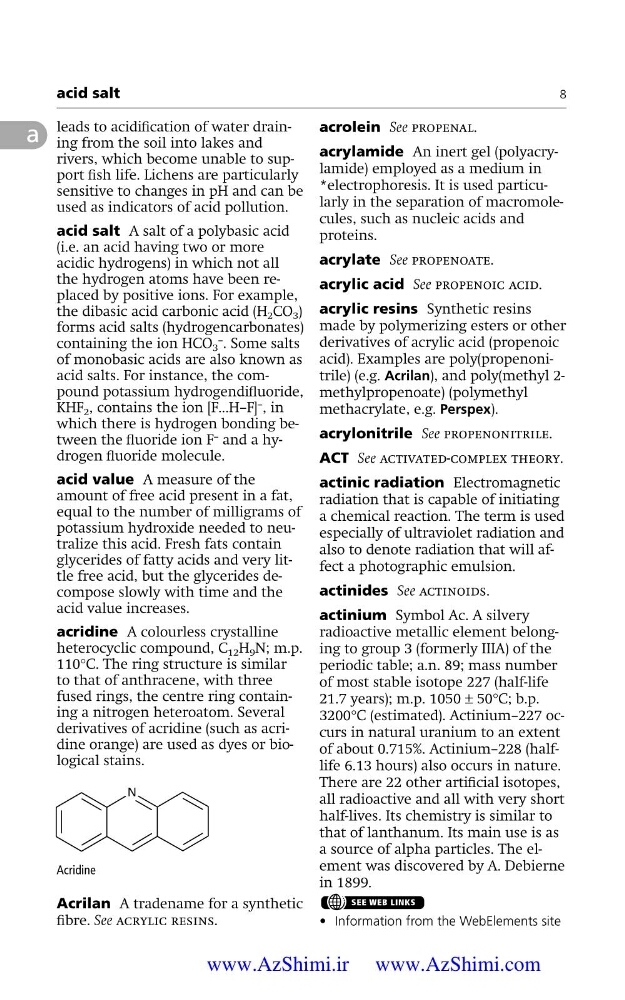
acridine A colourless crystalline
heterocyclic compound, C 12 H 9 N; m.p.
110°C. The ring structure is similar
to that of anthracene, with three
fused rings, the centre ring containing a nitrogen heteroatom. Several
derivatives of acridine (such as acridine orange) are used as dyes or biological stains.
acid salt
8
a
N
Acridine
Acrilan A tradename for a synthetic
Übre. See acrylic resins.
acrolein See propenal.
acrylamide An inert gel (polyacrylamide) employed as a medium in
*electrophoresis. It is used particularly in the separation of macromolecules, such as nucleic acids and
proteins.
acrylate See propenoate.
acrylic acid See propenoic acid.
acrylic resins Synthetic resins
made by polymerizing esters or other
derivatives of acrylic acid (propenoic
acid). Examples are poly(propenonitrile) (e.g. Acrilan), and poly(methyl 2methylpropenoate) (polymethyl
methacrylate, e.g. Perspex).
acrylonitrile See propenonitrile.
ACT See activated-complex theory.
actinic radiation Electromagnetic
radiation that is capable of initiating
a chemical reaction. The term is used
especially of ultraviolet radiation and
also to denote radiation that will affect a photographic emulsion.
actinides See actinoids.
actinium Symbol Ac. A silvery
radioactive metallic element belonging to group 3 (formerly IIIA) of the
periodic table; a.n. 89; mass number
of most stable isotope 227 (half-life
21.7 years); m.p. 1050 ± 50°C; b.p.
3200°C (estimated). Actinium–227 occurs in natural uranium to an extent
of about 0.715%. Actinium–228 (halflife 6.13 hours) also occurs in nature.
There are 22 other artiÜcial isotopes,
all radioactive and all with very short
half-lives. Its chemistry is similar to
that of lanthanum. Its main use is as
a source of alpha particles. The element was discovered by A. Debierne
in 1899.
A
• Information from the WebElements site
www.AzShimi.ir www.AzShimi.com
rivers, which become unable to support Üsh life. Lichens are particularly
sensitive to changes in pH and can be
used as indicators of acid pollution.
acid salt A salt of a polybasic acid
(i.e. an acid having two or more
acidic hydrogens) in which not all
the hydrogen atoms have been replaced by positive ions. For example,
the dibasic acid carbonic acid (H 2 CO 3 )
forms acid salts (hydrogencarbonates)
containing the ion HCO 3
–
. Some salts
of monobasic acids are also known as
acid salts. For instance, the compound potassium hydrogendiÛuoride,
KHF 2 , contains the ion [F...H–F]
– , in
which there is hydrogen bonding between the Ûuoride ion F
– and a hydrogen Ûuoride molecule.
acid value A measure of the
amount of free acid present in a fat,
equal to the number of milligrams of
potassium hydroxide needed to neutralize this acid. Fresh fats contain
glycerides of fatty acids and very little free acid, but the glycerides decompose slowly with time and the
acid value increases.
acridine A colourless crystalline
heterocyclic compound, C 12 H 9 N; m.p.
110°C. The ring structure is similar
to that of anthracene, with three
fused rings, the centre ring containing a nitrogen heteroatom. Several
derivatives of acridine (such as acridine orange) are used as dyes or biological stains.
acid salt
8
a
N
Acridine
Acrilan A tradename for a synthetic
Übre. See acrylic resins.
acrolein See propenal.
acrylamide An inert gel (polyacrylamide) employed as a medium in
*electrophoresis. It is used particularly in the separation of macromolecules, such as nucleic acids and
proteins.
acrylate See propenoate.
acrylic acid See propenoic acid.
acrylic resins Synthetic resins
made by polymerizing esters or other
derivatives of acrylic acid (propenoic
acid). Examples are poly(propenonitrile) (e.g. Acrilan), and poly(methyl 2methylpropenoate) (polymethyl
methacrylate, e.g. Perspex).
acrylonitrile See propenonitrile.
ACT See activated-complex theory.
actinic radiation Electromagnetic
radiation that is capable of initiating
a chemical reaction. The term is used
especially of ultraviolet radiation and
also to denote radiation that will affect a photographic emulsion.
actinides See actinoids.
actinium Symbol Ac. A silvery
radioactive metallic element belonging to group 3 (formerly IIIA) of the
periodic table; a.n. 89; mass number
of most stable isotope 227 (half-life
21.7 years); m.p. 1050 ± 50°C; b.p.
3200°C (estimated). Actinium–227 occurs in natural uranium to an extent
of about 0.715%. Actinium–228 (halflife 6.13 hours) also occurs in nature.
There are 22 other artiÜcial isotopes,
all radioactive and all with very short
half-lives. Its chemistry is similar to
that of lanthanum. Its main use is as
a source of alpha particles. The element was discovered by A. Debierne
in 1899.
A
• Information from the WebElements site
www.AzShimi.ir www.AzShimi.com