

merly, carbynes were called methylidynes.
carcinogen Any agent that produces cancer, e.g. tobacco smoke,
certain industrial chemicals, and
ionizing radiation (such as X-rays
and ultraviolet rays).
Carius method A method of determining the amount of sulphur and
halogens in an organic compound, by
heating the compound in a sealed
tube with silver nitrate in concentrated nitric acid. The compound is
decomposed and silver sulphide and
halides are precipitated, separated,
and weighed.
carnallite A mineral consisting of a
hydrated mixed chloride of potassium and magnesium, KCl.MgCl 2 .
6H 2 O.
carnauba wax A natural wax obtained from the leaves of the copaiba
palm of South America. It is extremely hard and brittle and is used
in varnishes and to add hardness and
lustre to other waxes in polishes.
Carnot, Nicolas Léonard Sadi
(1796–1832) French physicist, who
Ürst worked as a military engineer.
He then turned to scientiÜc research
and in 1824 published his analysis of
the efÜciency of heat engines. The
key to this analysis is the thermodynamic *Carnot cycle and the eventual introduction of the idea of
*entropy in thermodynamics. He
died at an early age from cholera.
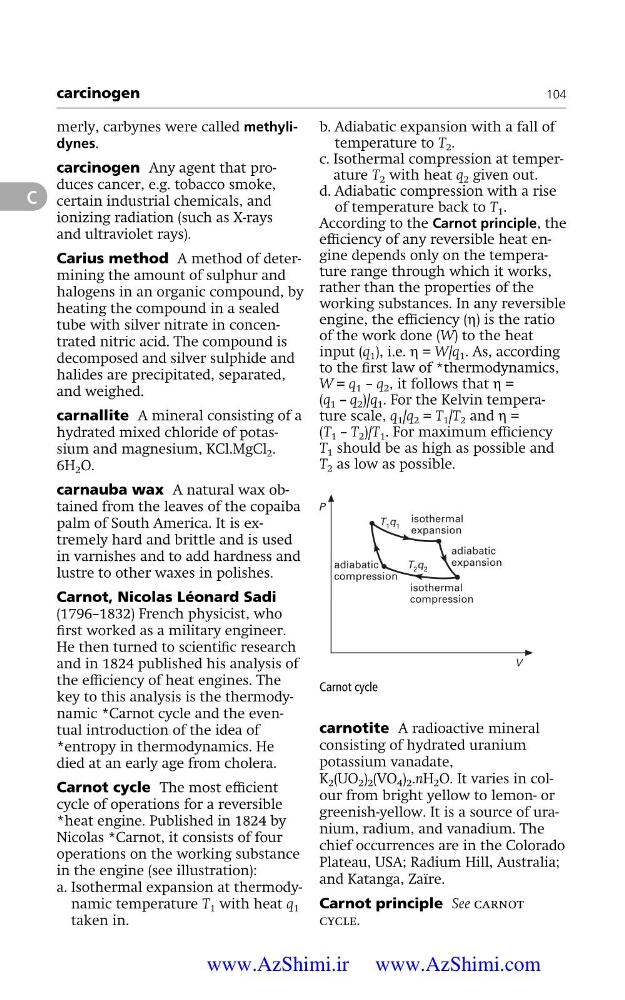
Carnot cycle The most efÜcient
cycle of operations for a reversible
*heat engine. Published in 1824 by
Nicolas *Carnot, it consists of four
operations on the working substance
in the engine (see illustration):
a. Isothermal expansion at thermodynamic temperature T 1 with heat q 1
taken in.
b. Adiabatic expansion with a fall of
temperature to T 2 .
c. Isothermal compression at temperature T 2 with heat q 2 given out.
d. Adiabatic compression with a rise
of temperature back to T 1 .
According to the Carnot principle, the
efÜciency of any reversible heat engine depends only on the temperature range through which it works,
rather than the properties of the
working substances. In any reversible
engine, the efÜciency (η) is the ratio
of the work done (W) to the heat
input (q 1 ), i.e. η = W/q 1 . As, according
to the Ürst law of *thermodynamics,
W = q 1 – q 2 , it follows that η =
(q 1 – q 2 )/q 1 . For the Kelvin temperature scale, q 1 /q 2 = T 1 /T 2 and η =
(T 1 – T 2 )/T 1 . For maximum efÜciency
T 1 should be as high as possible and
T 2 as low as possible.
carcinogen
104
c
adiabatic
compression
isothermal
compression
adiabatic
expansion
isothermal
expansion
T 1 q 1
T 2 q 2
V
P
Carnot cycle
carnotite A radioactive mineral
consisting of hydrated uranium
potassium vanadate,
K 2 (UO 2 ) 2 (VO 4 ) 2 .nH 2 O. It varies in colour from bright yellow to lemon- or
greenish-yellow. It is a source of uranium, radium, and vanadium. The
chief occurrences are in the Colorado
Plateau, USA; Radium Hill, Australia;
and Katanga, Zaïre.
Carnot principle See carnot
cycle.
www.AzShimi.ir www.AzShimi.com
carcinogen Any agent that produces cancer, e.g. tobacco smoke,
certain industrial chemicals, and
ionizing radiation (such as X-rays
and ultraviolet rays).
Carius method A method of determining the amount of sulphur and
halogens in an organic compound, by
heating the compound in a sealed
tube with silver nitrate in concentrated nitric acid. The compound is
decomposed and silver sulphide and
halides are precipitated, separated,
and weighed.
carnallite A mineral consisting of a
hydrated mixed chloride of potassium and magnesium, KCl.MgCl 2 .
6H 2 O.
carnauba wax A natural wax obtained from the leaves of the copaiba
palm of South America. It is extremely hard and brittle and is used
in varnishes and to add hardness and
lustre to other waxes in polishes.
Carnot, Nicolas Léonard Sadi
(1796–1832) French physicist, who
Ürst worked as a military engineer.
He then turned to scientiÜc research
and in 1824 published his analysis of
the efÜciency of heat engines. The
key to this analysis is the thermodynamic *Carnot cycle and the eventual introduction of the idea of
*entropy in thermodynamics. He
died at an early age from cholera.
Carnot cycle The most efÜcient
cycle of operations for a reversible
*heat engine. Published in 1824 by
Nicolas *Carnot, it consists of four
operations on the working substance
in the engine (see illustration):
a. Isothermal expansion at thermodynamic temperature T 1 with heat q 1
taken in.
b. Adiabatic expansion with a fall of
temperature to T 2 .
c. Isothermal compression at temperature T 2 with heat q 2 given out.
d. Adiabatic compression with a rise
of temperature back to T 1 .
According to the Carnot principle, the
efÜciency of any reversible heat engine depends only on the temperature range through which it works,
rather than the properties of the
working substances. In any reversible
engine, the efÜciency (η) is the ratio
of the work done (W) to the heat
input (q 1 ), i.e. η = W/q 1 . As, according
to the Ürst law of *thermodynamics,
W = q 1 – q 2 , it follows that η =
(q 1 – q 2 )/q 1 . For the Kelvin temperature scale, q 1 /q 2 = T 1 /T 2 and η =
(T 1 – T 2 )/T 1 . For maximum efÜciency
T 1 should be as high as possible and
T 2 as low as possible.
carcinogen
104
c
adiabatic
compression
isothermal
compression
adiabatic
expansion
isothermal
expansion
T 1 q 1
T 2 q 2
V
P
Carnot cycle
carnotite A radioactive mineral
consisting of hydrated uranium
potassium vanadate,
K 2 (UO 2 ) 2 (VO 4 ) 2 .nH 2 O. It varies in colour from bright yellow to lemon- or
greenish-yellow. It is a source of uranium, radium, and vanadium. The
chief occurrences are in the Colorado
Plateau, USA; Radium Hill, Australia;
and Katanga, Zaïre.
Carnot principle See carnot
cycle.
www.AzShimi.ir www.AzShimi.com